
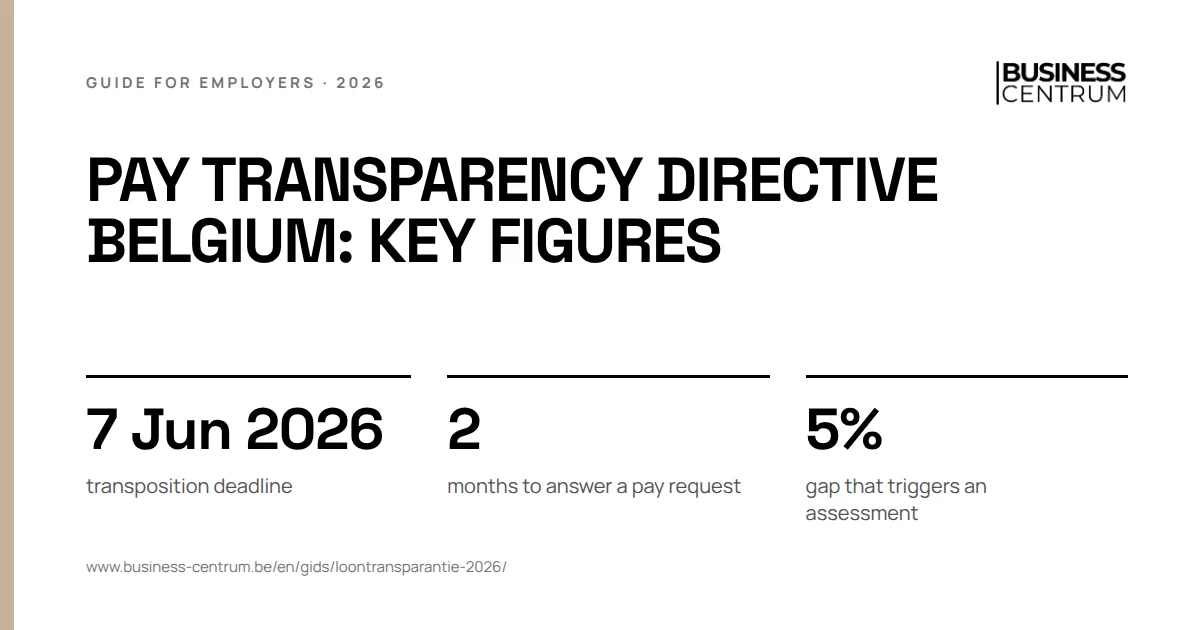
The pay transparency directive makes pay transparency an EU obligation for Belgium in 2026: the directive of 10 May 2023 had to be transposed into Belgian law by 7 June 2026. For private sector employers, on 20 October 2026 we found no federal transposition law in the Belgian Official Gazette. What you must do today comes from the gender pay gap act of 22 April 2012. What is coming can be read in the directive itself.
What is the EU pay transparency directive?
Directive (EU) 2023/970 aims to make the principle of equal pay for men and women for equal work or work of equal value enforceable. It uses two tools: transparency on how pay is set, and stronger rights for anyone who feels discriminated against.
The directive applies to employers in the public and private sectors and to all workers with an employment contract. For the recruitment rules, it also applies to job applicants. Pay is defined broadly: the basic or minimum wage and all other benefits in cash or in kind that a worker receives from the employer, including complementary or variable components. The pay level is the gross annual pay and the corresponding gross hourly pay. How a gross salary relates to what the employee receives net is explained in our guide from gross to net.
A directive is addressed to the member states. It obliges Belgium to put the rules into its own legislation. The concrete duties for your company, the dates and the penalties are only fixed once that Belgian law exists.
Pay transparency in Belgium in 2026: where transposition stands
The transposition deadline expired on 7 June 2026. This is what we found in the official sources:
| Level | Text | For whom | Status |
|---|---|---|---|
| Federal, private sector | No transposition law found in the Official Gazette | Private sector employers | Not yet transposed |
| Federal coalition agreement | Commitment to implement Directive (EU) 2023/970 | Government plan | Agreement of 4 February 2025 |
| Chamber | Resolution proposal DOC 56 1321/001 | Request to the government | Tabled on 26 January 2026 |
| Flanders | Decree of 12 June 2026 on pay transparency | Flemish services, local authorities, education | Official Gazette of 17 June 2026 |
| French Community | Decree of 16 May 2024 referring to the directive | Its own competences | Official Gazette of 12 September 2024 |
Federal. The coalition agreement of 4 February 2025 states in its equal opportunities chapter that the government will implement Directive (EU) 2023/970. That is an intention. A resolution proposal of 26 January 2026 asks the government not to go beyond the directive when transposing it and to keep existing law for the private sector as far as possible. A resolution is not a law and does not bind you.
Flanders. The Flemish decree of 12 June 2026 partly transposes the directive, but only for Flemish government services, local authorities and educational institutions and their staff. For a private employer in Ghent, it changes nothing.
What this means for you. The directive shows the direction. As long as the federal law does not exist, the existing rules apply to your company, and the dates in the directive are not yet Belgian dates.
What the pay transparency directive asks of employers in Belgium
Before hiring
A job applicant has the right to information about the starting pay or its range, based on objective, gender-neutral criteria, and about the provisions of the collective agreement you apply to that job. You give this information so that informed negotiation can take place before the interview, for example in the vacancy notice (article 5(1)).
Two things will no longer be allowed:
- Asking about current or previous pay. Article 5(2) bars employers from asking applicants about their pay history in their current or previous employment.
- Vacancy notices and job titles that are not gender-neutral. The recruitment procedure must be non-discriminatory (article 5(3)).
Which collective agreement applies to your jobs and what makes it binding is explained in what is a collective agreement.
Criteria for pay and pay progression
You give your employees easy access to the criteria used to set their pay, pay levels and pay progression. Those criteria are objective and gender-neutral (article 6(1)). A member state may exempt employers with fewer than 50 employees from the part on pay progression, not from the part on pay itself (article 6(2)). Whether Belgium uses that exemption will be decided by the transposition law.
Under article 4(4), the criteria include skills, effort, responsibility and working conditions, and where relevant other factors specific to the job. They are agreed with workers' representatives where they exist. Relevant soft skills must not be undervalued.
Right to information
Every employee may ask in writing for their own pay level and for the average pay levels, broken down by sex, for workers doing the same work or work of equal value (article 7(1)). They can also do so through their representatives. You answer within a reasonable period, and in any case within 2 months of the request (article 7(4)).
Each year you inform all your employees of that right and of the steps to exercise it (article 7(3)). Employees may disclose their own pay to enforce equal pay, and member states must prohibit contract terms that prevent this (article 7(5)). Anyone who receives information about others this way can be required to use it only to exercise their right to equal pay (article 7(6)).
Gender pay gap reporting
From 100 employees, you report on the pay gap between women and men: the mean and median pay gap, including for complementary or variable components, the share of women and men receiving such components, the split across pay quartiles and the pay gap by category of workers (article 9(1)).
| Employees | First report under the directive | Then |
|---|---|---|
| 250 or more | by 7 June 2027 | every year |
| 150 to 249 | by 7 June 2027 | every 3 years |
| 100 to 149 | by 7 June 2031 | every 3 years |
| fewer than 100 | voluntary, unless the member state requires it |
Each report covers the previous calendar year. Management confirms its accuracy after consulting the workers' representatives. You share the pay gap by category with all employees and their representatives.
Worked example. In the warehouse staff category, the men earn on average € 20.00 gross per hour, the women € 18.80. The gender pay gap is the difference expressed as a percentage of the men's average: (20.00 - 18.80) / 20.00 = 6%. That is more than 5%. If the employer cannot justify the gap with objective, gender-neutral criteria, such as seniority or a different job grade, the directive asks him to correct it.
Joint pay assessment
An employer that has to report carries out a joint pay assessment with the workers' representatives when three conditions are met together (article 10(1)):
- in a category of workers, the difference in average pay between women and men is at least 5%;
- the employer has not justified that difference with objective, gender-neutral criteria;
- the employer has not remedied it within 6 months of the report.
The assessment looks among other things at the proportion of women and men per category, the reasons for the differences and the measures to address them. It also looks at pay rises after maternity, paternity, parental or carers' leave.
Burden of proof, compensation and penalties
- Burden of proof. If an employee puts forward facts suggesting discrimination, the employer must prove there was no pay discrimination. If the employer has not met its transparency duties, the burden of proof in proceedings lies with the employer, unless the breach was manifestly unintentional and minor (article 18).
- Compensation. An employee who suffered harm is entitled to full compensation, with back pay, bonuses and payments in kind, lost opportunities, non-material damage and interest. A ceiling fixed in advance may not limit that compensation (article 16).
- Limitation period. The period to bring a claim is at least 3 years and only starts when the employee knows, or can reasonably be expected to know, of the infringement (article 21).
- Penalties. Member states set effective, proportionate and dissuasive penalties, including fines, and specific penalties for repeat infringements (article 23). Which fines apply in Belgium will only be set by Belgian law.
What already applies in Belgium
Apart from the directive, Belgium already has rules on pay differences between women and men. The most important ones for an employer come from the gender pay gap act of 22 April 2012.
Pay structure analysis report. A company that usually employs on average at least 50 workers makes a detailed analysis of its pay structure every 2 years. It shows whether the company has a gender-neutral pay policy. The data cover pay and direct social benefits, employer contributions for non-statutory insurance and other fringe benefits, each by sex and by status, job level, seniority and level of education.
- From 100 employees you use the full form, between 50 and 100 the short form, following the models of the Royal and Ministerial Decrees of 25 April 2014.
- The report is provided and discussed within 3 months after the financial year closes, with the works council or, if there is none, with the committee for prevention and protection at work.
- Members receive it at least 15 days before the meeting. They must treat the data confidentially.
- Based on the report, the workers' representatives decide in consultation with you whether an action plan is needed.
Social balance sheet. The gender pay gap act also required the pay data in the social balance sheet to be broken down by sex.
Gender-neutral job classifications. At sector level, the FPS Employment checks whether the job classifications of the joint committees are gender-neutral. If your company uses its sector's classification, that is your starting point for the criteria the directive asks for.
Mapping your workforce by sex, job and pay is exactly what a workforce analysis does.
Pay transparency directive timeline for Belgium
| Date | What | Where it is fixed |
|---|---|---|
| 10 May 2023 | Directive (EU) 2023/970 adopted | Official Journal of the EU |
| 4 February 2025 | Coalition agreement announces implementation | Chamber doc. DOC 56 0020/001, plan |
| 7 June 2026 | Transposition deadline for member states | Directive, article 34 |
| 7 June 2027 | First report from 150 employees | Directive, article 9; Belgian date follows from the transposition law |
| 7 June 2031 | First report for 100 to 149 employees | Directive, article 9; Belgian date follows from the transposition law |
What you can prepare now
None of this is a new duty today. These are steps you will need anyway once the Belgian law exists, and they make your pay policy defensible right now.
- Write down your jobs. A list of jobs with their content and, for each, the grade from your sector classification or your own system.
- Write out your criteria. What do you base the starting salary, a raise or a bonus on? Test them against the four criteria in the directive: skills, effort, responsibility and working conditions.
- Compare by category. For workers doing the same work or work of equal value, calculate the average pay by sex, as in the worked example. A gap you cannot explain now is a risk later.
- Review your vacancies and application forms. A "current salary" field or a question about previous pay is best removed now. Include a pay range or starting salary.
- Check your contracts. A clause banning employees from discussing their pay will no longer be allowed under the directive.
- Put your pay policy where it belongs. The rules on pay and payment are in your work rules; criteria for pay progression can go in a separate policy.
Common mistakes
- Thinking it does not concern a small business. Pay gap reporting only starts at 100 employees, but the recruitment rules and the right to information apply to every employer under the directive.
- Treating a directive date as a Belgian deadline. Belgian law decides when and how it applies to you.
- Letting pay gaps stand because "it has always been that way". What you cannot explain with objective, gender-neutral criteria, you cannot defend when an employee asks.
- Forgetting the analysis report. From 50 employees, that has been a duty since the gender pay gap act.
What Business Centrum does for you
From payroll, we extract the data by job and by sex that you need for the analysis report, set pay side by side per category and show where the gaps are. For new hires, we prepare the contract and starting salary in line with your joint committee, together with Acerta. As soon as the Belgian transposition law appears in the Official Gazette, we adapt your documents and payroll to it. Have your pay policy checked.