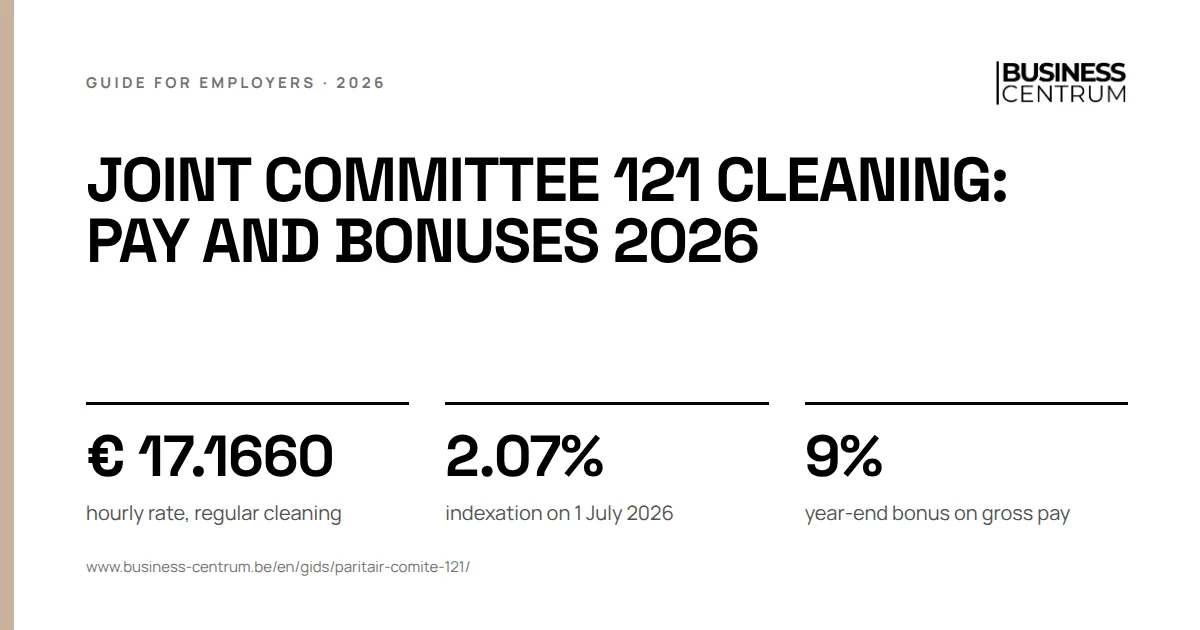
Joint committee 121 covers blue-collar workers of cleaning companies in Belgium. Since 1 July 2026 a cleaner doing regular cleaning has earned at least € 17.17 gross an hour, after an indexation of 2.07%. With NSSO and sector allowances, that hour costs you about € 25. The Social Fund pays the year-end bonus.
Who falls under joint committee 121?
JC 121 covers blue-collar workers of companies that clean for third parties, as their main activity or with a clearly separate group of workers. Cleaning here means any activity aimed at cleaning, without repair, supervision or assembly. Think of offices, schools, shops, hospitals, rolling stock, windows, chimneys and graffiti.
These activities also fall under JC 121:
- disinfection and pest control;
- running swimming pools, baths and toilets;
- keeping hotel rooms and public areas in order, except during a move;
- door-to-door waste collection on a schedule set by the authorities;
- running recycling parks, landfill sites and waste incinerators.
Outside JC 121 are activities of textile care, metalworking, garages, chemicals, construction and transport, among others. Your own in-house cleaning team in a factory or office falls under your own sector's committee, because you are not cleaning for a third party. Domestic helpers employed by a recognised service voucher company fall under JC 322.01. White-collar staff of a cleaning company do not fall under JC 121. If in doubt, read how the joint committee is determined.
Watch out with self-employed cleaners. The NSSO brings anyone doing JC 121 cleaning work under employee social security, unless that person shows they do not usually and mainly work for one client, use their own equipment and invoice on their own account. More in our guide on bogus self-employment.
Wages in joint committee 121: the hourly rates in 2026
The scales are hourly rates for a 37-hour week. They depend on the category of work. Only for window cleaners, chimney sweeps and part of industrial cleaning does experience also count. The table shows the main categories since 1 July 2026.
| Category | Hourly rate |
|---|---|
| 1.A Regular cleaning | € 17.17 |
| 1.B Special cleaning (more dust, dirt or contamination risk) | € 17.70 |
| 1.C Metro, car assembly halls outside production | € 17.87 |
| 2.A Medium-heavy cleaning | € 18.28 |
| 2.B Rail cars, buses and aircraft | € 18.80 |
| 2.E Disinfection | € 18.99 |
| 2.F IBC containers and drums | € 17.49 |
| 3.A Waste collection, sewers and septic tanks | € 19.51 |
| 3.C Waste collection driver | € 20.53 |
| 4.A Window cleaner, under 8 months' experience | € 19.38 |
| 4.D Window cleaner, 18 months' experience or more | € 20.52 |
| 6 Car wash | € 18.66 |
| 8 Industrial cleaning, unskilled labourer | € 18.87 |
| 8.C Industrial cleaning, first operator | € 22.99 |
A team leader earns at least 10% more than the workers he leads, a brigadier 5%. If someone switches between categories, you go by the job classification. In practice, a cleaner who also disinfects is paid the category 2.E rate for those hours.
Working time, overtime and part-time work in JC 121
The sector works a 37-hour week. Extra days off bring the effective average down to 36.50 hours, and that is the figure you report on documents for the National Employment Office.
- Overtime: 50% premium for hours above 37 a week or above 481 hours per thirteen weeks. The same hour never earns a double premium. The worker is paid the premium and takes the hour off within 4 weeks, unless your work rules say otherwise.
- Sunday and public holiday: 100% premium. On Saturday: 25%.
- Night (10 pm to 6 am): € 3.11 an hour. Shift work: € 1.08 an hour.
Most cleaners work part-time. In JC 121 the minimum is in principle 3 hours a day and 18 hours a week. For regular and special cleaning (categories 1.A and 1.B) those minimums do not apply: the minimum shift there is 1 hour, which you may spread over sites that directly follow each other. You may only ask volunteers to work additional hours. Up to 37 hours a month you pay them without overtime premium. If the schedule is exceeded by at least 1 hour a week on average over a quarter, the worker can ask for his contract to be adjusted. Everything on contracts and schedules is in our guide on the part-time employment contract.
How wages rise with the July 2026 indexation in JC 121
JC 121 indexes twice a year, on 1 January and 1 July, based on the smoothed health index. Both minimum and actual wages go up.
| Indexation | Percentage |
|---|---|
| July 2026 | 2.07% |
| January 2026 | 0.56% |
| July 2025 | 1.64% |
| January 2025 | 1.23% |
| July 2024 | 2.32% |
Worked example. A cleaner you pay above the scale, at € 17.50 an hour, received 2.07% extra on 1 July 2026: 17.50 x 1.0207 = € 17.86 an hour.
The July 2026 indexation was the first in cleaning under the cent index, which has applied since 1 June 2026. For a reference wage above € 4,000 a month, indexation was capped: 2% on the threshold and the remaining 0.07% on the full wage. On a 37-hour week that only applies above an hourly wage of € 24.95, so almost never for cleaning operatives. Do check it for team leaders and industrial cleaning operators. The next indexation is on 1 January 2027. More in the cent index explained.
Year-end bonus and other Social Fund benefits
In cleaning you do not pay the year-end bonus yourself: the Social Fund for cleaning companies (SFSOO) does. You finance the fund through a contribution collected by the NSSO.
- Amount: 9% of gross pay in the reference period, from 1 July 2025 to 30 June 2026 for the 2026 bonus.
- Condition: at least 60 NSSO days or at least € 3,010 in pay in that period. Pensioners, early retirees and workers dismissed for economic reasons get the bonus even below that threshold.
- Deduction: 13.07% employee NSSO on the amount at 108%, plus withholding tax.
- Payment: early December, through the trade union or directly by the fund.
Sick days count in part and maternity leave is treated as worked. The fund calculates everything itself from your DmfA return. Errors in that return, such as wrong days or the wrong committee, therefore lead straight to a wrong bonus.
The fund also pays an unemployment supplement of € 3.25 an hour, for at most 730 hours per calendar year, and runs the sector pension with a fixed contribution of 1.50%.
Meal vouchers in joint committee 121
Since 1 January 2026 all cleaning workers have been entitled to meal vouchers. A voucher is worth € 3.09: you pay € 2, the employee € 1.09. If you already granted meal vouchers before 1 January 2026, you raise them by € 2.
The sector agreement requires an hourly count, which matters most for part-timers: you take the hours worked each quarter and divide them by 7.40, rounded up. Someone working 20 hours a week works 260 hours a quarter. 260 / 7.4 = 35.13, rounded up to 36 vouchers per quarter. The maximum is the number of working days of a full-timer. You hand out the vouchers monthly and correct at the end of the quarter.
You also pay an RGPT allowance of € 1.63 net per day worked, because your cleaners have no canteen or toilets of their own on site. If a category 1.A cleaner maintains his own workwear, you pay € 2.52 a week, up to € 10.07 a month.
Travel and moves between sites
Travel is the biggest source of errors in cleaning. Since 1 January 2026 the sector has covered it in a new collective agreement.
- Commuting by public transport: you pay 100% of the season ticket.
- Commuting by own transport: 95% of the price of a monthly rail pass, per day worked. For 10 kilometres that is € 3.25 a day. If the worker has split shifts with a break of more than 3 hours, you pay the allowance for each shift.
- Bicycle: € 0.36 per kilometre, also for moves between sites.
- Time between two sites (not for window cleaners, waste collection and industrial cleaning): if there are no more than 3 hours in between and the distance exceeds 1 kilometre, you pay € 0.11 per kilometre, with a minimum of € 2.19 per move. For 8 kilometres that is 8 x 0.1095 = € 0.88, so you pay the minimum.
- Own car between sites at your request: the mileage rate the federal government pays its own staff.
- Base or meeting point to the site: a mobility allowance of € 0.19 per kilometre.
If a cleaner without a fixed workplace or fixed hours serves sites that follow one another directly, in a cascade, you pay working time from the start of the first to the end of the last site.
Checkin@work and inspections in cleaning
Since 1 September 2024 every cleaner who cleans a building for a client must record his start, finish and breaks on site through Check In and Out at Work. This also applies to agency workers, trainees and self-employed people on site.
The duty follows the thresholds of the declaration of works: per site from € 30,000 without a subcontractor, from € 5,000 with one subcontractor and always with two or more subcontractors. A missing registration falls under sanction level 3: an administrative fine of € 1,000 to € 10,000, which can be multiplied by the number of workers involved.
Flexi-jobs in JC 121: what is allowed since 2026?
Flexi-jobs have in principle been allowed across the private sector since 1 July 2026. JC 121 is not among the excluded sectors. A sector agreement of July 2026 frames them from 1 October 2026. In it the social partners ask to reserve flexi-jobs for pensioners and to limit the volume to 10% of the company's working volume. Flexi-jobbers receive no Social Fund benefits, no sector pension and no sector training right.
Flexi pay is at least the hourly rate of the category and at most 150% of it. On top come 7.67% flexi holiday pay and a 28% special contribution. For category 1.A: 17.1660 x 1.0767 = € 18.48 an hour for the flexi-jobber, plus € 5.17 contribution, € 23.65 an hour in total. Who can take a flexi-job is explained on the flexi-jobber page and in the cost of a flexi-job.
Worked example: from hourly rate to payroll cost
A full-time cleaner in category 1.A, at € 17.17 an hour, 37 hours a week, 21 days worked in the month:
| Item | Calculation | Amount |
|---|---|---|
| Gross monthly pay | 17.1660 x 37 x 13 / 3 | € 2,752.28 |
| Employer NSSO | 25% on 108% (2,972.46) | € 743.12 |
| Holiday contribution | 15.84% on 2,972.46 | € 470.84 |
| Meal vouchers | 21 x 2.00 | € 42.00 |
| RGPT allowance | 21 x 1.63 | € 34.23 |
| Total per month | € 4,042.47 |
Divided by 160.33 paid hours a month, that is € 25.21 an hour. Not included: the Social Fund contribution that pays for the year-end bonus, the sector pension, travel allowances, the structural reduction and occupational accident insurance. Use this figure as a floor when you price an hourly rate for a client.
Notice in JC 121
JC 121 has no notice periods of its own. You apply the statutory periods, which are the same for blue-collar and white-collar staff. For contracts starting from 1 August 2026, notice in the first six months is 1 week, after one year 8 weeks. For contracts from 1 June 2026 a cap of 52 weeks applies. If you take over the staff of the previous cleaning company when you win a new maintenance contract, sector rules on staff transfer apply.
Employer checklist for JC 121
- Category per site: classify each job by the work done, not the job title.
- Hours and Checkin@work: make sure registration on each site above the thresholds matches your schedules.
- Part-time contracts: at least 3 hours a day and 18 hours a week, except in categories 1.A and 1.B, with a schedule in the contract.
- Meal vouchers: recalculate each quarter for part-timers.
- Travel: track commuting, moves between sites and mobility separately.
- Returns: correct days and hours in the DmfA, because the fund pays the year-end bonus on that basis.
- Indexation: adjust wages on 1 January and on 1 July.
Mistakes we often see in JC 121
- Everything in category 1.A. Disinfection, special cleaning and window cleaning have a higher hourly rate, even for part of the day.
- No allowance between sites. Someone who serves two clients one after the other is entitled to the between-site allowance, with the minimum per move.
- Additional hours paid as normal hours. Above the monthly credit or above 37 hours a week, they are overtime with a premium.
- Meal vouchers per day instead of per 7.40 hours. With short shifts this gives too many or too few vouchers.
- July indexation forgotten. JC 121 indexes twice a year; most sectors only once.
What Business Centrum does for you
Business Centrum runs the payroll administration of cleaning companies in East Flanders, together with Acerta. We place each job in the right category, apply the January and July indexations, calculate meal vouchers per quarter and track travel per site, so the fund's year-end bonus is right as well.