
The sectoral pension plan JC 226 has required you since 1 January 2007 to pay 0.92% of the NSSO pay of every white-collar employee in the committee towards a supplementary pension. You do not have to arrange anything yourself: the NSSO collects the contribution through your quarterly return, the DmfA, and the Social Fund of JC 226 does the rest. With the special NSSO contribution of 8.86% added, it costs you 1% of NSSO pay. There is no opting out, and an exemption only in a few cases.
This guide covers the JC 226 plan and what you check as an employer. How sectoral pension plans work in general is explained in our guide to the sectoral pension plan.
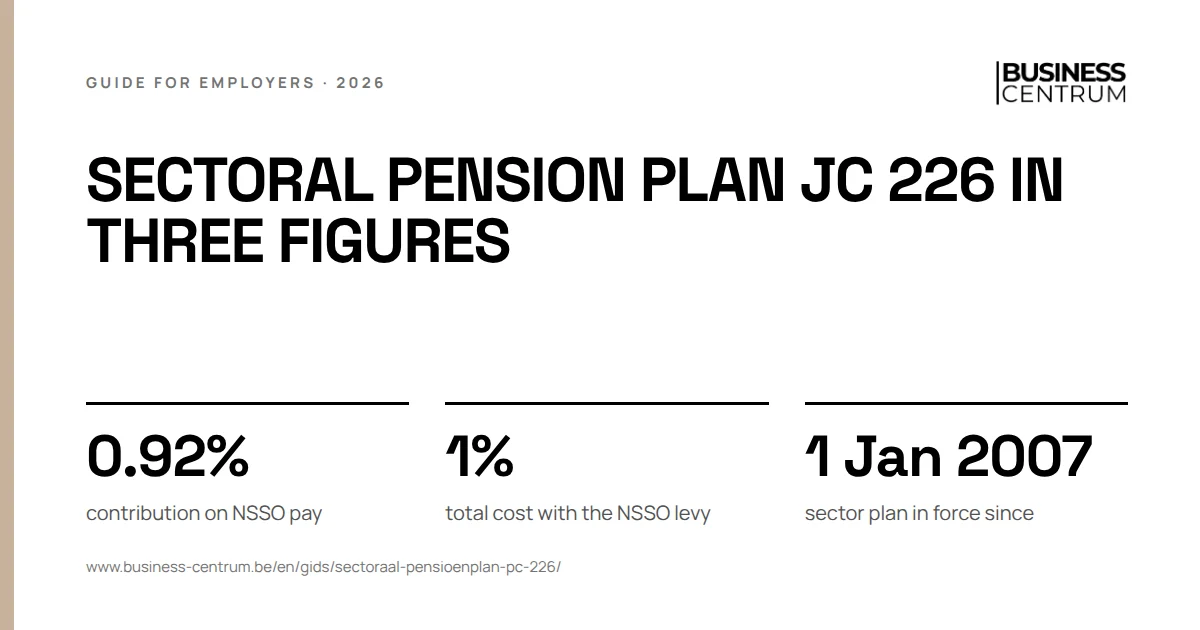
Sectoral pension plan JC 226 at a glance
| Item | What applies |
|---|---|
| In force since | 1 January 2007 |
| Who is covered | Every JC 226 employee of an employer that is not exempt |
| Employer contribution | 0.92% of NSSO pay, since 1 January 2011 |
| Special NSSO contribution | 8.86% on that contribution, collected together by the NSSO |
| Total cost | 1% of NSSO pay |
| Employee contribution | None |
| Organiser | The Social Fund of JC 226 |
| Pension institution | Vivium, a brand of P&V Insurance |
| Opting out | Not provided |
| Rules | Collective agreement of 6 November 2017 (no. 143068/CO/226), in force since 1 January 2018 |
The committee introduced the plan by the collective agreement of 4 April 2006; the agreement of 6 November 2017 replaced that text and sets today's rules. The plan is a defined contribution plan. The sector fixes what you pay, not what the employee receives later. The pension institution invests the contributions, and the return partly determines the size of the final capital.
Who falls under the sectoral pension plan JC 226?
The plan applies to employers and white-collar employees under the Joint Committee for employees of international trade, transport and logistics. These are the planners, dispatchers, customs declarants and office staff of transport, forwarding and logistics companies. If you are unsure whether your employees fall under JC 226, first read our guide to joint committee 226. The blue-collar workers of the same company, such as drivers and warehouse staff, fall under another committee and therefore not under this plan.
Two conditions decide whether an employee is covered:
- He falls under JC 226. The committee appears on his payslip and in your DmfA.
- His employer is not exempt. Only companies with an exemption under the collective agreement fall outside the sector plan; you will read below when.
If both conditions are met, the employee is automatically covered from the day he joins. Administratively, cover starts on the first day of the month in which he starts, or of the next month if he starts during a month. Age, seniority, job and type of contract play no role: an employee on a fixed-term contract builds up a pension too.
Two cases fall outside the build-up. A pensioner who comes back to work for you builds up nothing more in the sector plan, because his capital was paid out when he retired. And no contribution is due for periods without pay, see below.
How much is the contribution in the sectoral pension plan JC 226?
You pay 0.92% of the employee's NSSO pay. The Social Fund defines that NSSO pay as twelve monthly salaries, plus the year-end bonus and any other bonuses subject to NSSO contributions. You pay no contribution on the double holiday pay, because it is not subject to ordinary NSSO contributions.
That 0.92% includes the taxes and the costs of the organiser and the pension institution. On top of it comes the special NSSO contribution of 8.86% that applies to every payment for a supplementary pension. Because the NSSO itself collects for this sector plan, that contribution is already included in what the NSSO charges. You do not calculate or declare it separately.
The contribution has risen in two steps since the start:
| Period | Contribution via the NSSO |
|---|---|
| From 1 January 2007 | 0.46% |
| From 1 January 2009 | 0.69% |
| From 1 January 2011 to today | 0.92% |
Three rules you meet in practice:
- No pay, no contribution. You pay nothing for sickness after guaranteed pay, temporary unemployment, maternity leave, unpaid leave, full-time career break or a strike. For part-time career break or part-time thematic leave you pay on the reduced pay.
- The employee pays nothing. No pension deduction appears on the payslip. That sometimes confuses employees; explain it when they join.
- Giving more is not possible in the sector plan. You cannot raise the contribution and the employee cannot add to it. If you want to do more, you take out an own plan alongside the sector plan.
Worked example: what the sector plan costs for a class 1 employee
A full-time class 1 employee without seniority earns at least € 2,574.27 gross per month in 2026. The full pay scale per class is on our page JC 226 pay scale. We assume he works full-time all year, receives the annual bonus of one month's salary fully in cash and has no other bonuses.
- NSSO pay per year: € 2,574.27 x 13 monthly salaries = € 33,465.51.
- Pension contribution: € 33,465.51 x 0.92% = € 307.88 per year.
- Special NSSO contribution: € 307.88 x 8.86% = € 27.28.
- Total cost: € 335.16 per year, roughly 1% of NSSO pay.
For an ordinary month that comes to € 23.68 in pension contribution. The full amount goes to the employee's pension, after deduction of taxes and costs. If he earns more than the scale, the contribution rises with it, because it is a percentage of the actual NSSO pay.
How you pay: through the NSSO and the DmfA
You receive no separate invoice for the sector pension. Payment works like this:
- Every quarter you declare your employees' pay in the DmfA. The contribution for the sector pension is part of the employer contributions the NSSO charges.
- The NSSO collects the contributions and passes them on to the pension institution, after deducting its costs.
- The data per employee go through the Crossroads Bank for Social Security to the pension institution. It books the contribution on the individual account of each covered employee.
Your part is therefore a correct DmfA: the right committee per employee, the right pay and correct start and leaving dates. An employee you declare under JC 200 by mistake builds up nothing in this plan.
Do not confuse the pension contribution with the contribution to the Social Fund itself. That is a separate employer contribution, also collected by the NSSO and set by its own collective agreement. Besides the pension plan, the Fund has other tasks, such as the hiring bonuses.
| JC 226 sector contribution in the DmfA | Percentage | Period |
|---|---|---|
| Sector pension | 0.92%, plus 8.86% NSSO contribution on it | Since 1 January 2011, agreement without an end date |
| Social Fund | 0.50% of gross pay | All of 2026 |
| Social Fund | 0.50% of gross pay | First half of 2027, until 30 June 2027 |
Opting out and exemption in the sectoral pension plan JC 226
Opting out is not provided in JC 226. The supplementary pensions act allows a committee to let employers organise a plan of their own instead of the sector plan, but JC 226 did not take up that option. An own group insurance therefore does not replace the sector plan. You simply keep paying the sector contribution.
Exemptions do exist. Some date from the start of the sector plan, for companies that already had an own plan at that time. A new exemption is now possible only in four cases set out in the collective agreement:
- Your company is linked to a JC 226 company that was exempted at the start.
- Your company was created by the split of such an exempted company.
- Your company was created by a merger involving at least one exempted company.
- Your company is linked to a company in another joint committee that has an own plan at least equivalent to the sector plan.
In addition, your own plan must apply to all JC 226 employees in the company, regardless of age, job, seniority or type of contract. You may distinguish, for example, between employees and managers, as long as every plan reaches the minimum. For a defined contribution plan that minimum is an employer contribution of 0.92% of NSSO pay, including the premium tax of 4.40% and excluding the NSSO contribution of 8.86%. For a defined benefit plan other criteria apply; they are on the Social Fund's website.
According to the Social Fund, the application goes by registered letter to the chair of the joint committee, with the desired start date, proof that you are in one of the four cases and a certificate on model D showing that your plan is equivalent. The exemption takes effect from the quarter after notification and never retroactively. If you later stop your own plan, you can always rejoin the sector plan.
If you are exempt, you calculate and declare the NSSO contribution of 8.86% on the payments into your own plan yourself, separately in the DmfA. The NSSO then no longer collects it with the sector contribution.
What the employee receives and where he sees it
Every contribution you pay is immediately and permanently vested in the employee. Together with the return it forms his pension reserve. The employee receives that capital when he takes his statutory or early pension; under conditions he can also have it paid as an annuity. If he dies before his pension, the capital goes to his beneficiaries in the order set by the pension rules. There is no benefit for incapacity for work, and withdrawing part of it before retirement is not possible.
The return consists of the interest guarantee of the pension institution, possibly topped up with profit sharing. According to the Social Fund, the statutory minimum return under the supplementary pensions act is guaranteed by the organiser, so by the Fund itself, not by the individual employer.
The employee sees his supplementary pension in two places:
- On mypension.be. Sigedis records the status of pension reserves every year in the second pillar database, and mypension.be shows them per employer and per plan.
- In the pension statement. The pension institution puts a statement online every year. The first one appears in the third quarter of the year after he joined, and a few months later also on mypension.be.
You as the employer have no access to that statement and cannot request it from the Fund. Questions about his reserve go from the employee himself to the Social Fund or the pension institution.
Leaving the company: what happens to the supplementary pension JC 226
When an employee leaves, your contribution stops by itself with the last DmfA in which he appears. What has already been paid stays his. What happens next depends on his new employer:
- To another affiliated JC 226 employer: he simply stays covered. You stop paying, the new employer starts.
- To an exempt employer or another committee: he becomes a dormant member. No more contributions are added, but his reserve keeps earning a return.
In that second case the employee chooses what happens to his reserve. He can leave it in the sector plan, transfer it to the reception structure of the pension institution, or have it transferred to the plan of his new employer or the new sector. If he does not respond within 30 days, the reserve stays in the sector plan. The Social Fund recommends comparing the interest guarantees of both plans before a transfer.
If the employee later returns to an affiliated JC 226 employer, the build-up starts again. For you as the employer, the key point is that the leaving date is correctly recorded in Dimona and the DmfA, so that contributions stop at the right moment.
Sectoral pension plan JC 226 in 2026 and 2027
In 2026 the rate is 0.92%, as it has been since 1 January 2011. The collective agreement of 6 November 2017 was concluded for an indefinite period. Each party in the committee can terminate it with 6 months' notice. As long as no new agreement is made, the same contribution therefore also applies in 2027.
What is already fixed for 2027 is the separate contribution to the Social Fund: 0.50% of gross pay until 30 June 2027, set in a separate agreement of the committee.
Pitfalls with the supplementary pension JC 226
- Seeing an own group insurance as a replacement. Without an exemption you keep paying the sector contribution, even if you have an own plan.
- Declaring the wrong committee. A company with employees in JC 200 and JC 226 must use the right committee for each employee. Only JC 226 builds up in this plan. Our guide finding your joint committee helps if in doubt.
- Taking the Social Fund contribution for the pension contribution. They are two separate contributions, each with its own percentage and its own agreement.
- Promising extra contributions in the sector plan. That is not possible. Giving more only works with an own plan alongside it.
- Expecting an exemption with retroactive effect. It only takes effect from the quarter after notification.
- Forgetting the NSSO contribution with an own plan. An exempt employer declares the 8.86% on its own payments itself.
What you check now
- Check for each employee that he appears in your DmfA under JC 226, and not under JC 200 or another committee.
- Know for certain whether your company has an exemption. Without a letter or decision of the committee, you are affiliated.
- Check that the sector pension contribution appears on your quarterly NSSO statement.
- Tell every new employee when he joins that he builds up a pension in the sector plan and where he can see it.
- If you have an own plan alongside the sector plan, check that the NSSO contribution of 8.86% on it is declared separately.
- Make sure every departure is recorded correctly in Dimona and the DmfA.
If you employ drivers and office staff in the same company, our page on the transport sector shows what applies per committee.
What Business Centrum does for you
Business Centrum processes your payroll together with Acerta, with a fixed contact person in Ghent who knows your file. For transport and logistics companies, the page payroll for transport explains what that involves. Do you have a question about the sector plan or the committee of your employees? Request a call back.