
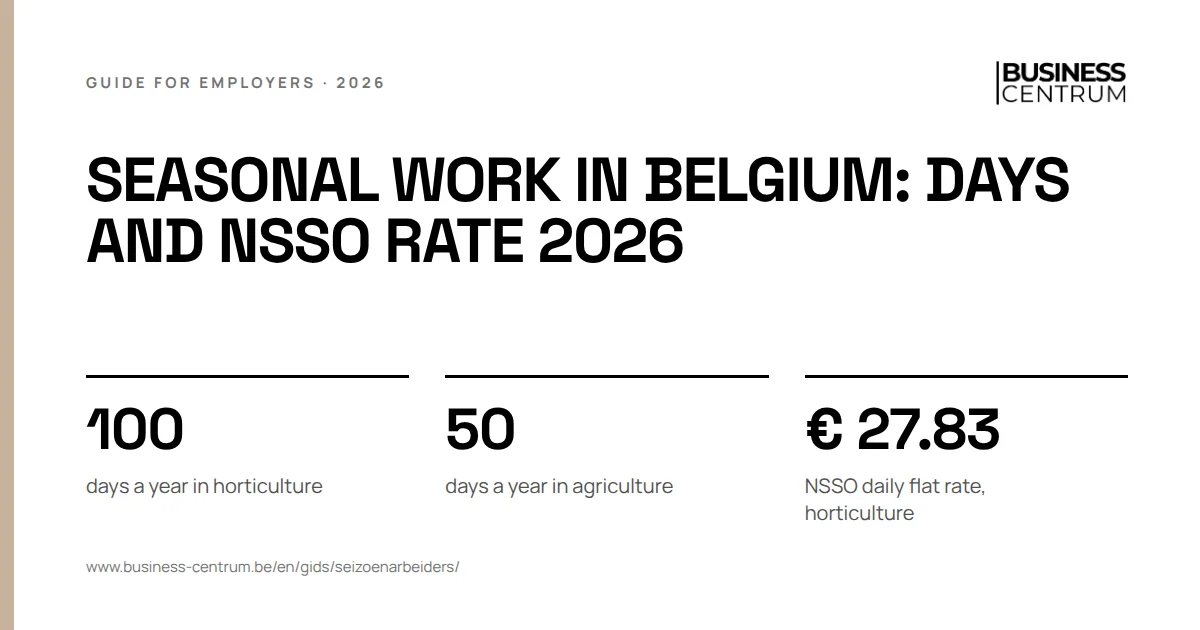
Seasonal work in Belgium, in agriculture and horticulture, is usually done by occasional workers: you then pay NSSO contributions on a fixed daily flat rate, for at most 100 days a year in horticulture (JC 145) and 50 days in agriculture (JC 144), all employers combined. If you do not choose that status, your seasonal worker is an ordinary manual worker on a fixed-term contract, and you pay the ordinary contributions on his full wage. In both cases a minimum hourly wage applies, a Dimona for every day and, for the occasional worker, the picking card.
Seasonal work in Belgium at a glance
| Horticulture, JC 145 | Agriculture, JC 144 | |
|---|---|---|
| Maximum days a year as an occasional worker | 100 | 50, in livestock farming 100 half days |
| Minimum hourly wage of an occasional worker since 1 January 2026 | € 12.51 to € 15.66, per crop | € 12.43, flax and hemp € 16.94 |
| NSSO daily flat rate since 1 April 2026 | € 17.65 to € 27.83, per crop | € 13.52 |
| Year-end and purchasing power bonus via the Fund | € 240.71, from 50 days | € 89.38, from 25 days |
| Picking card or occasional work form | from the Social and Guarantee Fund for horticulture | from the Social and Guarantee Fund for agriculture |
Across all sectors an occasional worker may work at most 100 days a year in this status. Someone who works in both agriculture and horticulture therefore does not get 100 plus 50 days.
Seasonal workers in Belgium: occasional worker or ordinary seasonal worker?
The term seasonal worker covers two statuses. The difference lies mainly in the NSSO contributions.
- Occasional worker. A manual worker in the system of article 8bis of the royal decree of 28 November 1969. You pay contributions on a fixed daily flat rate, as long as he stays within his days. He keeps a picking card and you file a Dimona for occasional work for every day.
- Ordinary seasonal worker. A manual worker on a fixed-term contract or a contract for a clearly defined job, such as sorting fruit during the harvest. He gets the pay scale of his category, falls under the holiday scheme and you pay the ordinary contributions on his full wage.
The occasional work system only applies to manual workers with these employers:
- JC 145, horticulture, except the laying out and maintenance of parks and gardens. A temporary worker in landscaping is always an ordinary worker.
- JC 144, agriculture, if the worker works only on the employer's own land. In a business whose main activity is livestock farming or a mixed farm, also for milking, feeding and caring for the animals and cleaning the stable.
- JC 322, temporary agency work, if the agency worker works for a user in one of those sectors.
Two conditions exclude someone. A person who worked in the same company under another status during the preceding 180 days is not an occasional worker. A fixed-term contract or a contract for a clearly defined job of at most 6 consecutive calendar weeks does not count. The rule also does not apply to someone who returns to the same company as an occasional worker after retirement.
If you choose ordinary seasonal work, watch the contract. A fixed-term contract has to be in writing at the latest when the worker starts, otherwise it counts as an open-ended contract. If you sign a new contract with the same worker every season, the law presumes an open-ended contract, unless you prove that the nature of the work, such as seasonal work, justifies the succession.
Seasonal farm work in Belgium: how many days a year?
The quota applies per worker and per calendar year, with all employers in the sector combined.
| Sector or crop | Maximum per year |
|---|---|
| Horticulture: vegetables, fruit, chicory, mushrooms, flowers and nurseries | 100 days |
| Agriculture, on the employer's own land | 50 days |
| Livestock and mixed farms: milking, feeding, care, stable | 100 half days |
| All sectors combined | 100 days |
A half day is a block of 4 hours between midnight and noon, or between noon and midnight. If the worker works longer, or his work overlaps both blocks, it counts as two half days. The half-day scheme for livestock and mixed farms runs until 31 December 2026.
Mushrooms. There you may only employ occasional workers during a period of intense activity of 156 days per calendar year per employer. That limit falls away if the joint committee grants your business its own arrangement, including an employment standard. You apply for it again every year.
Chicory. A separate flat rate used to apply from day 66. It has been abolished: since 1 January 2024 you declare all days at the ordinary chicory flat rate. That measure also runs until 31 December 2026.
A public holiday that you still pay after the end of the contract is declared at the flat rate. That day does not count towards the quota. If the NSSO finds that a worker exceeds his quota, you must be able to show that the excess consists of days not worked. Otherwise the NSSO adjusts your DmfA.
Seasonal worker pay in Belgium: the minimum per crop
The social partners set the minimum hourly wage of occasional workers in a separate collective agreement per committee. The amounts apply since 1 January 2026.
| Committee and crop | Minimum hourly wage of an occasional worker |
|---|---|
| JC 145, flower growing | € 13.89 |
| JC 145, forest tree nurseries | € 15.50 |
| JC 145, tree nurseries | € 15.66 |
| JC 145, fruit growing | € 13.38 |
| JC 145, fruit sorting companies | € 13.28 |
| JC 145, vegetable growing | € 12.92 |
| JC 145, mushroom growing | € 12.51 |
| JC 144, agriculture excluding flax | € 12.43 |
| JC 144, flax and hemp (39-hour week, since 1 October 2026) | € 16.94 |
In horticulture a minor occasional worker gets part of that wage: 85% at 17 and 70% at 15 and 16. If the seasonal worker is employed as an ordinary worker, you pay the pay scale of his category. All amounts are on our pay scale pages for JC 145 and JC 144, as the FPS Employment publishes them.
Part of the bonuses is paid by the sector's Social and Guarantee Fund, based on the days on the picking card:
| Bonus | JC 145, horticulture | JC 144, agriculture |
|---|---|---|
| Year-end and purchasing power bonus combined | € 240.71, from 50 days in the calendar year | € 89.38, from 25 days in the calendar year |
| Loyalty bonus | € 0.50 per day worked, from 30 days | € 0.50 per day worked, from 15 days |
In horticulture you have also paid, since 1 June 2026, a separation allowance of € 2 net per working day started. Wages, bonuses and indexation in horticulture are covered in our guide to joint committee 145.
Seasonal work in Belgium and the NSSO: the daily flat rate
For an occasional worker within the quota, the NSSO does not use the real wage. You declare a flat rate per day worked, however many hours he works that day. The amounts since 1 April 2026:
| Crop | Daily flat rate | Personal contribution per day |
|---|---|---|
| Horticulture | € 27.83 | € 3.64 |
| Chicory | € 27.83 | € 3.64 |
| Mushrooms | € 27.83 | € 3.64 |
| Fruit growing | € 24.54 | € 3.21 |
| Flower growing | € 17.65 | € 2.31 |
| Agriculture and dairy | € 13.52 | € 1.77 |
Occasional workers do not fall under the annual holiday scheme. So you do not raise the flat rate to 108%, and you pay no holiday contribution and no wage moderation contribution. The special contributions, such as the one for the Fund for Company Closures, remain due. The personal contribution is 13.07% of the flat rate. Because of the work bonus you usually do not have to withhold it.
Since 1 January 2026 the flat rates are indexed every year on 1 January, in the same way as the sector wages, and adjusted when the guaranteed minimum monthly income (GGMMI) rises in absolute terms. That is laid down in the royal decree of 14 April 2026. The previous decree was annulled by the Council of State on 5 January 2026. The new decree restored the legal basis, so the scheme continues without interruption.
Worked example. A fruit picker works an 8-hour day at the minimum of € 13.38. His gross wage is 8 x 13.38 = € 107.04.
| Ordinary worker | Occasional worker | |
|---|---|---|
| NSSO base for that day | € 107.04 x 1.08 = € 115.60 | € 24.54 |
| Personal contribution before the work bonus | 13.07% = € 15.11 | € 3.21, usually zero because of the work bonus |
| NSSO base over 30 harvest days | € 3,468.10 | € 736.20 |
| Employer contributions | ordinary contributions, including holiday and wage moderation | on the flat rate, without holiday and wage moderation contributions |
The wage itself does not change: in both cases the picker earns € 107.04 gross for that day. Only the base for the contributions differs.
Dimona for seasonal workers
For an occasional worker you file a Dimona for occasional work, of type EXT, for each day separately. You report the start time and the expected end time. Because you report start and end time each time, you can file several Dimona declarations for one calendar day. In the DmfA it remains a daily flat rate.
For changes, the same time limits apply as for other occasional workers. You change a modified start time at the latest when the worker starts. An earlier end can be reported until midnight after the planned end time, a later end within 8 hours. If the worker does not come in, you cancel the Dimona at the latest at midnight of that day.
The Dimona is an absolute condition. If you do not file it, you may not use the flat rate under any circumstances, not even afterwards. The worker is then an ordinary employee for the entire calendar year, and you pay all contributions on his full wage at 108%, including the holiday and wage moderation contributions.
Employers and agencies in JC 144 and JC 145 can check through Multi-Dimona whether a worker has already worked as an occasional worker this calendar year. Do you prefer not to file the Dimona declarations yourself? See what Dimona management involves. The basics are in what is Dimona.
The picking card in 2026: does it still exist?
Yes. The picking card is officially called the occasional work form, and in 2026 it is still compulsory for an occasional worker in agriculture and horticulture. The social inspection describes the procedure in its green sectors checklist of 30 June 2026:
- The first employer buys the picking card from the Social and Guarantee Fund of his sector: the Fund for horticulture or the Fund for agriculture.
- The employer fills in his details and the worker's details, at the latest when the employment starts.
- The worker fills in the picking card before he starts and must be able to show it at any time.
- The employer preferably checks it every day and initials it at least once a week.
Nothing replaces the picking card. In horticulture, with the worker's consent, you can see in the online service Green@work how many of his 100 days are already reserved. Multi-Dimona shows whether he has already worked as an occasional worker this year. The NSSO states explicitly that this does not replace the occasional work form. The 2026 collective agreements still count the days for the bonuses on the picking card or occasional work form.
The system itself is not new: in horticulture it has applied since 1 July 1994, in agriculture since 1 April 2000.
Pitfalls with seasonal work in Belgium
- No Dimona on the first day. The worker is then an ordinary employee for the whole calendar year, not just that day.
- The quota not checked. The days count with all employers combined. A picker who already worked for another grower may have used part of his days.
- The 180-day rule forgotten. Someone who recently worked for you under another status cannot be an occasional worker.
- Parks and gardens. Landscaping has no occasional work at a daily flat rate.
- Agriculture outside the employer's own land. If the worker does not work on the employer's own land, he falls outside the scheme, except for the livestock tasks.
- Mushrooms without an own arrangement. Outside the 156 days of intense activity, occasional work is not possible there.
- A picking card that is not initialled. The inspector asks for it during a check.
What to check now
- Record for every seasonal worker whether he is an occasional worker or an ordinary worker, and why.
- Check that you filed a Dimona for occasional work for every day worked, with start and end time.
- Count the days per worker and check them in Green@work or Multi-Dimona.
- Compare every hourly wage with the minimum for the crop and the committee's pay scale.
- Make sure every picking card is complete and initialled at least weekly.
What Business Centrum does for you
Business Centrum processes your payroll together with Acerta, including the pay of your seasonal workers. You have one fixed contact person in Ghent who knows your file. Would you like us to go through your season together? Request a call back.