
When an employee is on sick leave in Belgium, you as the employer first pay their wages yourself: that is the guaranteed salary. A white-collar employee receives 100% of their pay for 30 calendar days. A blue-collar worker receives 100% in the first week, after which you pay a falling share and the health insurance fund tops up. After the first month the health insurance fund takes over with 60% of capped pay. You also have a few obligations: following up the certificate, arranging a check if needed and, with long sickness, cooperating with the return to work.
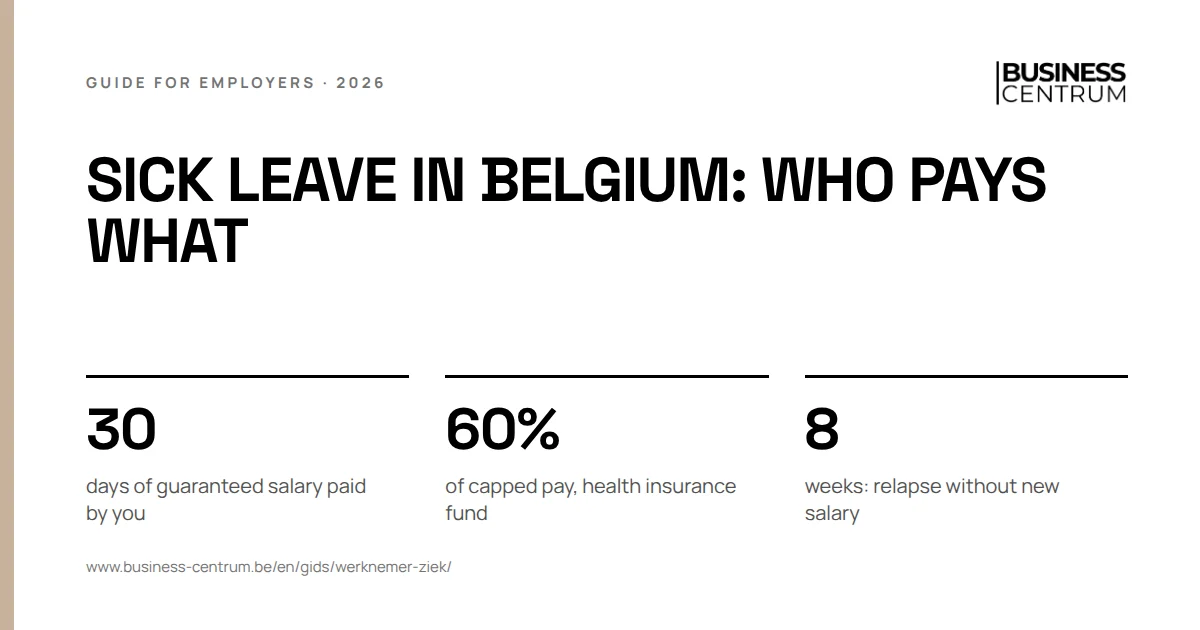
Sick leave in Belgium: who pays what?
| Period of sickness | White-collar employee | Blue-collar worker |
|---|---|---|
| Days 1 to 7 | You pay 100% | You pay 100% |
| Days 8 to 14 | You pay 100% | You pay 85.88% of pay |
| Days 15 to 30 | You pay 100% | You pay 25.88% up to the health insurance ceiling, the fund 60% |
| From day 31 | Health insurance fund: 60% of capped pay | Health insurance fund: 60% of capped pay |
Days are counted as calendar days from the first day of incapacity. You only pay for the days the employee would normally work. If they fall ill during a working day and go home, you pay that day in full and the period starts the next day.
Two exceptions often cost money. A blue-collar worker is only entitled to guaranteed salary after 1 month of uninterrupted service. And a white-collar employee on a contract of less than 3 months falls under the blue-collar scheme. The full calculation, with a worked example in euros, is in the guide to guaranteed salary.
After the first month, your wage cost does not always stop entirely. If your business has an average of at least 50 employees, for sickness starting from 2026 you pay a solidarity contribution of 30% on the benefit for the second and third month of sickness, for employees under 55.
Worked example: three weeks off sick, blue-collar beside white-collar
A blue-collar worker earns € 16 an hour and works 38 hours a week, so € 608 a week. He is ill for three weeks and his pay stays below the health insurance ceiling. A white-collar employee with the same weekly pay is ill for the same time.
| Week | Blue-collar worker: you pay | White-collar employee: you pay |
|---|---|---|
| Week 1 | 100% of € 608 = € 608.00 | € 608.00 |
| Week 2 | 85.88% of € 608 = € 522.15 | € 608.00 |
| Week 3 | 25.88% of € 608 = € 157.35, plus the health insurance benefit | € 608.00 |
| Total for you | € 1,287.50 | € 1,824.00 |
The difference lies in week three: for the blue-collar worker the health insurance fund already contributes, for the white-collar employee not yet. The example works per week to keep it clear. On the payslip it is done per day, on the days the employee would normally work.
Mistakes with a sick employee that cost money
- Paying a blue-collar worker in full during their first month. Without 1 month's service there is no guaranteed salary.
- Treating a white-collar employee's short contract as a normal contract. Under 3 months the blue-collar scheme applies.
- Booking a relapse as a new illness. Within 8 weeks you only pay the balance, unless a certificate shows a different illness.
- Paying in full despite a late certificate. You may refuse pay for the days before the certificate, if your work rules set the deadline.
- Leaving sick days during the holiday as holiday. You grant those days again later.
- Forgetting to notify the occupational doctor. After 4 weeks of sickness the occupational doctor should be informed.
Sick leave for white-collar and blue-collar staff: the difference
The term sick leave is somewhat misleading: it is not leave the employee applies for, but a suspension of the contract because of sickness. The difference between a white-collar employee and a blue-collar worker lies only in the first month.
- White-collar employee on an open-ended contract or one of at least 3 months: full pay from you for the whole first month, with no seniority condition.
- Blue-collar worker: one week of full pay, one week of a large share, and then a top-up on the health insurance benefit. Only after 1 month's service.
From the second month both are the same: the health insurance fund pays. For the benefit, the employee must report their incapacity to the health insurance fund themselves, a blue-collar worker within 14 calendar days and a white-collar employee within 28 calendar days.
Sick leave rules: the employer's obligations on day 1
- Have the employee report sick at once. They must inform you immediately, in the way your work rules prescribe.
- Follow up the certificate. If your work rules require a certificate, the employee delivers it within 2 working days. They may stay away on the first day of sickness without a certificate 2 times per calendar year. A business with fewer than 50 employees can exclude this.
- Decide whether to arrange a check. If in doubt, you send a control doctor.
- Pass the sickness on to your payroll. It determines which days are guaranteed salary and which code they get.
- Keep an eye on the duration. After 4 weeks you report the sickness to the occupational doctor of your external service for prevention and protection at work.
If the certificate arrives late, you can refuse guaranteed salary for the days before the certificate. How that works exactly, what your work rules must say and what to do with a note without a signature is covered in sick notes for employers.
Sending a control doctor to a sick employee
You may have an employee checked by a doctor you appoint and pay. If your work rules require availability, the employee must be at home for the check for no more than 4 consecutive hours between 7:00 and 20:00. The control doctor only assesses whether the employee is unfit, not what illness they have: the diagnosis stays confidential.
If the employee evades the check without a valid reason, they can lose their guaranteed salary for the sick days before the check that eventually takes place. If the control doctor finds them fit for work, you can refuse pay from the first check. If they dispute the finding, the most diligent party starts arbitration within 2 working days. The costs, the steps and a clause for your work rules are in sending a control doctor as an employer.
Does the employee fall ill again? Relapse within 8 weeks
If an employee falls ill again within 8 weeks of a sickness for which you paid guaranteed salary, no new period starts. You only pay the days left over from the first period. Until the end of 2025 that period was 14 days. If the employee shows with a certificate that it is a different illness, a new period of guaranteed salary does start.
Long-term sick employee: return to work and medical force majeure
If the sickness lasts longer, the question shifts from who pays to how the employee returns. New rules have applied since 1 January 2026:
- After 4 weeks you report the sickness to the occupational doctor, who contacts the employee.
- From 8 weeks a work potential assessment can follow. With at least 20 employees, you request it yourself.
- After 6 months of uninterrupted incapacity, the procedure for medical force majeure can start. If the occupational doctor finds that the employee can permanently no longer do the agreed work and there is no adapted work, the contract ends without notice. You do pay € 1,800 to the Return to Work Fund.
The week-by-week timeline is in return to work 2026, the procedure with all deadlines and a template letter in medical force majeure.
Ill during holidays or during notice
During the holiday. If an employee falls ill during their annual holiday, since 1 January 2024 you pay guaranteed salary for those days and they keep their holiday days. They must always send you a certificate. How to grant and book the days again is in sickness during holidays.
During notice. If you gave notice, the sickness stops the notice and the end date moves back. If the employee resigned, notice keeps running. What you keep paying, and when ending the contract at once is cheaper, is covered in sickness during the notice period.
Dismissing a sick employee?
Sickness gives no protection against dismissal. You may dismiss a sick employee with notice or with a payment in lieu. The illness itself may not be the reason: health is a protected criterion, and a discriminatory dismissal costs 6 months' gross pay. Notice, medical force majeure and an agreement are compared in dismissing an employee during sickness.
Everything about a sick employee
- Guaranteed salary: what you pay for a blue-collar worker and a white-collar employee, in euros.
- Sick notes for employers: the 2026 rules and the days without a certificate.
- Sending a control doctor as an employer: costs, rules and a clause.
- Return to work 2026: what changed for employers.
- Medical force majeure: the procedure and timeline.
- Sickness during holidays: which days you grant again.
- Sickness during the notice period: the new end date.
- Dismissing an employee during sickness: is it allowed and what it costs.
- Types of leave: the other absences besides sickness.
Business Centrum processes every period of sickness on the payslip: which days are guaranteed salary, which percentage applies to a blue-collar worker and when the health insurance fund takes over. Together with Acerta we make sure the declarations are correct. Unsure about a certificate, a relapse or a long absence? Ask us.