
In Belgium, social liabilities (sociaal passief) are the total a company owes or may come to owe its staff: accrued holiday pay, the pro rata end-of-year bonus and notice or severance pay according to length of service, plus outplacement, supplementary pensions and the indemnities for protected employees. In a takeover, a restructuring or a closure, you turn them into one amount. How to calculate one indemnity is in severance pay calculation.
Social liabilities in Belgium: two layers
Social liabilities have two layers. The first is already fixed, the second is added as soon as contracts end.
What has already built up. You owe this even if nobody leaves:
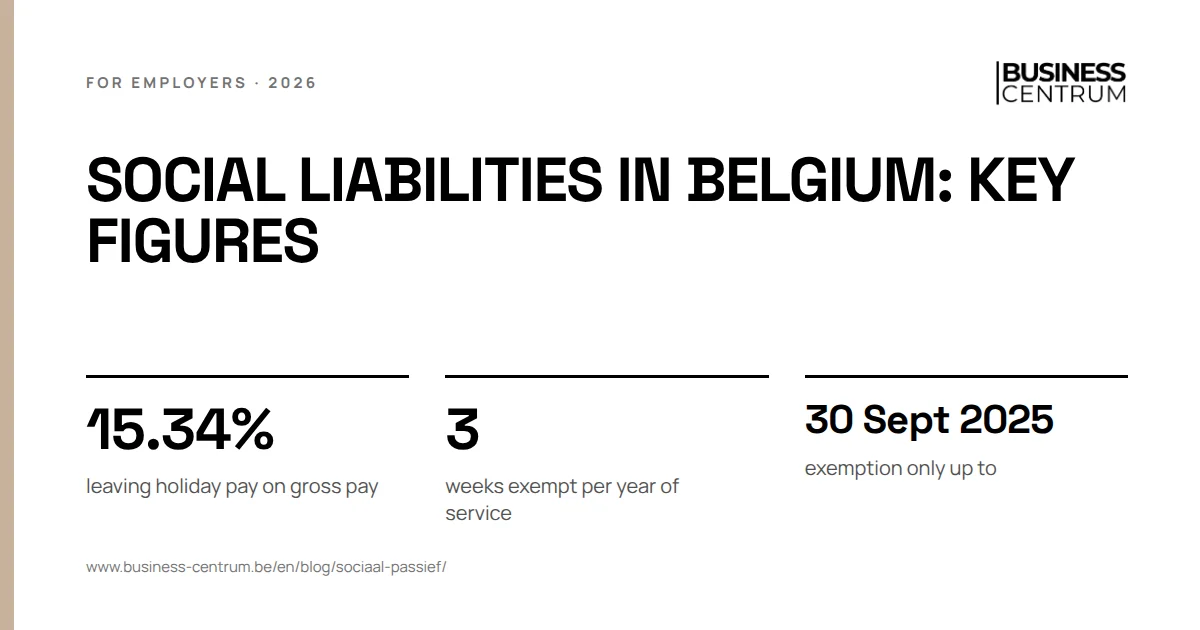
- Holiday pay for white-collar employees. A white-collar employee builds up this year the holiday pay you pay next year. Double holiday pay is 92% of a monthly salary. If he leaves, you pay 15.34% of the gross pay he earned in the current year. How holiday pay works in 2026 is in holiday pay 2026.
- Holiday pay for blue-collar workers. Here a holiday fund pays: 15.38% of the previous year's pay, raised to 108%. You finance it through your contributions on pay, not through a payment on departure.
- Pro rata end-of-year bonus. What an employee receives on leaving during the year depends on your sector's collective agreement. Some joint committees grant a pro rata bonus, others only after a minimum length of service. The rules per sector are in end-of-year bonus calculation.
What is added when contracts end. This is the largest part:
- Notice or severance pay. The number of weeks follows length of service, see the guide notice period in Belgium. For an employee already in service before 1 January 2014, you add up two parts, the first of which still follows the rules from before 2014.
- Outplacement. Mandatory with notice of 30 weeks or more, and in certain cases for employees aged 45 or over.
- Supplementary pension. Group insurance or a pension plan does not fall under the rules on transfers of undertakings. Check the plan rules separately.
- Protected employees. For pregnant employees, employees on time credit or parental leave, staff representatives and prevention advisers, among others, the law provides an additional protection indemnity on top of the normal indemnity, if the dismissal breaches the protection.
Social liabilities calculation in four steps
- Make a list per employee. Status, start date, joint committee, gross pay, variable pay over twelve months and contractual benefits.
- Add up what has built up. Holiday pay and the pro rata end-of-year bonus, on a fixed reference date.
- Calculate the indemnities. Weeks from the table times the weekly pay: monthly salary × 3 / 13, plus benefits. You can calculate each employee with severance pay calculation.
- Add the employer cost. On severance pay you pay the normal employer contributions, about 25% before reductions. Also add outplacement and protection indemnities where they apply.
The result is a maximum: what it costs if all contracts end on the reference date with an indemnity. In a takeover or restructuring, that is the figure buyer and seller work with.
Worked example
A team of three white-collar employees, reference date 30 September 2026
Three fictitious white-collar employees, all with a contract that started after 2014. Their sector agreement grants an end-of-year bonus of one month's salary, pro rata per month. We assume the 2026 holidays have already been taken.
| Ann | Bram | Chloé | |
|---|---|---|---|
| In service since | 1 September 2018 | 1 April 2021 | 1 August 2025 |
| Gross monthly salary | € 2,900 | € 3,400 | € 2,600 |
| Weeks of notice | 27 | 18 | 8 |
| Leaving holiday pay: 15.34% of 9 months' pay | € 4,003.74 | € 4,694.04 | € 3,589.56 |
| Pro rata end-of-year bonus, 9/12 | € 2,175.00 | € 2,550.00 | € 1,950.00 |
| Indemnity: monthly salary x 3 / 13 x weeks | € 18,069.23 | € 14,123.08 | € 4,800.00 |
Already built up: € 12,287.34 in holiday pay and € 6,675.00 in end-of-year bonus, € 18,962.34 together.
Added if all three leave: € 36,992.31 in indemnities, plus about € 9,248.08 in employer contributions. Outplacement does not apply: nobody reaches 30 weeks.
Social liabilities on 30 September 2026: about € 65,202.73. Contractual benefits and the contributions on holiday pay are left out for simplicity. With meal vouchers or group insurance, the amount is higher.
Takeover: what collective agreement no. 32bis says
The rules for transfers of undertakings are in collective agreement no. 32bis of 7 June 1985 of the National Labour Council. They apply to every change of employer resulting from a contractual transfer of an undertaking or part of one. Two situations follow:
- You buy the shares. The company remains the employer. The commentary to the agreement states that these rules do not apply to restructurings without a change of employer. The social liabilities therefore stay with the same employer: the company you buy.
- You buy the business or a division. The rights and obligations under the employment contracts existing at the time of the transfer pass to the new employer. Seller and buyer are jointly and severally liable for the debts existing at that moment, except those from supplementary pensions.
The transfer itself is not a ground for dismissal, for either seller or buyer. A dismissal for serious cause, or for economic, technical or organisational reasons, remains possible. After a bankruptcy, other rules apply, in chapter III of the same agreement.
Restructuring: when is it a collective dismissal?
The collective dismissal procedure, with information and consultation under collective agreement no. 24, only applies in companies that employed on average more than 20 employees in the previous calendar year. In a company with more than 20 and fewer than 100 employees, it is a collective dismissal from 10 dismissals for economic or technical reasons within 60 days. For a small team, the normal rules per employee apply, as in dismissing an employee.
Social liabilities and corporate tax: the exemption is phased out
The single employment status brought a tax exemption for social liabilities, in article 67quater of the Income Tax Code 1992. It applied both in corporate tax and in the personal income tax of self-employed people with staff. The law of 18 December 2025 limits it sharply, with effect from 31 August 2025:
- The exemption now only applies to pay granted up to and including 30 September 2025, to employees with at least 5 years of service after 1 January 2014.
- The exempt amount is 3 weeks of pay per year of service from the sixth year started after 2014, and only for years of service up to 31 August 2025.
- What was already exempt stays spread at 20% per taxable period. If the employee leaves the company, the amount already exempted returns to profits.
- The last claim can be made in the return for assessment year 2031 in corporate tax, and 2030 in personal income tax.
Have social liabilities been abolished? The exemption disappears, the liabilities do not. What you owe your staff is still owed.
Employer's corner: which figures to pull from payroll
For reliable social liabilities, ask for each employee:
- the start date and length of service, including earlier contracts with you;
- the status, the joint committee and the gross pay for the last twelve months;
- the benefits: meal vouchers, group insurance, company car;
- the holiday pay for the current year and the end-of-year bonus rules;
- current suspensions and protections: pregnancy, parental leave, time credit, candidates in the social elections;
- the supplementary pension plan rules, and the 281.78 certificates if you used the tax exemption.
What Business Centrum does for you
Business Centrum keeps the pay, length of service, holiday pay and bonuses of your staff up to date in payroll, together with Acerta. In a takeover or restructuring, your dedicated contact pulls the figures per employee from those records, so you calculate the social liabilities on real data. Request the figures before you sit down with a buyer or acquirer.