Severance pay calculation in Belgium comes down to paying the current pay and the contractual benefits for the notice period the employee does not work: the number of weeks times the weekly pay, plus the weekly share of the benefits. First find the number of weeks with the tool to calculate the notice period. This page turns those weeks into an amount, using the rules of article 39 of the Employment Contracts Act of 3 July 1978.
The law calls the amount a notice indemnity (opzeggingsvergoeding). The Federal Public Service Employment adds that it is also called a severance indemnity (verbrekingsvergoeding): they are the same thing. How long the notice is per length of service, and when it starts, is in the guide notice period in Belgium. This page is about the next step: the amount.
When do you pay severance in Belgium?
The party that ends an open-ended contract without serious cause and without respecting the notice period pays the other party an indemnity. The contract then ends immediately. For an employer, there are three situations:
- Dismissal with immediate effect. You give no notice and pay the full period.
- Notice that is too short. The indemnity covers the missing part.
- Notice you cut short. The employee works part of the notice and you decide to stop straight away. You pay the remaining part.
No special form is required: a dismissal with severance can even be verbal. Put it in writing anyway, so you can prove it if there is a dispute later. An employee who leaves without working his notice also owes you an indemnity, calculated the same way on his own, shorter period. Every way to end a contract, with the steps and costs, is in dismissing an employee.
Severance pay calculation in Belgium: what article 39 says
Article 39, § 1 of the Employment Contracts Act sets the calculation. In short, four rules:
- Current pay. The indemnity equals the current pay for the length of the notice period, or for the part of it that remains.
- Benefits. The indemnity covers not only the current pay but also the benefits acquired under the contract.
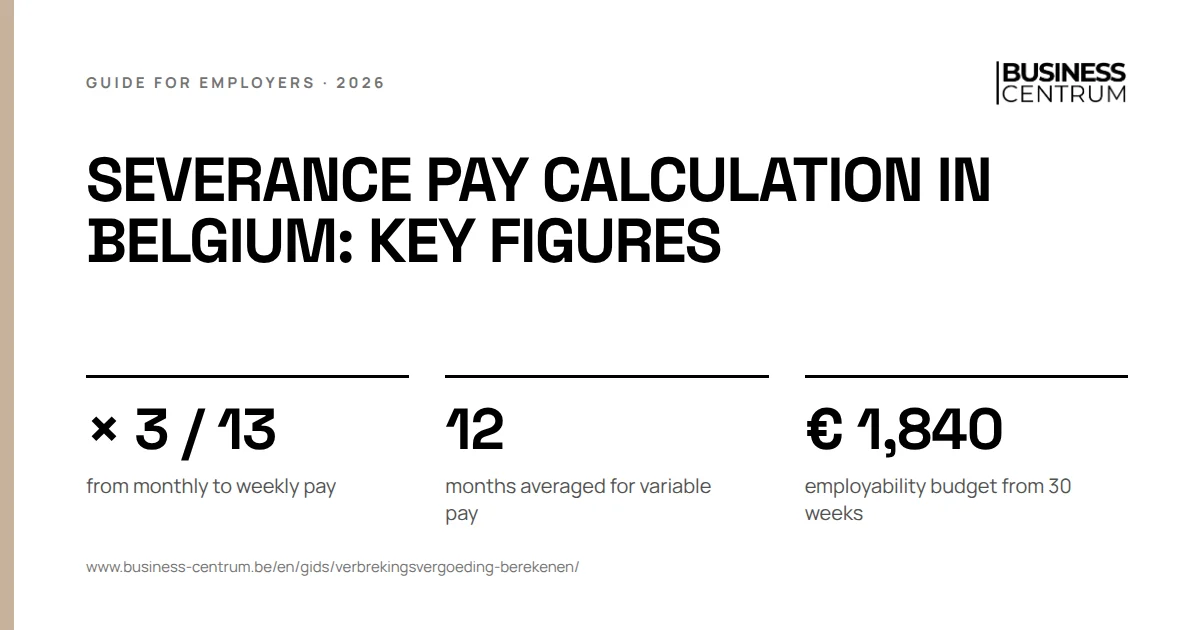
- Variable pay. If part of the pay or benefits varies, you take the average of the previous 12 months. If the employee was in service for less time, the average of that shorter period.
- Weekly pay. For employees paid a fixed monthly salary, the weekly pay is the monthly salary × 3 / 13.
What is current pay? According to the Federal Public Service Employment, the fixed gross monthly salary at the time of dismissal, plus for example shift or production bonuses and overtime pay for overtime worked regularly over a longer period.
And benefits acquired under the contract? These are all benefits the employee is entitled to, not as a gift or act of generosity, but through his employment contract, the law, a collective agreement, established practice in the company or a unilateral commitment by the employer. Costs that belong to the employer are not included. The example the Federal Public Service gives is the cost of a mobile phone for business use.
How is severance pay calculated: the formula in four steps
- The number of weeks. Take the notice you should have given, in weeks. The tool to calculate the notice period works it out from the start date and length of service, and the full table is in employer notice period. If part of the notice was already worked, only the rest counts.
- The weekly pay. Monthly salary × 3 / 13. For an hourly wage, start from the hourly wage times the number of hours per week.
- Benefits and variable pay per week. Add up, on an annual basis, what the employee receives on top of his fixed salary, with the variable part as an average over 12 months. Divide by 52.
- Multiply and add. Weekly pay times the number of weeks, plus benefits per week times the number of weeks. That is the gross amount.
Prefer to work with annual pay? You end up in the same place. Twelve monthly salaries divided by 52 weeks is exactly the monthly salary × 3 / 13. Annual pay with benefits, divided by 52, times the number of weeks: that is the indemnity.
What counts in annual pay, and what does not
There is no statutory list. The test is that of article 39: is the employee entitled to it through his contract, a collective agreement, established practice or a commitment from you? Then it counts. Is it a gift, or a cost of your business? Then it does not. Applied to the items most common in a small business:
| Item | Test |
|---|---|
| Fixed monthly salary | Always: the current pay on the day of dismissal |
| Shift, production and other fixed bonuses | Counts as current pay |
| Overtime pay | Counts if the overtime was worked regularly over a longer period |
| Commissions, bonuses and other variable pay | Average of the previous 12 months |
| End-of-year bonus | Counts if it follows from the contract, a collective agreement or practice |
| Meal vouchers and eco vouchers | The employer's share, if the employee is entitled to them by contract or collective agreement |
| Employer contributions to group insurance | Count if the employee is entitled to them by contract or pension plan rules |
| Private use of a company car | Counts if the contract grants it; there is no fixed formula to convert it into euro |
| Expense allowances, phone for business use | Does not count: costs that belong to the employer |
| A one-off gift | Does not count: an act of generosity |
Two items need extra care. For the company car, the law nowhere says how to convert the benefit into euro. For holiday pay, it depends on the status, as shown below. Have both checked before you propose an amount: a dispute over one item later becomes a dispute over the whole amount.
Blue-collar and white-collar: holiday pay
Holiday pay runs differently for each status, and that also affects a dismissal.
- White-collar employee. You pay the holiday pay yourself. Double holiday pay is 92% of a monthly salary. When the employee leaves, you also pay leaving holiday pay: 15.34% of the gross pay he earned with you in the current year. That is a separate payment, apart from the severance pay.
- Blue-collar worker. A holiday fund pays the holiday pay: 15.38% of the previous year's pay, raised to 108%. You finance it through contributions on pay, not through a separate payment on departure.
Article 39 does not spell out whether and how the double holiday pay of a white-collar employee counts in the annual pay used for severance. In the example below we leave it out of the sum, and we say so. If you choose otherwise, record that choice and have it checked. With a long notice period, a difference of almost one month's pay per year adds up.
Part-time work, time credit and parental leave
- Part-time contract. The current pay is the part-time pay the employee earns at the time of dismissal.
- Temporarily working less. If you dismiss an employee during time credit, a career break or thematic leave such as part-time parental leave, the current pay is the pay he would earn had he not reduced his hours. That has been in article 39, § 2/1 since 10 November 2022. The rule does not apply if the reduction was agreed for an indefinite period.
- Adapted work after illness. If you dismiss during a period of adapted or other work after incapacity, you calculate on the pay of the contract before the return to work (article 39, § 2).
Long notice: the employability budget and outplacement
If the employee is entitled to notice of at least 30 weeks, he is also entitled to a one-off budget for measures that improve employability, such as training, career coaching or extra outplacement. That budget is € 1,840 in 2026 and the employee applies for it himself at the National Employment Office (article 39ter).
For dismissals since 1 April 2025, you no longer split the indemnity in two parts. The employee receives the full amount. The budget is financed by the employer contributions on the part of the notice above 2/3, with a minimum of 26 weeks. The social security office collects those contributions and passes them on to the National Employment Office. For dismissals before that date, the old two-part dismissal package still applied.
Notice of 30 weeks or more also means outplacement. If you pay severance and make a valid outplacement offer, the employee receives an indemnity reduced by 4 weeks of pay: the value of the coaching. Without a valid offer, that reduction falls away. The rules and deadlines are in mandatory outplacement.
Social security and withholding tax on severance
Social security. For the National Social Security Office, severance pay is pay, just like pay for days worked. You withhold the personal contribution of 13.07% and pay the employer contributions. In the DmfA return, the indemnity goes under pay code 3.
Special contribution for the Closure Fund. If the employee's annual pay is at least € 50,166, you pay a special contribution on top of the normal contributions: 1% up to € 61,437, 2% up to € 72,707 and 3% above that. It only applies to the part of the indemnity built up through work from 1 January 2014. The social security office calculates that annual pay from the normal pay of the last quarter with work, divided by the number of days and multiplied by 260.
Withholding tax. Withholding tax on a notice indemnity follows its own scale from the Federal Public Service Finance. The rate depends on the reference pay: the pay used to calculate the indemnity. If it lies between € 42,695.01 and € 55,355, the withholding tax is 31.30%. The highest rate is 48%. For an employee with dependent children and a low reference pay, a partial exemption applies. You calculate the tax on the indemnity after deducting the personal social security contribution.
Severance pay calculation in Belgium: a worked example
Worked example
Sofie, white-collar employee, six years and eight months of service
Sofie is a fictitious white-collar employee. She started on 1 March 2020 and you end her contract on Monday 2 November 2026 with immediate effect. Her contract began before 1 June 2026, so the cap does not apply. With six full years of service, she is entitled to 21 weeks of notice.
| Item | Per year | For 21 weeks |
|---|---|---|
| Monthly salary € 3,800: € 3,800 x 3 / 13 = € 876.92 per week | € 45,600.00 | € 18,415.38 |
| End-of-year bonus under the sector agreement, one month's salary | € 3,800.00 | |
| Meal vouchers, employer share € 8.91 x 220 days | € 1,960.20 | |
| Employer premium for group insurance | € 1,200.00 | |
| Commissions, average of the last twelve months | € 2,400.00 | |
| Benefits and variable pay: € 9,360.20 x 21 / 52 | € 9,360.20 | € 3,780.08 |
| Gross severance pay | € 22,195.46 |
Deductions. Personal social security of 13.07%: € 2,900.95. Taxable: € 19,294.51. The reference pay is 12 x € 3,800 + € 9,360.20 = € 54,960.20, so the withholding tax is 31.30%: € 6,039.18. With no dependent children, Sofie keeps about € 13,255 net.
Employer cost. Employer contributions come on top of the indemnity, about 25% before reductions: € 5,548.87. The special contribution for the Closure Fund does not apply. With € 11,400 normal pay in her last quarter, divided by 65 days and multiplied by 260, her annual pay for that contribution is € 45,600, below € 50,166. The employability budget and outplacement do not apply: 21 weeks is less than 30.
What comes separately. You also pay her leaving holiday pay of 15.34% on her gross pay for 2026. Double holiday pay is not in the indemnity above, for the reason given in the section on holiday pay.
Had you first let Sofie work eight weeks of notice and then stopped, you would pay the indemnity for the remaining thirteen weeks, at the current pay of that moment.
Work the notice or pay it, and the combinations
A week of notice worked or a week of indemnity paid costs the same pay. The difference lies elsewhere. During notice, the employee still works, the end date moves with sickness or holidays, and he is entitled to time off to look for a job. With an indemnity, the contract is over straight away and you pay everything in one go. A company recognised as being in difficulty, or facing exceptionally unfavourable economic circumstances, may pay in monthly instalments (article 39bis).
- Notice, then indemnity. You give notice, the employee works part of it, then you stop. You pay the indemnity for the remaining part of the period.
- Counter-notice. If the employee finds another job during your notice, he can leave with a counter-notice: after one year of service, at most 4 weeks. The contract then ends at the end of that counter-notice and you pay nothing for the rest of your notice.
- Fixed-term contract. Article 40 applies: the pay up to the end date, but never more than 2 times the notice that would apply to an open-ended contract. Worked out in terminating a fixed-term contract.
Did anything change in 2026?
Not the formula. Article 39 was last amended in 2022, with the rule for time credit and thematic leave. What does change in 2026 is the number of weeks you calculate on, and so the amount:
- Cap. For contracts from 1 June 2026, the employer's notice stops at 52 weeks, and the indemnity with it.
- Short notice. For contracts from 1 August 2026, the notice in the first six months is 1 week.
- Budget. The employability budget was indexed to € 1,840.
- Withholding tax. The scale for notice indemnities is the one in the rules of 1 January 2026.
The laws behind these changes, with three dismissals as examples, are in the new notice periods of 2026. If a takeover or restructuring means adding up the indemnities of a whole team, you calculate the social liabilities.
What Business Centrum does for you
Business Centrum calculates severance pay on the right number of weeks, with the current pay and benefits taken from your own payroll records, and processes the indemnity, social security, withholding tax and social documents together with Acerta. You have a dedicated contact who knows your files. Unsure about an item in the annual pay? Have it checked before you name an amount to the employee.