
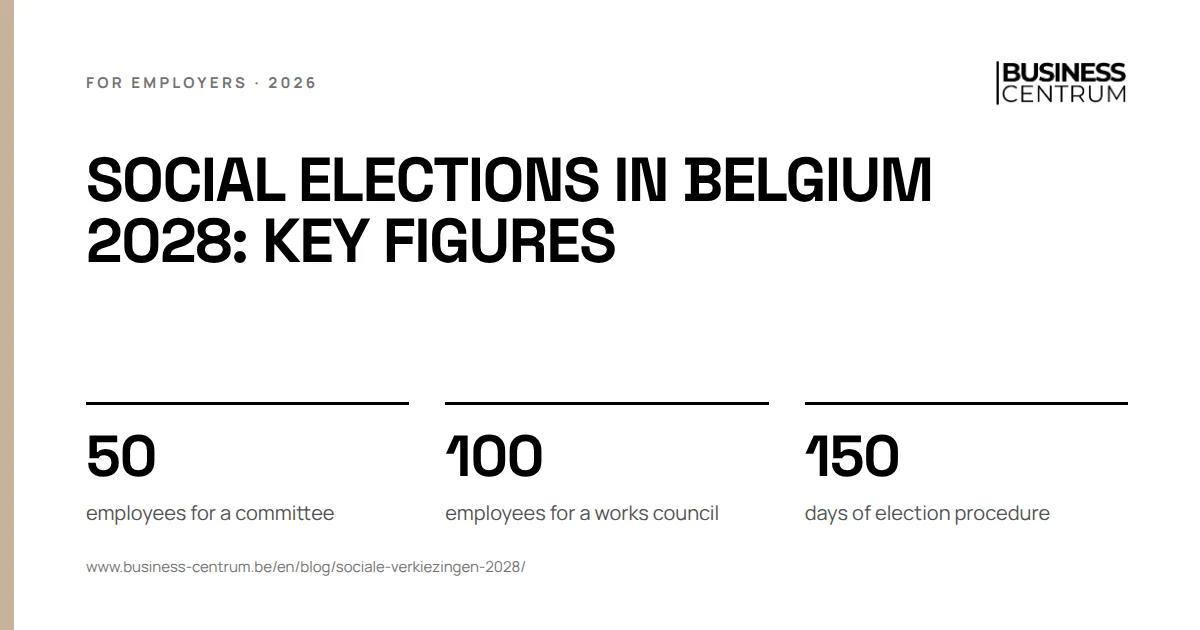
The 2028 social elections in Belgium are the next round in which employees elect their representatives to the committee for prevention and protection at work and to the works council. They take place every 4 years; the previous round ran from 13 May 2024 to 26 May 2024. The 2028 election period is not fixed yet: a law does that, on the advice of the social partners. What is fixed are the thresholds of 50 and 100 employees and the rule for the reference period. If election day falls in spring again, that reference period already starts on 1 October 2026.
What are the social elections in Belgium in 2028?
In social elections, a business sets up or renews its consultation bodies. There are two bodies, each with equal representation: the employer appoints its delegation from senior management, and the employees elect their delegates from lists of the representative unions and, for the works council, also of the managerial staff organisations.
- The committee for prevention and protection at work (CPBW) looks for and proposes measures to promote the wellbeing of employees in their work.
- The works council (OR) gives advice on measures that may change the organisation of work, working conditions and productivity, and receives economic and financial information on how the business is doing.
The names of the members of both bodies belong in your work rules. How to build them is in drawing up work rules.
Do you have to take part in the 2028 social elections in Belgium?
| Average number of employees | What you organise |
|---|---|
| Fewer than 50 | No social elections |
| 50 to fewer than 100 | Election of a committee. If you already had a works council, you renew it too, but the members elected to the committee hold the mandate |
| 100 or more | Election of a committee and a works council |
You count per technical business unit. The law defines that unit on the basis of economic and social criteria, and where in doubt, the social criteria prevail. A site can therefore be a unit of its own, and several companies can together form one unit. Two companies with 30 employees each that operate as a whole can thus exceed the threshold together.
If you stay below the threshold, you have no committee, but wellbeing at work remains your obligation. How an external prevention and protection service fits in is explained in our guide.
Reference period for the 2028 social elections
The law uses an average over 4 quarters, starting on the first day of the sixth quarter before the quarter in which election day falls. For each employee, you count the calendar days between start and end of employment as declared in Dimona, and divide the total by 365. An employee who is sick or whose contract is suspended still counts.
| Social elections 2024 | Rule applied to an election day from April to June 2028 | |
|---|---|---|
| Reference period for staff | 1 October 2022 to 30 September 2023 | 1 October 2026 to 30 September 2027 |
| Reference quarter for agency workers | 1 April 2023 to 30 June 2023 | 1 April 2027 to 30 June 2027 |
The 2028 column is not an official calendar. It shows what article 7 of the law of 4 December 2007 gives if election day falls in the second quarter of 2028, as in 2024. If the law sets a different period, these dates move with it.
Part-timers. If someone works less than 75% of a full-time schedule, you divide their calendar days by two. What counts is the actual schedule, even if they work more hours than their contract says.
Agency workers. They count with you as the user, not with the agency. During the fourth quarter before the quarter of election day, you keep an annex to the general staff register for this, with for each agency worker the start and end date of the assignment, the agency and the weekly working hours. An agency worker who replaces a permanent employee whose contract is suspended does not count.
Worked example. A wholesaler has 40 full-time employees employed all year during the reference period, 10 half-time employees and, in the reference quarter, an average of 8 agency workers. That is 40 + 10 / 2 + 8 = 53. The business must hold an election for a committee.
Social elections 2028: calendar and date
There is no fixed date for 2028 yet. On 20 October 2026, article 9 of the law of 4 December 2007 only mentions the 2024 period. For that round, the National Labour Council gave its opinion on 20 December 2022, and the Minister of Employment turned it into a bill. For 2028, there is no law on that date. The federal employment service FOD WASO reports that the evaluation of the 2024 elections is under way, with a view to the 2028 edition.
The procedure lasts 150 days and counts back from election day. This is what the 2024 calendar looked like, depending on the election day a business chose:
| Step | Social elections 2024 |
|---|---|
| X-60: first written information | 15 December 2023 to 28 December 2023 |
| X-30: start of dismissal protection | 14 January 2024 to 27 January 2024 |
| X: announcement of the election date | 13 February 2024 to 26 February 2024 |
| X+35: filing of candidate lists | 19 March 2024 to 1 April 2024 |
| Y: election day | 13 May 2024 to 26 May 2024 |
If the 2028 period falls in May again, the procedure starts in December 2027. The preparation therefore falls in 2027.
Preparing in 2027: X-60, X and Y
The procedure revolves around two days. Day X is the day you post the notice with the election date, day Y is election day itself, exactly 90 days later. The 60 days before day X are the preparation.
- X-60. You inform the existing works council or committee in writing, or otherwise the union delegation, about how your technical business units are made up, how many employees you have per category, which roles belong to senior management and, for the works council, which roles are managerial staff.
- From X-60 to X-35. You consult the existing body or the union delegation on those points.
- X-35. You communicate your decisions in writing. An appeal to the labour court is possible.
- Day X. The notice with the date and the provisional voter lists is posted. The list includes the employees who will have at least 3 months of service on day Y, except senior management, and agency workers who worked at least 32 days with you in the 3 calendar months before the month of day X. Employees under 25 form a separate category.
- X+35. The unions file their candidate lists.
- Day Y. The vote, followed by the result and the installation of the new bodies.
Dismissal protection and hidden protection
You may only dismiss delegates and candidates for serious cause accepted in advance by the labour court, or for an economic or technical reason recognised in advance by the joint committee. Protection starts on the 30th day before day X. The candidate lists only arrive at X+35. In between, you do not know who will stand, but every future candidate is already protected. That is the hidden protection.
A candidate who is not elected at their first candidacy stays protected until the next elections. If they also stood the previous time without being elected, protection runs until 2 years after the result. How a dismissal for serious cause works is in dismissal for serious cause.
Employer's corner: what you can already do
- Track your headcount per entity. Compare the Dimona days per legal entity and per possible technical business unit. If election day falls in spring 2028, the reference period has been running since 1 October 2026.
- Keep the annex for agency workers. For an election day in the second quarter of 2028, the reference quarter for agency workers is the second quarter of 2027.
- Do not plan dismissals blind. A dismissal around X-30 of an employee who later appears on a list falls under the protection. Decide on structural dismissals before that period, and give reasons for every dismissal as always. What applies to every dismissal is in dismissing an employee.
- Prepare the lists. On day X-60, you must be able to name senior management, managerial staff and young employees by role.
- Follow the legislation. The 2028 period will come from an opinion of the National Labour Council and a law. How such an agreement between the social partners works, and how a collective agreement comes about, is in our explainer.
What Business Centrum does for you
Your HR administration and payroll hold the data you use to check whether you will exceed 50 or 100 employees in 2028: hires and departures, working arrangements and part-time hours per legal entity. Your dedicated contact at Business Centrum keeps them up to date, together with Acerta. Want to know which data you will need for 2028? Ask us to call you back.