
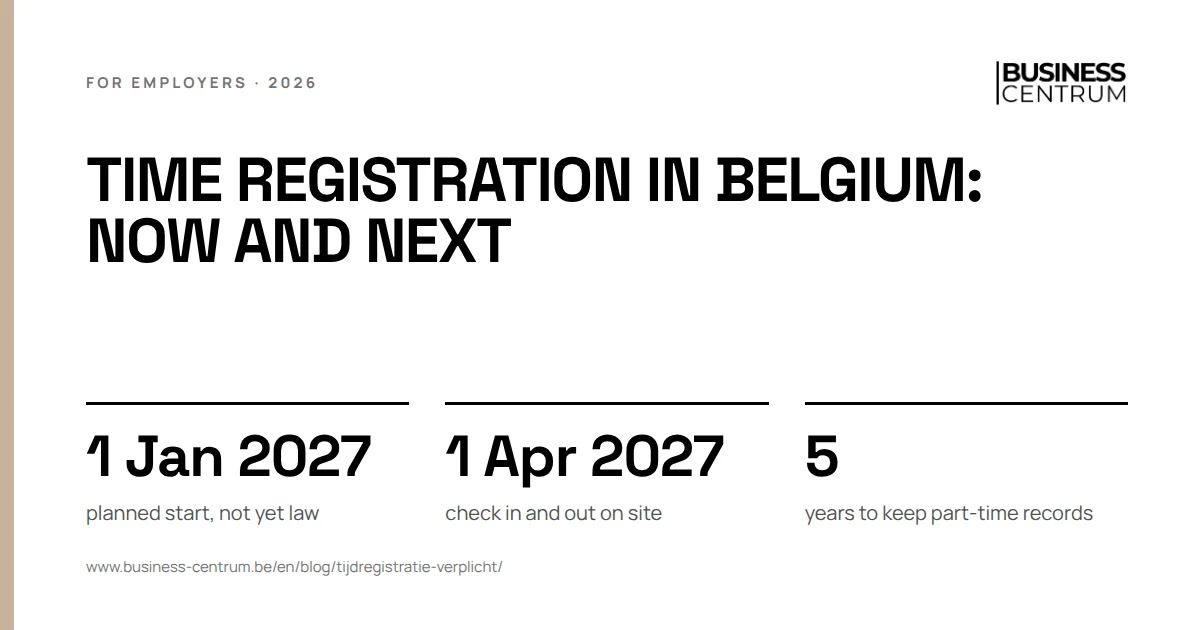
Time registration in Belgium is not mandatory today for every employee. It is mandatory for part-timers who work outside their schedule, under flexitime and on larger building sites. A general duty from 1 January 2027 is set out in a preliminary draft bill, on which the National Labour Council gave its opinion on 30 September 2026. It is not yet law.
Is time registration in Belgium mandatory today?
Not in general. The Labour Act of 16 March 1971 sets limits on working hours and rest periods, but at present contains no article requiring every employer to record the hours of every employee. The EU Court of Justice did rule on 14 May 2019 that member states must impose such a duty. Belgium has not yet put that step into law.
That does not mean you have nothing to record. Three groups already fall under a clear duty, and in hospitality a social security advantage depends on daily recording.
Where time registration in Belgium is already mandatory
| Situation | What you record | Keep for | Source |
|---|---|---|---|
| Part-time employee who deviates from the schedule | Each day start, end and breaks, at the moment itself | 5 years | Programme Act of 22 December 1989, FPS Employment |
| Flexitime | Identity and the daily duration of work | 5 years | Labour Act, art. 20ter |
| Building site from € 500,000 excl. VAT | Daily attendance in Checkinatwork, before work starts | via the NSSO | NSSO, Checkinatwork |
Part-time employees. When a part-timer works outside the published schedule, you must record that deviation. You do this with a reliable time tracking system that records the start and end of work and of breaks each day, at the moment they start or end. Only if you have no such system do you use a paper record of deviations, following the model of the Royal Decree of 8 March 1990. Filling it in afterwards does not count. The rules on schedules and additional hours are in our guide to the part-time employment contract.
Flexitime. Since the Act of 5 March 2017 on workable and agile work, a collective agreement or the work rules can allow flexitime. Employees then choose their own start and finish within set limits, with at most 9 hours a day and 45 hours a week. Under article 20ter of the Labour Act, an employer who uses flexitime must have a time tracking system that records the daily duration of work for each employee. Changing a schedule or introducing flexitime is not something you do on a whim: first read can an employer change the work schedule.
Construction. On a site from € 500,000 excl. VAT, you currently record attendance in Checkinatwork every day, before anyone starts work. The Programme Act of 30 May 2026 adds a registration on leaving the site: Check in and out at work. According to the NSSO, that duty starts on 1 April 2027.
Hospitality. An employer who wants to apply the NSSO target group reduction for permanent staff in hospitality records, according to the NSSO instructions, the start and end time of each staff member's attendance every day, through the registered till system or the NSSO's alternative system. That is a condition for the reduction, on top of the Dimona.
Worked example. You employ four part-time shop assistants who regularly stay an hour longer on Saturdays, without anyone writing it down. During an inspection you risk a fine of € 1,000 to € 10,000 per employee, so at least four times the minimum for four employees. On top of that comes the presumption that they worked full time, which you have to rebut yourself.
Mandatory time registration in Belgium from 2027: what is on the table
The federal coalition agreement of 4 February 2025 announces annualised working time and adds that working time registration will be introduced where possible. That was an intention, not a rule.
On 26 March 2026, the Minister of Employment asked the National Labour Council for an opinion on a preliminary draft bill introducing a general duty to record working time. According to that opinion, the draft provides the following:
- every employer sets up a system that records each employee's daily and weekly working time objectively and reliably;
- the form of the system is free, and a system that only records deviations from the fixed or variable schedule is enough if it shows the time actually worked;
- managers and staff in positions of trust, sales representatives, travelling staff and family workers are excluded;
- the data are kept for 5 years;
- the duty would start on 1 January 2027, with time until 31 March 2027 for employers who do not yet have a system.
On 30 September 2026 the Council gave a split opinion: employee and employer organisations did not agree. The government still has to approve the text and send it to the Chamber. The text can therefore still change, including the date. Until a law appears in the Belgian Official Gazette, the current rules apply. Other changes the government is making to working time are covered in our guide to the labour deal.
That explains why 2027 comes up when people search for time registration in Belgium: the planned start year of the general duty, and the check in and out on building sites from 1 April 2027, which is already in law.
Why Europe requires working time registration
In the CCOO v Deutsche Bank judgment (case C-55/18) of 14 May 2019, the Court of Justice held that member states must require employers to set up an objective, reliable and accessible system for measuring the daily working time of each worker. Without such a system, nobody can check whether the maximum working time and the rest periods are respected. The Court leaves member states to choose the form and to take account of the features of a sector or the size of a company. According to the National Labour Council's opinion, the explanatory memorandum to the draft aims to bring Belgian law into line with that case law.
What you can do now as an employer
Only what is in the table is mandatory today. If you want to prepare anyway, you can do so without losing anything:
- Map who already falls under a duty. Part-timers with changing hours, employees on flexitime, crews on a site above the threshold.
- Check whether your current system records daily, at the moment itself. A rota that only shows planned hours proves no deviation.
- Choose a system that also shows weekly totals. That is what the draft describes, and it already helps when calculating overtime and the voluntary overtime of 2026.
- Wait for the law before changing your work rules. Better to adapt them once than to a text that can still change.
What Business Centrum does for you
We check which employees you already have to record today, match the recorded hours of part-timers and flexitime with payroll, and process additional hours and overtime correctly, together with Acerta. If the general duty comes, we align your work rules and schedules with the text published in the Official Gazette. Have us look at your situation.