
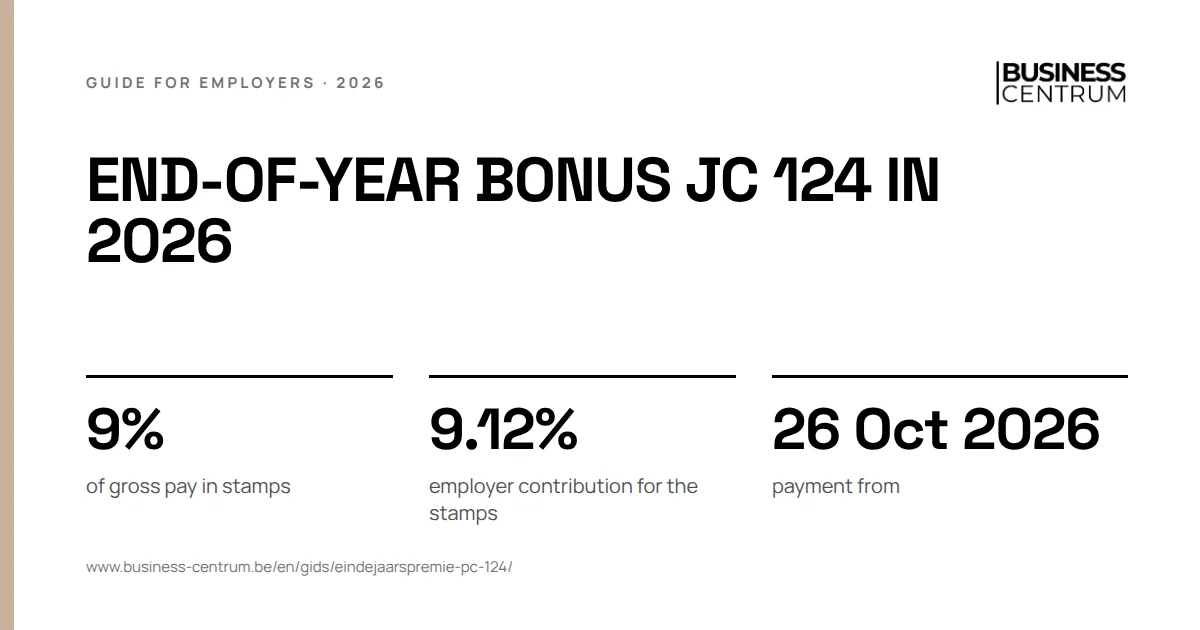
An end-of-year bonus JC 124 does not exist: construction workers get loyalty stamps instead, worth 9% of their gross pay. As the employer, you do not pay a bonus but a contribution of 9.12% to the sector fund. The stamps for the service year that ended on 30 June 2026 are paid out from 26 October 2026.
Why there is no end-of-year bonus JC 124
In most committees, the employer pays a bonus himself in December. In construction, the sector chose a different system: the Social Security Fund for Construction Workers (Fonds voor Bestaanszekerheid van de Werklieden uit het Bouwbedrijf), today Constructiv, grants loyalty stamps. The employer pays a contribution every quarter, and after the service year the worker gets a document with his stamps, which he has paid out.
The rules are in the collective agreement of 12 September 2013 on the granting of loyalty stamps and bad weather stamps. That agreement was amended in 2019 only for foreign employers. The percentage, the service year and the payment have been the same since 2013.
The agreement applies to:
- the employers and workers of companies that fall under the Joint Committee for the Construction Industry;
- temp workers who work at such a company, and the temp agency that provides them;
- foreign employers who post workers to a Belgian construction site, with an exception set out further down this page.
It does not apply to students working under a student contract. White-collar employees of a construction company do not fall under JC 124 but under JC 200, with the ordinary end-of-year bonus JC 200. Whether your workers fall under the construction committee and which other sector rules apply is explained in our guide on joint committee 124.
How much are the loyalty stamps? The end-of-year bonus in construction 2026, calculated
The agreement says it word for word: the stamps represent 9% of the pay. That percentage applies to the gross pay at 100% of the workers and temp workers, as stated in the quarterly DmfA return. The fund collects that data through the Crossroads Bank for Social Security. So you do not need to declare anything separately: what is in the DmfA determines the value of the stamps.
The period that counts is called the service year. For loyalty stamps it runs from 1 July to 30 June. The stamps paid out in the autumn of 2026 cover the pay from 1 July 2025 up to and including 30 June 2026.
Worked example: a bricklayer with a full service year
This is an example, not a calculation for your situation. A bricklayer had a declared gross pay at 100% of € 40,000 in the service year from 1 July 2025 to 30 June 2026. His stamps are worth: 40,000 x 9% = € 3,600 gross. If he worked for two construction companies in that service year, he gets one document per employer, and together they come to the same percentage of his total declared pay.
Loyalty stamps paid out by a social security fund are subject to withholding tax of 23.22%, without reduction. The FPS Finance sets this in the withholding tax rules for 2026. How an ordinary end-of-year bonus works out net in other sectors is explained in end-of-year bonus calculation.
What do you pay as an employer in construction?
You do not pay a bonus to the worker. You pay a global contribution of 9.12%, calculated on the same gross pay at 100%. Of that, 9% goes to the stamps and 0.12% to management costs. Temp agencies pay the same contribution for the temp workers they provide to a construction company.
The payment rules are strict:
- You pay the contributions every quarter, at the latest on the last day of the month after the quarter.
- If you pay late, a contribution surcharge of 10% of the amount due follows, plus late-payment interest as with ordinary social security contributions.
- If you still lower the gross pay in the DmfA after the stamps have been issued, the fund no longer takes that into account, not for the contributions and not for the value of the stamps.
- A clause in which the worker waives his stamps is void.
When are the loyalty stamps paid out in 2026?
After the end of the service year, the collection body draws up a document with the stamps for each employer. Each service year gets a different colour. The agreement sets two dates:
| Step | Date for the 2026 stamps |
|---|---|
| End of the service year | 30 June 2026 |
| Document with the stamps at the worker's, at the latest | 31 October 2026 |
| Payment of the stamps, from | 26 October 2026 |
The agreement does not say "26 October". It says payment is made "from the Monday preceding 1 November" after the end of the service year. In 2026, 1 November falls on a Sunday, so that is Monday 26 October 2026. Constructiv does not publish its own date for 2026.
The worker has his stamps paid out by the payment body of his trade union. A worker who is not a member of a trade union can turn to the collection body. Constructiv confirms that these benefits are still paid out through the trade union. You as the employer get an overview of the stamps issued for your workers at the same time.
End-of-year bonus JC 124 on dismissal, sickness or part-time work
This is where construction differs most from other committees. The agreement has no length-of-service condition, no date on which the worker must be employed and no list of absences treated as worked. It only counts the gross pay at 100% stated in the DmfA each quarter.
In practice, this means:
- Dismissal, resignation or end of contract. The agreement contains no rule that makes the stamps lapse, not even on dismissal for serious cause. The pay declared up to the date of leaving counts.
- Starting during the service year. There is no minimum period. Pay declared from the first day builds up stamps.
- Part-time workers. The agreement makes no distinction. The percentage applies to their own declared gross pay.
- Sickness, temporary unemployment or other absence. The agreement contains no rules that treat absences as worked. It only refers to the declared gross pay at 100%.
If you want to know which other sector benefits Constructiv pays during sickness or unemployment, see our guide on joint committee 124.
What if the worker receives no stamps?
If the worker does not have his document on the set date, he contacts his trade union or the collection body as soon as possible to find out why. The agreement covers three cases:
- The employer is in default. The worker asks his employer to put things right immediately. If that does not happen, he files a complaint with the Social Legislation Inspectorate. If he still has no document 6 months after the date, he submits a request to the fund. If the request is well-founded, he gets a dispute document worth the stamps earned.
- The employer is bankrupt. The worker files his claim for the stamps directly with the fund, within 45 days of the judgment. The fund pays those stamps at the latest 1 year after the bankruptcy is declared.
- The address is wrong or the document is lost. The worker gives his correct address to the collection body, or asks for a duplicate through his trade union or directly.
Foreign employers and posted workers
Loyalty stamps are part of the terms of employment and pay that a foreign employer must respect when he posts workers to a Belgian construction site. An employer from another member state of the European Union does not have to pay the contributions if his workers already get a comparable benefit for that period. The agreement describes this as a bonus on top of normal pay, such as an end-of-year bonus, a Christmas bonus or a 13th month, granted every year and amounting to about one month's pay. Holiday pay and posting allowances do not count.
The foreign employer must register with the collection body. Since the 2019 amendment, he does this automatically with his Limosa declaration, if he enters "construction" in it and states whether he pays a comparable bonus. The collection body then assesses whether that scheme is comparable, subject to what the social inspectorate finds.
Mistakes we see with loyalty stamps
- Thinking you must pay an end-of-year bonus yourself in December. The sector arranges it through the stamps and your contribution of 9.12%.
- Lowering the pay after issue. A correction that lowers the gross pay no longer counts once the stamps for that quarter have been issued. So check the DmfA before the end of the service year.
- Paying the contribution late. That costs 10% extra plus interest, and the worker runs the risk that his document does not arrive on time.
- Forgetting temp workers. They also build up stamps; the temp agency pays the contribution.
What Business Centrum does for you here
Business Centrum handles the payroll administration of construction companies together with Acerta, with correct DmfA returns as the basis for the contributions to Constructiv and therefore for your workers' stamps. More on our approach is on the page about the construction sector. How the end-of-year bonus works in the other committees is in our overview of the end-of-year bonus in 2026 per joint committee.