
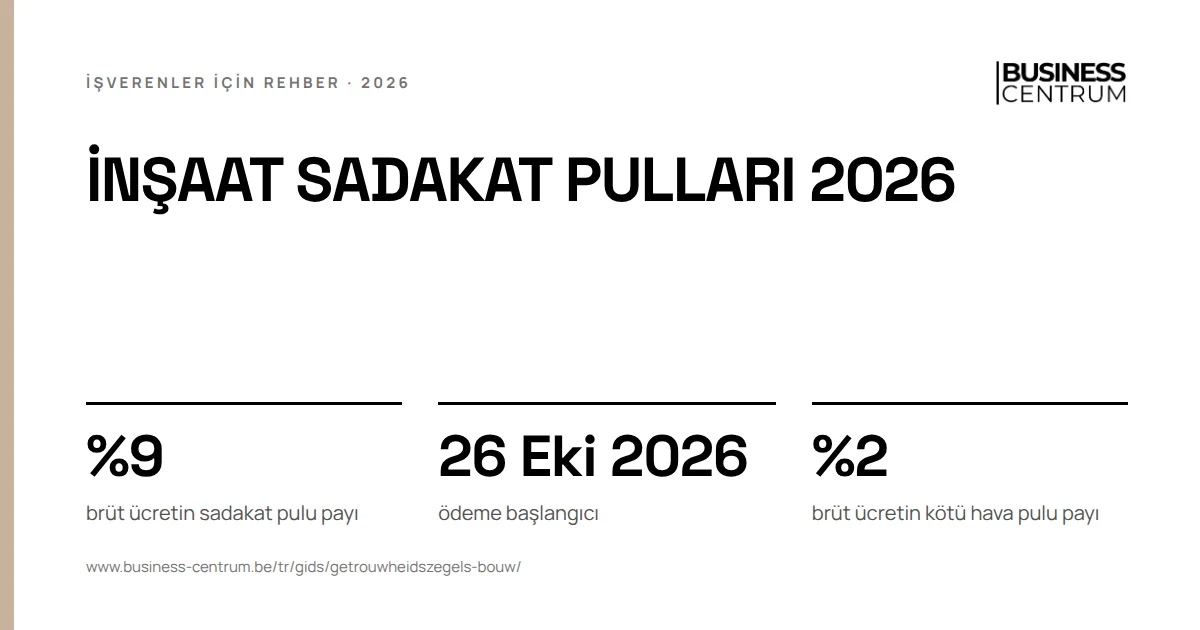
Construction loyalty stamps 2026 are worth 9% of the gross pay a worker earned between 1 July 2025 and 30 June 2026. Payment starts on Monday 26 October 2026, through the trade union or, for workers who are not members, through the PDOK. A worker at a construction company in category A or B also receives bad-weather stamps of 2% in the spring. As an employer you pay nothing directly to the worker: every quarter you pay a contribution of 9.12% to the sector fund. Below are the amounts, the dates, what happens if the stamps do not arrive and what you have to arrange yourself.
What are loyalty stamps and bad-weather stamps?
Loyalty stamps (getrouwheidszegels in Dutch, timbres fidélité in French) are the annual bonus of a Belgian construction worker. They do not come from the employer but from the Subsistence Security Fund for construction workers, known today as Constructiv. The fund has the contributions collected by the PDOK, the employers' office that organises and controls the subsistence security schemes. After each service year the PDOK draws up a document per employer listing the stamps the worker is entitled to, in a different colour every year.
The word stamps has stayed, but the worker now receives a document showing an amount, which he has paid out. Workers also call them construction stamps or the construction end-of-year bonus.
Bad-weather stamps (weerverletzegels, timbres intempéries) are a second type. They make up for pay lost to bad weather and are worth 2% of gross pay. Only companies in category A (construction code 024) and category B (construction code 054) pay a contribution for them, so only their workers receive them.
Both types are set out in the same collective agreement of the Joint Committee for the construction industry, dated 12 September 2013. The percentage, the service year and the way of payment have not changed since.
Who receives loyalty stamps? Workers in JC 124
The agreement covers the blue-collar workers of companies under the Joint Committee for construction. Whether your company falls under it is explained in our guide to joint committee 124. Stamps go to:
- blue-collar workers of a construction company in JC 124, full-time or part-time, on a permanent or fixed-term contract;
- temporary agency workers at such a company: the agency then pays the contribution;
- workers posted by a foreign employer to a Belgian site, unless their EU employer already pays them a comparable bonus. What such an employer must do as well is in our guide for the foreign employer and on the Limosa declaration.
No stamps go to:
- student workers on a student employment contract;
- white-collar staff of a construction company. They fall under JC 200 and receive the ordinary end-of-year bonus JC 200 from their employer.
The agreement sets no seniority condition, no minimum number of days and no date on which the worker must still be employed. All gross pay in the quarterly declaration earns stamps. A worker who left in March therefore receives stamps on his pay from July to March, also after dismissal or resignation. A clause in which the worker gives up his stamps is void.
Periods without pay earn no stamps, because the agreement only counts declared gross pay. Think of sickness after guaranteed pay or days of temporary unemployment paid by the National Employment Office.
Construction loyalty stamps 2026: amounts and percentages
| Loyalty stamps | Bad-weather stamps | |
|---|---|---|
| Value for the worker | 9% of gross pay | 2% of gross pay |
| Employer contribution | 9.12% | 2.10% |
| Of which management costs | 0.12% | 0.10% |
| Who pays the contribution | every JC 124 employer and the temporary work agency | only employers in category A (024) and B (054) |
| Calculated on | gross pay at 100% in the DmfA | gross pay at 100% in the DmfA |
| Service year | 1 July to 30 June | calendar year |
| Document with the worker, at the latest | 31 October | 29 April |
| Paid from | the Monday before 1 November | the Monday before 1 May |
The fund takes the pay data from the DmfA itself, through the Crossroads Bank for Social Security. You do not declare anything separately for the stamps. A correction that lowers gross pay no longer counts once the stamps for that quarter have been issued: not for your contribution and not for the value of the stamps.
There is no fixed amount in euros. The stamps follow pay: more hours or a higher category give more stamps. The minimum pay per category is in the JC 124 pay scale, and the January rise in the JC 124 indexation of January 2027.
Worked example: construction loyalty stamps 2026 for a bricklayer and a roofer
These are examples, not a calculation for your situation.
A bricklayer with a full service year. Between 1 July 2025 and 30 June 2026 his employer declared gross pay at 100% of € 40,000. His loyalty stamps are worth 40,000 x 9% = € 3,600 gross. The fund withholds 23.22% withholding tax, or € 835.92. He receives € 2,764.08. Over the service year his employer paid 40,000 x 9.12% = € 3,648 in contributions for this.
A roofer who changed employer. He worked for employer X from July to December 2025 and for employer Y from January to June 2026. He receives two documents, one per employer, together worth 9% of his total declared pay. If employer Y is in category B, he also receives bad-weather stamps of 2% on his 2026 pay at Y, paid from 26 April 2027.
| Gross pay at 100% in the service year | Loyalty stamps (9%) | Withholding tax (23.22%) | After withholding |
|---|---|---|---|
| € 25,000 | € 2,250 | € 522.45 | € 1,727.55 |
| € 32,000 | € 2,880 | € 668.74 | € 2,211.26 |
| € 40,000 | € 3,600 | € 835.92 | € 2,764.08 |
| € 46,000 | € 4,140 | € 961.31 | € 3,178.69 |
Withholding tax is an advance. The final tax follows from the worker's personal income tax return.
Payment of the construction loyalty stamps 2026: date and procedure
The agreement does not set a calendar date but a rule: payment starts on the Monday before 1 November following the end of the service year. In 2026, 1 November is a Sunday, so payment starts on Monday 26 October 2026. For bad-weather stamps it is the Monday before 1 May.
| Step | Date |
|---|---|
| End of the loyalty stamp service year | 30 June 2026 |
| Loyalty stamp document with the worker, at the latest | 31 October 2026 |
| Loyalty stamps paid from | 26 October 2026 |
| Bad-weather stamps for 2025: document at the latest | 29 April 2026 |
| Bad-weather stamps for 2025: paid from | 27 April 2026 |
| Bad-weather stamps for 2026: document at the latest | 29 April 2027 |
| Bad-weather stamps for 2026: paid from | 26 April 2027 |
This is how payment works:
- The PDOK draws up the document. One document per employer the worker worked for in the service year, with the value of his stamps. According to Bouwunie, this year everything went out by ordinary post by 28 September 2026 at the latest. The agreement sets 31 October 2026 as the deadline.
- The worker has the document paid. A union member goes to his union's payment office. A worker who is not a member, or prefers to, goes to the PDOK. According to Bouwunie, a non-member writes his bank account number on the document and sends it to the PDOK.
- The money comes from the fund. The union or the PDOK pays the amount with Constructiv's funds. You as employer pay nothing and at the same time receive an overview with the names of your workers and the stamps issued for them.
Constructiv does not transfer the loyalty stamps to the worker's account itself: under the agreement, the unions' payment offices and the PDOK do that. Constructiv also refers questions about the stamps to the union or the PDOK. The allowance for rest days is different: union members receive it directly in their account in December. The dates are on our page about construction leave in Belgium 2027.
Loyalty stamps not received: what now?
If the worker has no document by 31 October 2026, or the amount was not paid, he contacts his union or the PDOK as soon as possible to find out why. The agreement covers four cases:
- The employer is in default. He did not pay his contributions or did not declare the pay. The worker asks his employer to put it right at once. If that does not happen, he files a complaint with the Social Legislation Inspectorate. If he still has no document 6 months after the date, he files a request with the fund. If it is well founded, he receives a dispute document worth the stamps he earned.
- The employer is bankrupt. The worker files his claim for the stamps directly with the fund, within 45 days of the bankruptcy judgment. The fund pays those stamps no later than 1 year after the judgment.
- The address is wrong. The worker gives his correct address to the PDOK, which sends the document again.
- The document is lost or never arrived. The worker asks for a duplicate through his union or directly from the PDOK.
A worker who changed employer checks that he has a document from every employer in the service year. For a missing document he follows the same steps.
What the employer must do for the loyalty stamps
You pay no bonus and transfer nothing to the worker. Your tasks are the declaration and the contributions:
- A correct DmfA every quarter. The gross pay at 100% in your declaration sets the value of the stamps. Check it before the end of the service year, because a reduction after issue no longer counts.
- Pay the contribution on time. 9.12% for the loyalty stamps, plus 2.10% for the bad-weather stamps if you are in category A or B. You pay every quarter, by the last day of the month after the quarter. Your social secretariat then has 20 working days to pass on what it received from you. How advance payments work in construction is explained in social security advance payments.
- Paying late costs money. The fund charges a surcharge of 10% and late-payment interest. A company owing more than € 70 in the stamp scheme has a social debt. Its clients must then withhold on its invoices, see the contractor's withholding obligation.
- No extra end-of-year bonus. The agreement does not ask for one. If you pay an extra bonus anyway, it is pay, with the usual social security and withholding tax.
- Refer workers' questions. You receive the overview of the stamps issued. For the payment itself, refer to the union or the PDOK.
- Agency workers and foreign subcontractors. For agency workers the agency pays. A foreign employer registers with the PDOK through its Limosa declaration.
Tax and social security treatment of the loyalty stamps
Withholding tax. End-of-year and loyalty bonuses paid by a subsistence security fund are subject to a fixed withholding tax of 23.22%, without reduction. This is set in the withholding tax rules of the Federal Public Service Finance. The fund withholds it, not you. Withholding tax is an advance: the final tax follows from the worker's personal income tax. What changes next year for withholding tax on wages is in withholding tax 2027.
Social security. Your contribution of 9.12% is a sector contribution on pay, paid through the DmfA. You do not declare the stamps themselves as pay, because you do not pay them. The National Social Security Office excludes from the concept of pay the benefits a subsistence security fund grants in the form of stamps, when the scheme dates from before 1 January 1970.
Net for the worker. An end-of-year bonus paid by the employer goes through the social security deduction and the rate for exceptional payments. You can check how that works out in net end-of-year bonus. On the stamps the fund only withholds the fixed withholding tax, as in the example above.
Loyalty stamps or end-of-year bonus: the difference
Loyalty stamps are often called the construction end-of-year bonus. Yet they differ on every point.
| End-of-year bonus in most joint committees | Loyalty stamps in JC 124 | |
|---|---|---|
| Who pays | the employer, with the pay | the sector fund, through the union or the PDOK |
| How the employer pays | the bonus itself | a contribution of 9.12% per quarter |
| Amount | per the committee's agreement, often a month's pay | 9% of declared gross pay |
| Reference period | usually the calendar year | 1 July to 30 June |
| Conditions | often seniority and employment on a set date | none: all declared pay counts |
| Payment | usually in December | from the Monday before 1 November |
| Deductions | social security and withholding tax on exceptional payments | fixed withholding tax of 23.22% |
Why construction workers get no end-of-year bonus from their employer, and what applies on dismissal or sickness, is in our guide to the end-of-year bonus JC 124. How the bonus works in other committees is in the overview of the end-of-year bonus 2026 per joint committee and in calculating the end-of-year bonus.
The stamps are not the only thing the fund pays. The rest days are on construction leave 2027 and in the leave calendar 2027, the sector pension in the sectoral pension plan JC 124.
What Business Centrum does for you here
Business Centrum handles the payroll for construction companies together with Acerta, with correct DmfA returns as the basis for the contributions to Constructiv and therefore for your workers' stamps. More on our approach is on the page about the construction sector and on our payroll administration. In doubt whether your returns for this service year are right? Have them checked.