
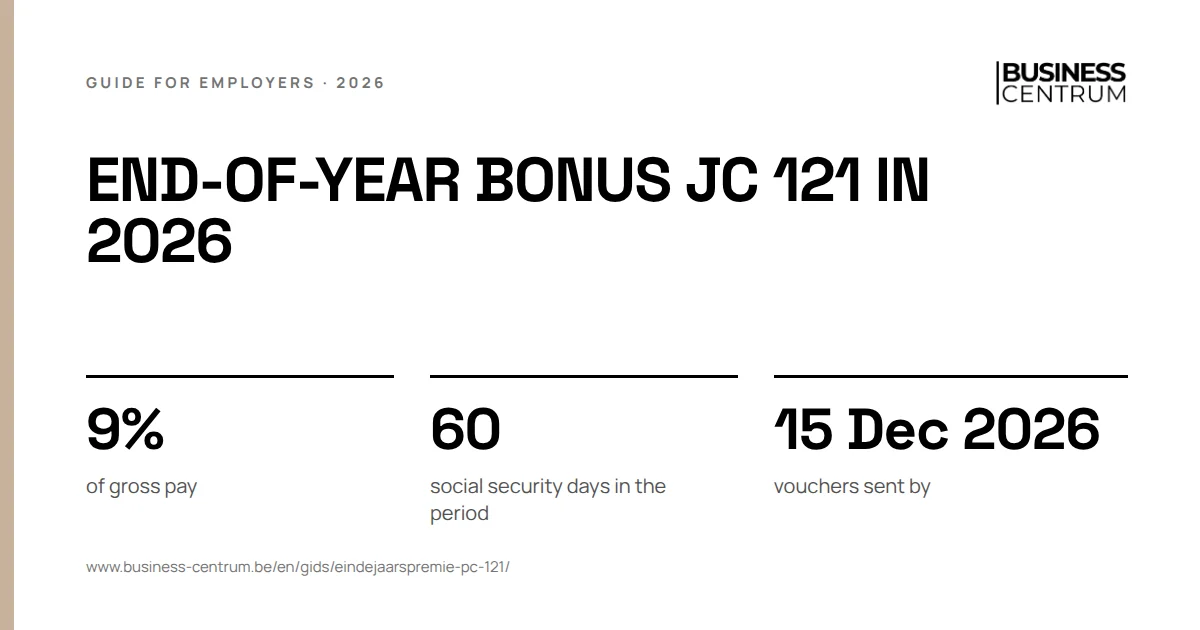
The end-of-year bonus in JC 121 is 9% of the gross pay declared to social security for the reference period, and it is not you but the Social Fund for cleaning companies that pays it, from December. For the 2026 bonus that period runs from 1 July 2025 to 30 June 2026.
Who gets the end-of-year bonus in JC 121?
The agreement applies only to blue-collar workers, male and female, regardless of age. White-collar employees of a cleaning company do not fall under this scheme. The committee covers, among others, regular and special cleaning, waste collection, window cleaners, car washes, chimney sweeping and industrial cleaning. The exact activities and categories are in our guide to joint committee 121.
A worker is entitled to the bonus if he meets one of two conditions during the reference period:
- At least 60 social security or assimilated days of service in the sector. The agreement counts the days in the sector, not with one particular employer.
- A minimum gross pay that the agreement sets as an alternative, linked to the minimum wage of category 1A.
Three groups are exempt from these conditions, provided they were entitled to the bonus for the previous year: pensioners who stopped all work in the sector, early retirees and older unemployed, and workers dismissed for economic reasons.
If a worker under 21 does not meet the conditions, he may add his voucher without entitlement to the voucher of the next reference period. Together they must then reach the threshold of the second year.
Calculating the JC 121 end-of-year bonus
The formula is in the agreement word for word: the gross bonus is 9% calculated on the gross pay declared to social security for the reference period. The agreement has no maximum in weeks of pay, no twelfths and no separate rule for part-time workers: the percentage applies to the declared gross pay.
Two assimilations widen the base:
- Sickness. 63.16% of the pay lost through sickness is assimilated. According to the fund, this applies to sick days under code 50, for at most 1 year per illness.
- Maternity rest. Maternity rest is assimilated for at most 114 days per maternity rest, if there were actual working days during the reference period.
From the gross amount, the fund deducts 13.07% social security, calculated on the gross at 108%, and 23.22% withholding tax.
Worked example: a full-time cleaner
This is an example, not a calculation for your situation. A worker has € 28,000 gross pay declared to social security for the reference period, with no sickness. The gross bonus is 9% x 28,000 = € 2,520 gross. The fund calculates social security on 108% of that amount: 2,520 x 1.08 x 13.07% = € 355.71. Then comes the withholding tax of 23.22%. More on the difference between gross and net is in our guide to calculating the end-of-year bonus.
When does the fund pay the JC 121 end-of-year bonus?
The agreement says the fund pays the bonus from the month of December of the year it relates to. The fund follows a fixed order:
- At the end of October the worker receives a letter with the calculation of his bonus and a request to check his account number.
- Between 10 December 2026 and 15 December 2026 at the latest the fund sends the payment vouchers. A voucher has three parts: one for the fund, one for the union and one for the worker, which replaces the tax form.
- In early December the bonus is paid. A worker who is a union member receives it through his union. A worker without a union receives it directly from the fund.
A worker who joined the sector after 30 June of the previous year and receives a bonus for the first time still gets a voucher by post in early December. The same applies if two unions both claim the worker as a member. A worker without a union writes his account number on the voucher, signs it and sends it to the fund.
No payment voucher is issued if the bonus does not reach € 5. The right to the bonus lapses 42 months after the end of the reference period.
End-of-year bonus JC 121 on dismissal or leaving
The agreement has no separate rules for dismissal by the employer, resignation, dismissal for serious misconduct or the end of a fixed-term contract. The conditions are the same for everyone: 60 social security or assimilated days in the sector, or the minimum gross pay, during the reference period. The bonus is a percentage of the gross pay declared to social security in that period.
The agreement only makes an exception for three groups: those who retire, those who take early retirement or the older unemployed scheme, and those dismissed for economic reasons. They are exempt from the condition of days or minimum pay if they were entitled to the bonus for the previous year.
What you do as an employer
You do not pay the end-of-year bonus yourself. It does rest on your declaration. The agreement calculates the bonus on the gross pay declared to social security, the condition of 60 days counts social security or assimilated days, and for the sickness assimilation the fund takes the sick days under code 50. Whatever is missing from your declaration is therefore also missing from the bonus base.
Three points need attention:
- All pay. The bonus is 9% of gross pay as declared to social security.
- All days. They decide whether a worker reaches the threshold of 60 days.
- Sick days. The partial assimilation of 63.16% of lost pay starts from the declared sick days.
Can your own scheme replace the end-of-year bonus?
The agreement calls its provisions minimum benefits that leave more favourable arrangements in companies fully intact. A more favourable scheme in your company therefore continues to apply. The agreement says nothing about converting the bonus into another benefit.
Mistakes we see with the JC 121 end-of-year bonus
- Thinking the employer pays. In JC 121 the Social Fund pays.
- Including white-collar staff. The fund's scheme applies only to blue-collar workers.
- Ignoring the letter at the end of October. It contains the calculation, and your worker uses it to check his account number.
- Dropping sickness entirely. 63.16% of the lost pay counts, provided it is declared correctly.
What Business Centrum does for you
Business Centrum handles the payroll of cleaning companies together with Acerta. That payroll covers the right category per worker and the declaration of days, pay and sickness on which the fund calculates the bonus. The rules of the other committees are in our overview of the end-of-year bonus in 2026 by joint committee.