
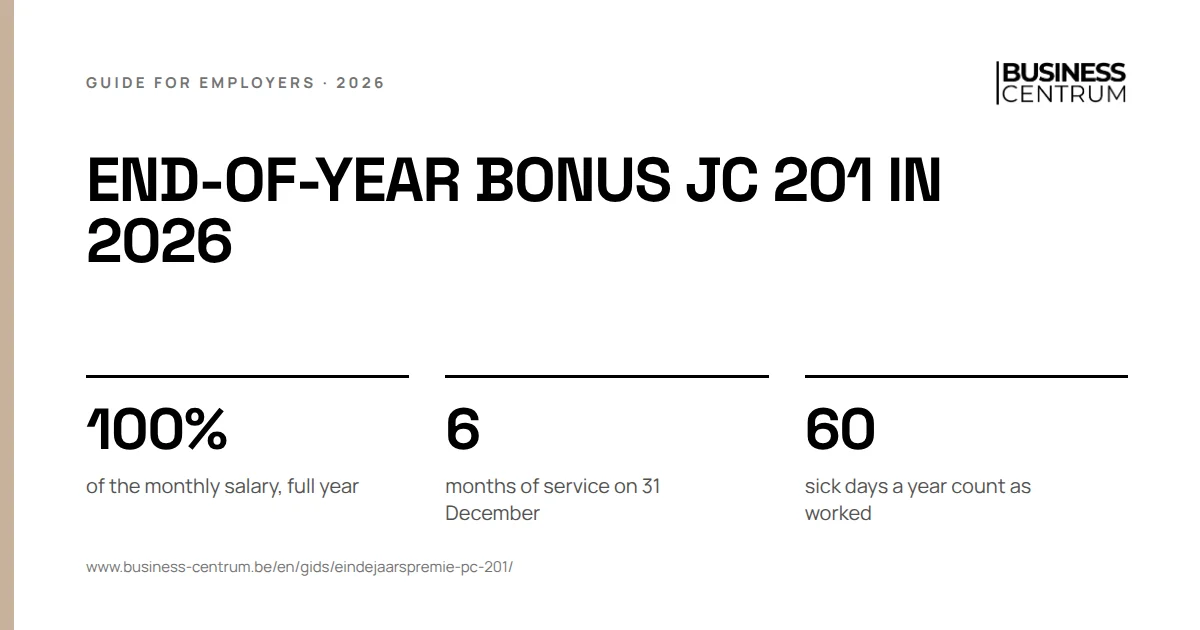
The end-of-year bonus JC 201 is one full monthly salary for an employee who worked the whole year in your shop, and you pay it yourself as the employer between 15 December 2026 and 31 December 2026. The employee is entitled if he is on the payroll on 31 December 2026 and has at least 6 months of service by then. Anyone who started later or left earlier gets a bonus based on days worked and days treated as worked.
Who is entitled to the end-of-year bonus in JC 201?
Joint committee 201 covers the white-collar employees of retail businesses that do not fall under the committees for large retail businesses, department stores or food chains with many branches. The collective agreement on the end-of-year bonus applies to the employers and white-collar employees of those businesses. Blue-collar workers are not covered. If you are not sure whether your shop falls under JC 201, first read our guide on joint committee 201.
An employee is entitled to the end-of-year bonus if he meets two conditions:
- On the payroll on 31 December of the reference year. For 2026, that is 31 December 2026.
- At least 6 months of service in the company on that same date.
An employee who started on 1 September 2026 does not have 6 months of service on 31 December. The sector agreement gives him no bonus for 2026. Separate rules apply to anyone who leaves before the payment, further down this page.
End-of-year bonus JC 201 calculation
The agreement distinguishes two groups:
- An employee who worked the whole reference year in the company gets 100% of the monthly salary. The minimum monthly salary per category is in the JC 201 pay scale.
- Another employee with at least 6 months of service on 31 December gets a bonus "based on the days actually worked and treated as worked".
Which pay you take as the basis depends on how the employee is paid:
- Fixed pay: the bonus is calculated "on the basis of the average of the pay actually received for all work performed in the year concerned". If the salary changed during the year, for example through indexation, you start from that average and not from the December salary.
- Branch managers and employees paid wholly or partly on commission: the bonus is calculated on the monthly average of the fixed and variable gross pay paid during the year.
The agreement has no separate rule for part-time employees. It starts from the pay the employee actually received. It also sets no divisor for the bonus based on days: it does not say whether you calculate per day, per week or per month. Choose a method and apply it the same way to everyone.
Worked example: an employee who worked the whole year
This is an example, not a calculation for your situation. A full-time shop assistant has worked for you for three years. Throughout 2026 she earned a fixed salary of € 2,400 gross a month, without change. She worked the whole reference year and was not absent apart from her holidays. Her end-of-year bonus is 100% of her monthly salary: € 2,400 gross, to be paid between 15 December 2026 and 31 December 2026.
Which absences count for the end-of-year bonus in JC 201?
Since 1 January 2024 you may not reduce the bonus for these absences:
| Absence | Reduces the bonus |
|---|---|
| Annual holidays and public holidays | no |
| Days of inactivity set in a collective agreement | no |
| Leave for compelling reasons | no |
| Occupational disease and accident at work | no |
| Sickness or accident, maternity leave, and paternity leave of a worker whose wife cannot take maternity leave | not up to 60 days a year |
Up to the end of 2023, the agreement only counted the first 30 days of sickness or accident. Anyone still using that old limit reduces the bonus too early.
Temporary unemployment is not on the list. The agreement does not say that it counts, nor that it does not.
For an employee who is absent at the time of payment because of time credit, palliative leave, leave to care for a seriously ill family member or parental leave, a separate rule applies: the bonus is prorated according to the number of months actually worked.
End-of-year bonus JC 201 on dismissal or leaving
The agreement also entitles an employee who leaves the company before the bonus is paid in December to an end-of-year bonus. That bonus is calculated on the days actually worked and treated as worked in the reference year, provided he has at least 6 months of service in the company when he leaves. The agreement makes two exceptions.
| Situation | End-of-year bonus |
|---|---|
| Dismissal by the employer, not for serious cause | yes, with 6 months of service when leaving |
| Termination by mutual agreement | yes, the agreement names this case explicitly |
| Retirement or early retirement | yes, the agreement names this case explicitly |
| Resignation by the employee | no |
| Dismissal for serious cause | no |
| End of a fixed-term contract | the agreement does not name this case separately |
| Unemployment with company supplement (SWT) | the agreement does not name this case separately |
For the end of a fixed-term contract or SWT, the agreement therefore has no separate rule. It only contains the general rule for anyone who leaves before the payment, with the two exceptions above. Include the bonus in the final settlement at every departure and on the social documents on dismissal.
When do you pay the end-of-year bonus in JC 201?
The bonus is due and must be paid at the latest between 15 December 2026 and 31 December 2026. No social fund pays the bonus: it is part of the December payroll of your own company.
On the bonus you withhold 13.07% personal social security, then withholding tax under the scale for exceptional payments. Without dependent children, that withholding tax is zero up to a normal gross annual salary of € 10,675, 40.38% between € 26,340 and € 31,830, and 53.50% above € 59,900. As the employer, you pay the basic contribution of 25% on the gross amount. The full calculation from gross to net is in our explanation on calculating the end-of-year bonus.
Can your own scheme replace the end-of-year bonus in JC 201?
The sector agreement does not apply in two cases:
- the company grants an advantage that is at least equivalent during the year, whatever its name, as a contractual bonus or as a gift;
- the company sets the pay and working conditions of its employees itself in a company agreement, and the advantages of that agreement taken together are at least equal to those of the sector agreement.
A more favourable own scheme therefore remains in force. A less favourable one does not replace the sector agreement. The agreement provides no conversion of the end-of-year bonus into other advantages.
End-of-year bonus or annual bonus in JC 201?
Do not confuse the end-of-year bonus with the annual bonus of JC 201. That is a separate bonus from an agreement of 2017: € 188 gross for a full-time employee with a full reference period, paid with the August salary. The reference period runs from August of the previous year up to and including July. Companies that give an equivalent advantage through meal vouchers do not pay it. The annual bonus comes on top of the end-of-year bonus and does not replace it.
Mistakes we see with the end-of-year bonus in JC 201
- Using the old sickness limit. Since 2024, 60 days of sickness or accident a year count as worked, no longer 30.
- Taking the December salary when fixed pay changed. The agreement refers to the average of the pay actually received during the year.
- Paying nothing on a dismissal during the year. If you dismiss an employee with at least 6 months of service, part of the bonus belongs in the final settlement.
- Paying on resignation. If the employee resigns, no bonus is due under the sector agreement. An own scheme in your company may provide otherwise.
- Postponing payment to January. The bonus must be paid at the latest between 15 December 2026 and 31 December 2026.
What Business Centrum does for you
Business Centrum calculates the end-of-year bonus of your employees under this agreement, together with Acerta, as part of your payroll administration. We include the bonus in the December payroll and in the final settlement when an employee leaves. The rules of the other committees are in our overview of the end-of-year bonus in 2026 per joint committee.