
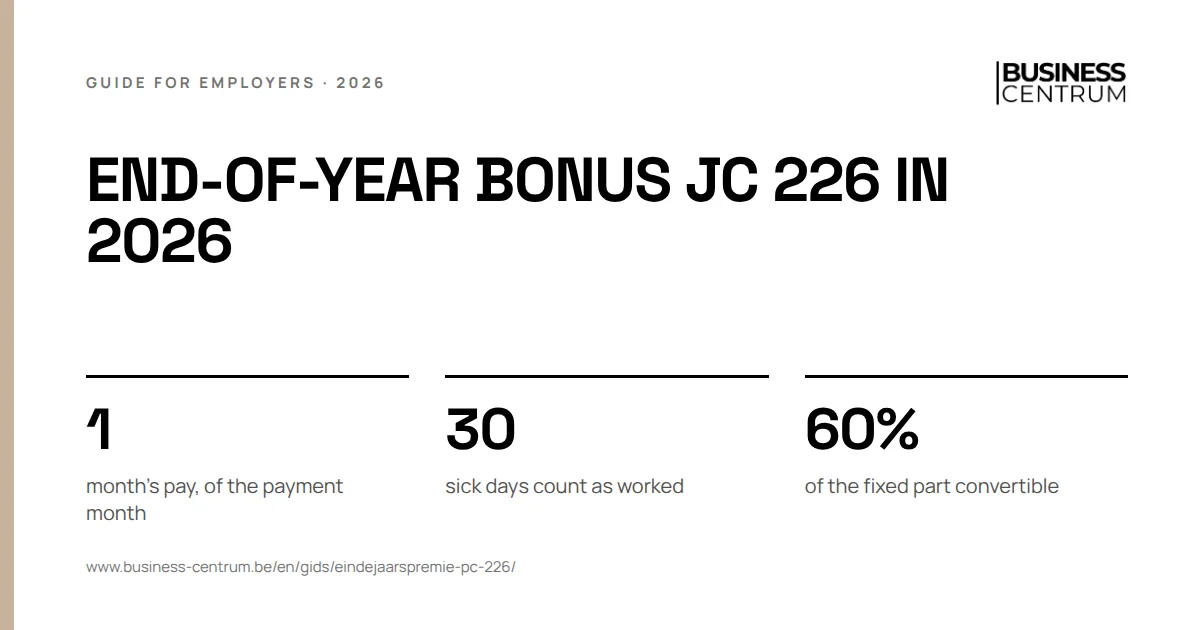
The end-of-year bonus in JC 226 is an annual bonus equal to the pay for the month in which you pay it, and you pay it yourself as the employer, at the end of the year. Someone who did not actually work the whole year receives 1/12 of the bonus per full month of actual work. The collective agreement calls it the annual bonus, and also the end-of-year bonus in the article on conversion.
Who gets the end-of-year bonus in JC 226?
The scheme applies to the white-collar staff of companies under the Joint Committee for employees in international trade, transport and logistics. Whether your staff belong there and which pay scales apply is in our guide to joint committee 226. Your drivers and warehouse staff, as blue-collar workers, usually fall under subcommittee 140.03 and receive their bonus from the SFTL; see the end-of-year bonus JC 140.
An employee is entitled to the full bonus if he meets two conditions at the same time:
- Employed on the payment date. He is still employed on the day you pay the bonus. For someone who leaves earlier, a separate list of cases applies, further down this page.
- Actually worked the whole reference year. Absences treated as worked count as worked.
The collective agreement sets no minimum length of service for someone employed on the payment date. A minimum of 6 months only matters when someone leaves before the payment date.
How much is the end-of-year bonus in JC 226?
The bonus equals 1 month's pay: the pay for the month in which you pay it. If you pay in December, December's salary is the yardstick. A pay rise or promotion during the year therefore counts in full. The minimum monthly salary per category is in the JC 226 pay scale.
For employees with variable pay, the collective agreement gives two rules:
- Fixed and variable part. The bonus is the fixed part for the payment month, plus the monthly average of the variable parts paid in the 12 months before the payment month. Variable pay is everything that is not fixed, is subject to social security contributions and was granted regularly and continuously throughout the reference year.
- Fully variable pay. The bonus is the monthly average of the pay for the 12 months before the payment month.
If an employee switches during the reference year from full-time to part-time, or the other way round, or from one part-time scheme to another, the bonus is the sum of his monthly salaries for the reference year divided by twelve. The annual bonus, double holiday pay and variable elements not granted regularly and continuously are left out. For an employee who works the whole year in the same part-time scheme, the bonus is simply his part-time monthly salary for the payment month.
Worked example: an employee who started in April
This is an example, not a calculation for your situation. An employee earns € 3,200 gross a month and started on 1 April 2026. You pay the bonus at the end of December and he is still employed. He has nine full months of actual work: 3,200 x 9/12 = € 2,400 gross.
A colleague with a fixed salary of € 2,800 and a variable part that averaged € 300 a month over the last 12 months worked the whole year. His bonus is 2,800 + 300 = € 3,100 gross.
Reference year and payment of the end-of-year bonus JC 226
Unless something else applies in your company, the reference year coincides with the calendar year and you pay the bonus at the end of the year. The collective agreement sets no fixed day. A rule at company level can choose a different reference year and payment date. Put that in writing, because the condition "employed on the payment date" depends on that date.
The bonus goes through the ordinary payroll calculation. You withhold 13.07% personal social security and pay the employer contribution, with a basic rate of 25%. Withholding tax follows the scale for exceptional payments: for example 40.38% for a normal annual salary between € 26,340 and € 31,830. What that leaves net, you can check with our page about calculating the end-of-year bonus.
Which absences count for the end-of-year bonus in JC 226?
An employee who did not actually work the whole year receives 1/12 per full month of actual work. A long list of absences counts as actual work:
| Absence | Counts for the bonus |
|---|---|
| Annual holidays, public holidays, short leave | in full |
| Paid educational leave and Flemish training leave, union leave | in full |
| Occupational disease, workplace accident, accident on the way to or from work | in full |
| Temporary unemployment | in full |
| Maternity leave, birth leave, prophylactic leave | in full |
| Palliative leave taken as thematic leave | in full |
| Adoption leave | 3 days |
| Sickness or non-work accident | the first 30 days |
In JC 226, temporary unemployment counts without a limit. For sickness, the assimilation stops after 30 days. The collective agreement counts per full month; it does not say how to treat a month that is partly assimilated and partly not. Choose a method, apply it equally to everyone and record it.
End-of-year bonus JC 226 on dismissal or leaving
If the contract ends before the payment date, the employee receives 1/12 per full month of actual work, but only in the cases the collective agreement lists:
| Situation | Entitled to a pro rata bonus |
|---|---|
| Dismissal by the employer | yes, except for serious cause or an end in the first 6 months |
| Resignation by the employee | yes, except for an end in the first 6 months |
| End due to force majeure | yes, except for an end in the first 6 months |
| End by mutual agreement | yes, except for an end in the first 6 months |
| Dismissal for serious cause | no |
The 6 month period is reduced by uninterrupted periods of agency work in your company, if they were in the same job and immediately preceded the contract without a break.
The end of a fixed-term contract, retirement, unemployment with company top-up and death are not in this list. The sector agreement provides no pro rata for those cases. A more favourable scheme in your company or in the employment contract remains possible.
Example. An employee on € 3,000 a month, employed for three years, resigns and leaves on 30 September. He receives 3,000 x 9/12 = € 2,250 gross. The collective agreement does not say when you pay that amount. Had he been employed for only four months when he resigned, the sector agreement would have given him no bonus.
Converting the end-of-year bonus JC 226 into another benefit
Since 2026 you may convert up to 60% of the fixed part of the bonus into an equivalent benefit. Until the end of 2025 the limit was 50%. Three conditions apply together:
- the conversion is set out in a company collective agreement and in an individual agreement with the employee;
- employer and employee both do it voluntarily;
- the employees are informed in advance about the conversion and its consequences.
The unions commit to cooperate constructively if the company decides on such a conversion. You pay the remaining part as an ordinary bonus.
Mistakes we see with the end-of-year bonus in JC 226
- Taking the wrong monthly salary. The yardstick is the payment month, not an average over the year and not January's salary.
- Forgetting the variable part. Commissions and other regular variable elements are included through the monthly average.
- Deducting all sick leave. The first 30 days of sickness or accident count as worked, temporary unemployment in full.
- Treating resignation as an exclusion. Someone who resigns after the first 6 months is entitled to his pro rata share.
- Converting without a company collective agreement. An individual agreement alone is not enough.
What Business Centrum does for you
Business Centrum calculates the end-of-year bonus of your white-collar staff under this collective agreement, together with Acerta, as part of payroll. We track the absences treated as worked and the variable pay, and include the pro rata share in the final settlement when someone leaves. The rules of the other committees are in our overview of the end-of-year bonus in 2026 by joint committee.