
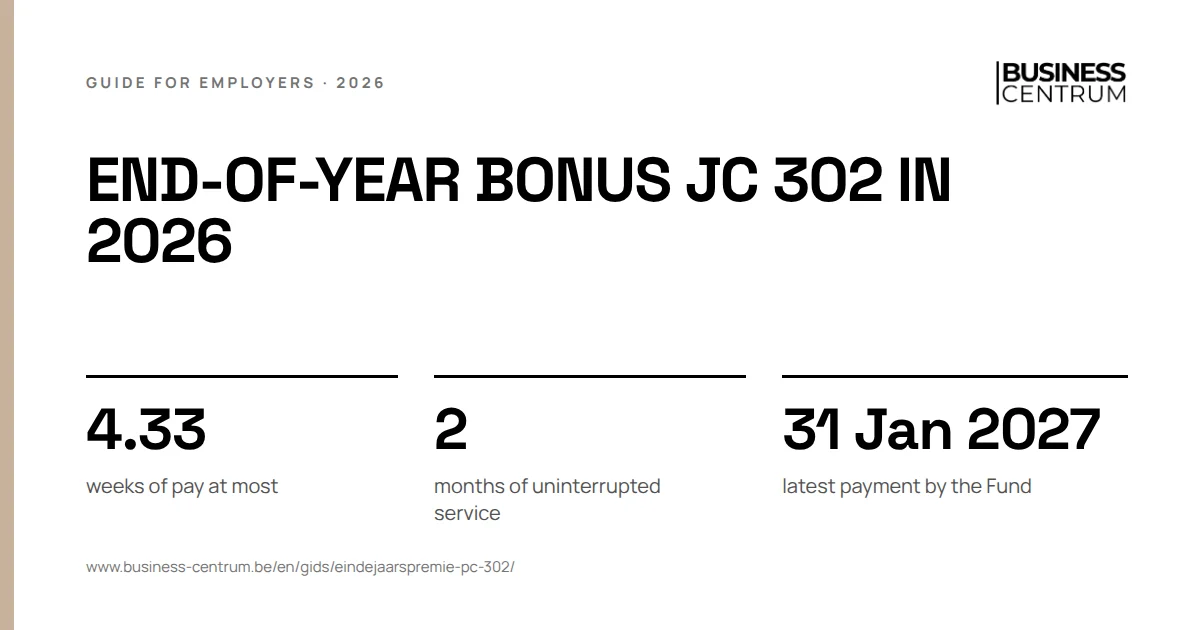
The end-of-year bonus in JC 302 is at most 4.33 weeks of pay for a full year, and it is not you but the Horeca Guarantee and Social Fund that pays it, by 31 January 2027 at the latest. You finance the bonus with a monthly advance to the Fund and, after the year, declare the gross bonus of each worker.
Who gets the end-of-year bonus in JC 302?
The collective agreement applies to employers and workers of all companies under the Joint Committee for the hotel industry: blue-collar and white-collar, full-time and part-time, and extras. Which businesses fall under the committee is explained in our guide to joint committee 302.
Entitled to the bonus:
- A full-time or part-time worker bound by an employment contract for at least 2 uninterrupted months during the calendar year. That period may span two calendar years; the rights then build up from the second year.
- An extra who works for the same employer in interrupted periods and performs at least 44 working days during the calendar year, however long those days are.
Students who only pay the solidarity contribution fall outside the agreement, but only in establishments that use a registered cash system. A fixed-term contract that ends on the agreed date keeps the right if the condition of 2 months or 44 days is met.
The reference period is the calendar year. The 2026 bonus covers 1 January 2026 to 31 December 2026.
Calculating the JC 302 end-of-year bonus: the maximum
The maximum equals 4.33 weeks of pay. Pay means the hourly, weekly, flat daily or monthly wage of December. For a worker who leaves during the year, the wage at the time of leaving applies. The Fund does not include pay supplements such as the Sunday premium.
| Pay method | Maximum end-of-year bonus |
|---|---|
| Fixed hourly wage, 38-hour week | 164.67 x hourly wage |
| Fixed hourly wage, 39-hour week | 169 x hourly wage |
| Fixed hourly wage, 40-hour week | 173.33 x hourly wage |
| Service percentage, five-day week | 21.67 x flat daily wage |
| Service percentage, six-day week | 26 x flat daily wage |
| White-collar employee | 100% of the monthly salary |
How many twelfths does your worker get?
A worker who was not present for the full year receives one twelfth of the maximum per block of attendance. Assimilated days count as attendance.
- Full-time: one twelfth per 21.67 days in a five-day week, per 26 days in a six-day week and per 17.33 days in a four-day week.
- Part-time: one twelfth per block of average weekly working hours x 52 weeks divided by 12 months. You calculate the maximum on the part-time worker's own weekly wage.
- Extras: you divide the hours worked in the year by 8 to get days, and give one twelfth per 21.67 days. The maximum is the last hourly wage x 173.33, or with a service percentage the last flat daily wage x 21.67.
For full-time and part-time workers there is a floor: the number of twelfths is never lower than the number of full calendar months actually worked or assimilated.
Worked example: a cook who started on 1 July
This is an example, not a calculation for your situation. A full-time cook in a 38-hour week earns € 17.00 gross per hour in December. The maximum is 164.67 x 17.00 = € 2,799.39. He started on 1 July 2026 in a five-day week and has 130 worked and assimilated days up to the end of December. 130 divided by 21.67 gives 6 full blocks, so 6/12 of the maximum: € 1,399.70 gross. How to get from there to net pay and your cost is explained in our guide to calculating the end-of-year bonus. The minimum hourly wage per category is in the JC 302 pay scale.
Which absences count for the JC 302 end-of-year bonus?
The agreement lists the assimilated days exhaustively. The main ones:
| Absence | Counts for the bonus |
|---|---|
| Statutory holidays, paid public holidays, compensatory rest for reduced working time, extra-statutory leave under a collective agreement | fully |
| Temporary unemployment | fully |
| Short leave, educational leave, civic duties, strike or lock-out | fully |
| Birth leave under the Employment Contracts Act | 10 days |
| Maternity rest | assimilated |
| Union or worker training | at most 12 days per year |
| Short illness with a medical certificate | 7 calendar days per year |
| Illness of at least 6 months | at most 6 months, at 50% |
| Partial incapacity after temporary total incapacity, recognised at at least 66% | the first 12 months |
For short illness, a worker with more than 1 year of seniority keeps his 7 assimilated days even if he was ill more often during the year, until he reaches 6 months of uninterrupted incapacity. A long illness may span two calendar years, and within an incapacity of more than one year you apply the assimilation only once.
Note for 2026. For the reference years 2024 and 2025, an absence justified under the Employment Contracts Act was enough. That rule applied to those two years only. For the 2026 bonus, a short illness only counts with a medical certificate.
End-of-year bonus JC 302 on dismissal or leaving
| Situation | Right to the bonus |
|---|---|
| Dismissal by the employer, even if the worker gives counter-notice | yes, if the condition of 2 months or 44 days is met |
| Dismissal by the employer without that condition | yes, after 3 years without interruption in the same company |
| Dismissal for serious misconduct | no |
| Resignation by the worker for serious misconduct by the employer | yes, on the same conditions as a dismissal by the employer |
| End due to medical force majeure confirmed by a certificate | yes, if the condition is met |
| End of a fixed-term contract on the agreed date | yes, if the condition is met |
| Resignation | no, except in the four cases below |
| Full-time unemployment with company supplement at the employer's initiative | one twelfth per month worked, plus 20% of the remaining amount for the months after |
| Death | assimilation until 31 December, at most 6 months |
A worker who resigns keeps the bonus if he resigns on 31 December at the end of his shift, if his notice period worked ends on 31 December or later, if you release him from a notice period ending on 31 December or later, or if he leaves on statutory or early statutory retirement. The agreement does not deal separately with termination by mutual consent. The Fund's social guide treats it as leaving voluntarily, so in principle without a bonus.
If a worker with a right to the bonus leaves during the year, you declare that bonus before the end of the month following the month in which the contract ended.
What you do as an employer with the Horeca Fund
The Fund's statutes are set by collective agreement 144844/CO/302 of 20 December 2017. They give you three tasks.
- Monthly advance. Each month, by the 15th of the following month at the latest, you pay 12% of the gross payroll on which the previous month's social security contributions were calculated. For blue-collar workers that is 108% of the gross payroll, for white-collar employees 100%. This payment is separate from your social security contributions.
- Annual declaration. You declare each worker's gross bonus by 10 January 2027 at the latest, via the portal or in XML. If nobody is entitled, you file a nil declaration. Without a declaration you owe flat-rate damages of € 495.
- Check the control statement. Before payment you receive an overview per worker. You have 10 calendar days to correct it. After that the amount is final.
The Fund deducts 13.07% personal social security, and bonuses from a social security fund carry 23.22% withholding tax. It pays the net bonus into the account the worker has given himself. Whatever remains of your advances after payment, the Fund refunds by 31 May 2027 at the latest.
After 3 years of regular advances you can ask for an exemption from the monthly payment. You then pay in one go before the declaration date, plus an interest contribution.
Can your own scheme replace the end-of-year bonus in hospitality?
The agreement keeps the more favourable conditions that already exist in some companies. It says nothing about converting the bonus into another benefit. A related rule sits in the committee's minimum wages: with a company agreement you may count other cash pay components to reach the minimum wage, but never the end-of-year bonus.
Mistakes we see with the JC 302 end-of-year bonus
- Counting a short illness without a certificate. For 2026 the medical certificate is required again.
- Putting the Sunday premium into the maximum. The maximum rests on the basic December wage.
- Forgetting the declaration after a dismissal. The deadline runs to the end of the month after the contract ended, not to January.
- Not converting the hours of extras. Divide the hours worked by 8 before counting the blocks.
What Business Centrum does for you
Business Centrum processes the payroll of hospitality businesses together with Acerta, as a social secretariat for hospitality. That payroll covers the advances to the Fund, the assimilated days per worker and the gross bonus you declare to the Fund. The rules of the other committees are in our overview of the end-of-year bonus in 2026 by joint committee.