
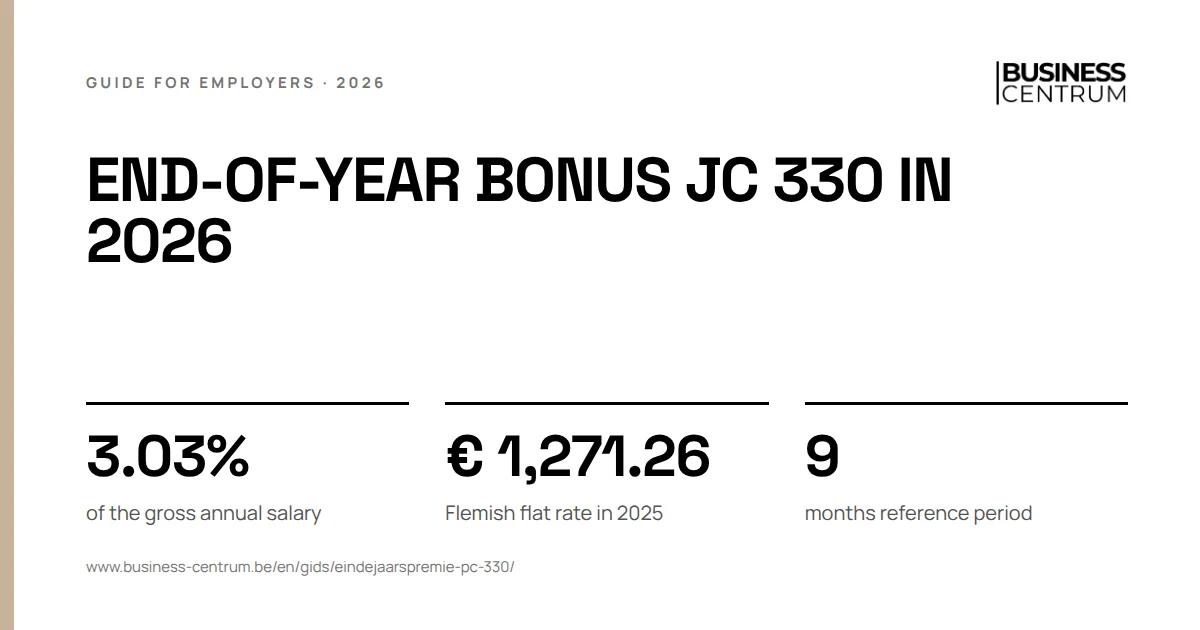
The end-of-year bonus in JC 330 consists of an indexed flat-rate amount plus 3.03% of the gross annual salary, and you as the employer pay it yourself, at the latest in December. That applies both in the federal private care sectors, such as hospitals and home nursing, and in the Flemish sectors, such as residential care centres. Each sector does have its own collective agreement with its own flat rate.
Which employers fall under the end-of-year bonus JC 330?
Joint committee 330 is large and fragmented. This page covers the two schemes that affect most employers in Flanders. They apply to blue-collar and white-collar workers.
| Scheme | Sectors |
|---|---|
| Federal collective agreement no. 173231/CO/330 | hospitals, forensic psychiatric centres, rehabilitation centres with an RIZIV agreement that remained federal, home nursing, the blood services of the Red Cross, medical-paediatric centres and community health centres |
| Flemish collective agreement no. 196670/CO/330 | categorical hospitals, residential care centres and rest and care homes, day care centres, assisted living facilities, short-stay centres, psychiatric care homes, sheltered housing initiatives, Flemish rehabilitation centres, multidisciplinary support teams and palliative care networks |
The federal agreement explicitly excludes the categorical hospitals, the psychiatric care homes and sheltered housing: they follow the Flemish agreement if your institution falls under the Flemish Community or the Flemish Community Commission in Brussels. Doctors do not fall under the federal agreement, except doctors in a community health centre. The Flemish agreement of 17 November 2025 was amended on 8 December 2025 by agreement no. 197232/CO/330, which added the palliative networks and teams to its scope.
How much is the end-of-year bonus JC 330 in 2026?
Both agreements use the same formula: an indexed flat-rate part, increased by a percentage part of 3.03% of the indexed gross annual salary. That annual salary is 12 times the scale gross salary the employee receives for October, with the household or residence allowance if there is one. Other bonuses, supplements and allowances do not count.
The difference lies in the flat rate:
| Federal sectors | Flemish sectors | |
|---|---|---|
| Percentage part | 3.03% of the annual salary | 3.03% of the annual salary |
| Flat-rate part, last amount named in the agreement | € 1,057.56 plus € 400, 2022 amounts | € 1,271.26, 2025 amount |
| Additional flat-rate part | none | € 480.83, 2025 amount |
| Increased bonus since | 1 January 2022 | 1 January 2025 |
The flat rate is adjusted every year. You take last year's flat rate and multiply it by the index figure of October of this year, divided by the index figure of October of last year. For 2026 the amount therefore depends on the October 2026 index, which had not yet been published at the time of writing. That is why this page gives no flat rate for 2026, and no calculation of its own either. For the federal sectors, the agreement only names the 2022 amounts; the indexed amounts for the years after that appear in no agreement.
The increase of € 400 comes from agreement no. 174729/CO/330 of 13 June 2022 and has been indexed along with the rest since 2022. It does not apply to doctors, except in the community health centres. Since 2022, the federal bonus has been the merger of the former attractiveness bonus and end-of-year bonus. The Flemish agreement of 2025 aims to bring the Flemish bonus to the same level as the federal one.
Worked example: a care assistant in a Flemish residential care centre
This is an example, not a calculation for your situation. A care assistant works full time and earns € 3,200 gross in October 2026 under her pay scale. She worked the full reference period.
- Gross annual salary: 12 x 3,200 = € 38,400.
- Percentage part: 3.03% of € 38,400 = € 1,163.52.
- Flat-rate parts: in 2025 these were € 1,271.26 and € 480.83. For 2026 both amounts will come out higher after the October 2026 index adjustment.
If the same care assistant had worked only six of the 9 months of the reference period, she gets six ninths of the full bonus: for the percentage part that is 1,163.52 x 6/9 = € 775.68, plus six ninths of the flat rate.
Reference period and pro rata in JC 330
The reference period runs from 1 January to 30 September inclusive of the year of payment, so 9 months. Each month worked or treated as worked gives a right to one ninth of the bonus.
- Full bonus. The employee who received, or would have received, his full salary during the whole reference period gets the full bonus.
- What counts as a month. An engagement that starts before day 16 of the month counts as a month. Someone who starts on the tenth therefore gets that month included.
- Starting or leaving during the period. The bonus is set pro rata to the work performed or treated as worked in the reference period.
- Part-time employees. The bonus is calculated pro rata to the contractual working time the employee performed or would have performed in the reference period.
There is no minimum length of service and no condition to be employed on a specific date. The agreement makes no distinction between blue-collar and white-collar workers.
Which absences count for the end-of-year bonus JC 330?
The periods that the annual holiday rules treat as equivalent to work count as worked. For this, the agreement refers to the royal decree on annual holidays and does not list them itself. How many days of sickness or maternity leave count therefore follows from those holiday rules and not from the agreement.
The agreement does regulate one absence itself: temporary unemployment. An employee who was temporarily unemployed during the reference period keeps that period as treated as worked, however long it lasted. The principle is that the employee suffers no additional financial loss on top of the temporary unemployment.
No bonus is due for:
- work under a student contract;
- work under a replacement contract, for the part of the reference period for which the replaced employee gets the bonus himself;
- in the Flemish sectors: work during a probationary period that was ended.
End-of-year bonus JC 330 on dismissal or leaving
Both agreements give a bonus pro rata to the work in the reference period when someone leaves. They make no distinction according to how the contract ends, with one exception.
| Situation | Right to a pro rata bonus |
|---|---|
| Dismissal by the employer | yes |
| Resignation or end by mutual agreement | yes, the agreement sets no length-of-service condition |
| End of a fixed-term contract | yes |
| Retirement or unemployment with company top-up | yes, the agreement does not regulate these cases separately |
| Dismissal for serious misconduct | no |
| Flemish sectors: in a probationary period at the time of payment | no |
You then pay the bonus in the month the employee leaves, together with the final settlement. An employee who leaves on 30 June after a full first half-year has six months worked in the reference period and gets six ninths. Include the amount on the social documents at dismissal.
When do you pay the end-of-year bonus in JC 330?
You pay the bonus in one go, at the latest in December of the same year, or in the month the employee leaves. There is no social fund that pays out the bonus: the employer pays through the payroll. The bonus goes through the payroll calculation, with 13.07% employee social security and withholding tax under the scale for exceptional payments. On top of the gross amount comes the employer contribution, with a base of 25%. How to go from gross to net and to the total cost is explained in end-of-year bonus calculation.
The government funds the increases. The agreements say that the increase of € 400 in the federal sectors and the additional flat rate in the Flemish sectors can only be granted insofar as the competent government covers the costs on a recurrent basis. In the Flemish sectors, the Flemish Department of Care (Departement Zorg) pays the facilities a compensating amount every year, at the latest in March of the year after the reference year. For this, employers report data to IF.IC vzw. For the additional part of 2025, that had to be done by 6 February 2026 at the latest. So you first pay your staff yourself and afterwards receive compensating funding for the increase.
Your own scheme and bike leasing in JC 330
A more favourable scheme that already exists in your institution, or that you introduce later, keeps applying. An employee who already gets an end-of-year allowance that is at least equivalent does not fall under the sector agreement. A less favourable scheme of your own does not replace the sector agreement.
The bonus can be converted into one single alternative benefit: bike leasing at the level of the institution. Only the conversion of the gross bonus including the employer's social security contribution is possible, under the sector bike agreement. The part you may convert each year is capped at what is needed for a lease cost of at most € 12,000 in the federal sectors and € 12,688.15 in the Flemish sectors, each time for a lease period of 3 years. For a shorter period a proportional part applies, and the cap is indexed.
Mistakes we see with the end-of-year bonus in JC 330
- Applying the wrong agreement. A psychiatric care home does not follow the federal hospital agreement but the Flemish agreement, with an additional flat rate.
- Copying last year's flat rate. The flat rate changes every year with the October index. Wait for that index before you set the December bonus.
- Composing the annual salary wrongly. Only the October scale salary and the household or residence allowance count, no other bonuses or supplements.
- Deducting temporary unemployment. It counts in full in the reference period.
- Paying nothing on resignation. The agreement gives a pro rata bonus in that case too.
What Business Centrum does for you
Business Centrum calculates the end-of-year bonus of your care staff under the agreement of your sector, together with Acerta, as part of your payroll administration. We check whether your institution falls under the federal or the Flemish agreement, adjust the flat rate as soon as the October index is known and include the bonus in the final settlement when someone leaves. The rules of the other committees are in our overview of the end-of-year bonus in 2026 per joint committee.