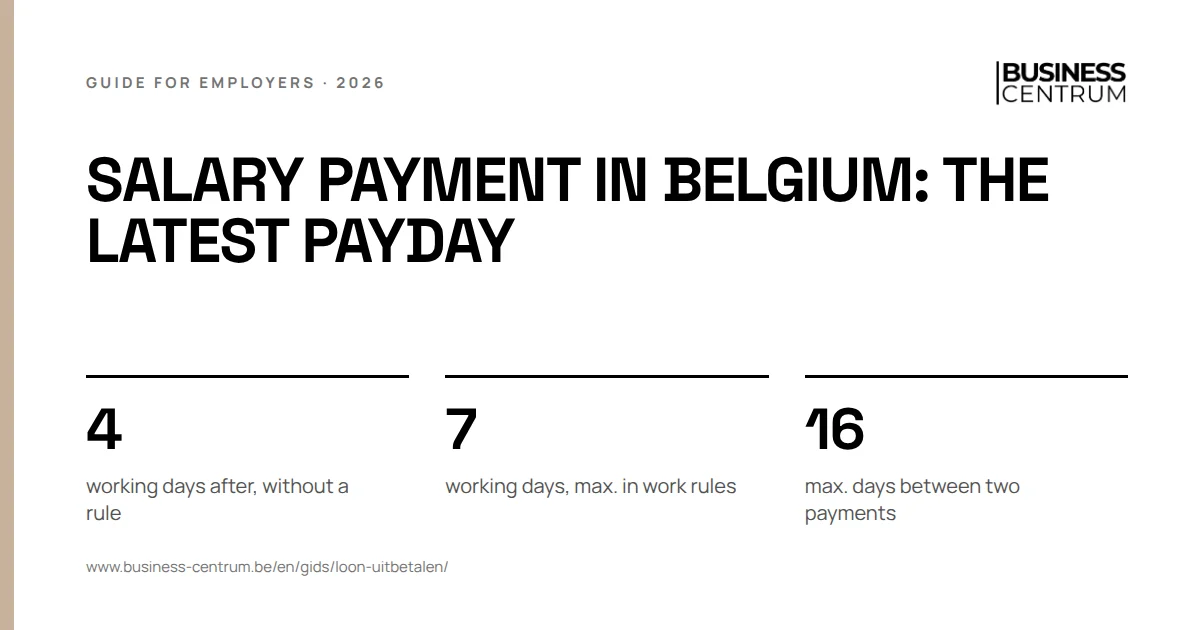
Salary payment in Belgium is due on the payday set by your collective agreement or your work rules and, without such a rule, no later than 4 working days after the work period. Work rules may not set the payday later than 7 working days after that period. Blue-collar workers are paid at least 2 times a month, white-collar employees at least once a month. On that day the money must be in the employee's account, not just have left yours. The basic rules come from the Act of 12 April 1965 on the protection of workers' wages, the Wage Protection Act.
Salary payment: the deadlines at a glance
| Situation | What the law requires |
|---|---|
| Payday set in a collective agreement | The day in the agreement, the law sets no final limit |
| Payday in the work rules | No later than working day 7 after the work period |
| No rule in an agreement or the work rules | No later than working day 4 after the work period |
| Blue-collar workers | At least 2 times a month, no more than 16 days apart |
| White-collar employees | At least once a month |
| Commission (not sales representatives) | At least every 3 months |
| End of the employment contract | Without delay, no later than the next payday |
These deadlines are in Articles 9 and 11 of the Wage Protection Act. The short answer to whether you may pay later than agreed is on may an employer pay wages later?. Below you read how the rules fit together, with a worked example for the December 2026 payday.
Salary payment date: collective agreement, work rules or the law
The law has three layers. The first one that says something sets your payday.
- A collective labour agreement. An agreement of your sector or your company can set the payday. The Federal Public Service Employment (FPS Employment) puts it this way: the law then sets no final date.
- The work rules. Without an agreement, the day in your work rules applies. That day may not be later than working day 7 after the work period you are paying for.
- The law itself. If no rule says anything, you pay no later than working day 4 after the work period.
The work rules must state how, when and where wages are paid. Article 6 of the Act of 8 April 1965 on work rules requires this. If your work rules still mention a day that no longer matches how you pay today, amend them using the proper procedure. Our guide on drawing up work rules explains how.
What is a working day? For wage payment, a working day is every day of the week except Sundays and public holidays. Saturday counts, even if your business is closed that day. There are 10 statutory public holidays a year. If a public holiday falls on a Sunday or a normal day of inactivity, you set a replacement day. According to the FPS, that replacement day has the status of a public holiday for your employees, so it does not count as a working day either.
Worked example: the latest payday after November 2026
You pay monthly and the work period is November 2026. It ends on 30 November 2026, a Monday.
| Working day after the period | Date |
|---|---|
| 1 | Tuesday 1 December |
| 2 | Wednesday 2 December |
| 3 | Thursday 3 December |
| 4 | Friday 4 December |
| 5 | Saturday 5 December |
| 6 | Monday 7 December (Sunday does not count) |
| 7 | Tuesday 8 December |
- No rule in an agreement or the work rules: the wage must be in the employee's account no later than 4 December 2026.
- Payday in the work rules: the rules may set the payday no later than 8 December 2026.
- Payday in a collective agreement: the day in the agreement, even if it is later.
When is salary paid in Belgium for blue-collar workers?
A blue-collar worker is paid at regular intervals, at least 2 times a month, no more than 16 days apart. One of those payments is the final settlement of the month's wages. In practice the other one is an advance. Paying weekly is also allowed: the FPS mentions it explicitly.
Two nuances:
- Deviation by the joint committee. A decision of the competent joint committee made generally binding by the King can deviate from payment twice a month. Without such a decision, you do not pay a blue-collar worker once a month.
- Piece rate or task-based pay. For workers paid per piece or per job, at least a partial or final payment each month is enough.
If your worker has flexible working hours or a small-flexibility scheme, he is entitled at each pay period to the wage for his average or normal weekly working time, not for the hours he happened to work that week.
When is salary paid in Belgium for white-collar employees?
A white-collar employee is paid at least once a month. The law does not require an interim advance for white-collar employees. Do check your sector agreement and your work rules, as they may set a payday or an advance.
Commission. An employee who is not a sales representative and is paid on commission receives that commission at least every 3 months. Sales representatives follow their own statute. Profit shares and similar benefits are paid according to the agreement between the parties or the rules that govern them.
When does the salary count as paid?
With a bank transfer, what counts is not the day you place the order but the day the employee's account is credited. Plan the payment so the money is in his account on payday. Other non-cash methods have fixed days:
| Payment method | Deemed paid on |
|---|---|
| Transfer to the employee's account | The day his account is credited |
| Postal order | Working day 3 after the date on the order |
| Circular cheque sent by post | Working day 3 after the date on the cheque |
| Circular cheque handed over | Working day 1 after handover |
Postal or bank charges may not be deducted from the wage.
Can salary payment be made in cash?
Since 1 October 2016, payment by bank transfer or other non-cash means is the rule: a transfer, a circular cheque or a postal order. Paying cash, hand to hand, is only allowed if a collective agreement concluded in a joint body, an implicit agreement or a practice in your sector allows it. That sector arrangement had to be formalised through a set procedure and published on the FPS Employment website.
On the FPS list of agreements in force, one sector appears on 20 October 2026: horticulture, JC 145, with an agreement of 15 December 2023 allowing partial payment in cash for seasonal and occasional work. If you pay in cash:
- have the employee sign a receipt for the payment;
- pay at or right next to the workplace, unless you agree otherwise, and never in a canteen, a bar or a shop, except to people who work there;
- the employee must not have to travel on a rest day to collect his wage.
If you pay in cash without your sector allowing it, the law treats the wage as unpaid (Article 47bis). The wage then remains due.
Pay in kind. Part of the wage may be paid in kind if that is customary or desirable in your sector or occupation. That part may not exceed 20% of the total gross wage, or 40% if you provide a house or flat. You value it in writing and inform the employee when he is hired.
Advance on the salary: what the law says
If you pay a blue-collar worker twice a month, the first payment is usually an advance. Such an advance must roughly match the net wage due. The advance follows the employee's wage and is not an arbitrary amount.
Another kind of advance is money you lend against wages not yet due, for example a loan to an employee. That cash advance may later be deducted from the wage: Article 23 of the Wage Protection Act explicitly allows it. But there is a limit. Advances, fines under the work rules, damages and a security deposit together may not exceed 20% of the net cash pay at each payment, so after withholding tax and social security.
Worked example. You advanced € 1,000 to an employee. His net cash pay is € 2,000 a month.
- Per payment you may deduct no more than € 2,000 x 20% = € 400.
- First and second month: € 400 each time.
- Third month: the rest, € 200.
If you also impose a fine under the work rules that month, it counts within the same limit. The limit does not apply if the employee committed fraud. You may not unilaterally deduct overpaid wages from a later wage; offsetting is only possible by mutual agreement, made after the wage has become payable. Everything you may deduct is on may an employer withhold wages?.
Salary payment during sickness
If an employee is ill, you first keep paying his wage yourself: the guaranteed salary. A white-collar employee keeps his right to his wage for the first 30 days of incapacity (Article 70 of the Employment Contracts Act). A blue-collar worker is entitled, at the employer's expense, to his normal wage for 7 days; after that you pay a decreasing share and the health insurance fund steps in later (Article 52).
In both cases the law speaks of the right to wages at the employer's expense. Those wages fall under the Wage Protection Act, which defines wages as the cash pay the employee is entitled to from the employer because of his employment. So you pay the guaranteed salary with the regular wage payment, on the same payday as the wage for days worked. How much you pay per day for a blue-collar and a white-collar worker is in our guide on guaranteed salary. The full process, from medical certificate to health fund benefit, is in employee sick.
Salary payment after dismissal or departure
When the employment contract ends, you pay the wages still due without delay, and no later than the first payday after the date the employment ends (Article 11). This applies to dismissal by you, resignation by the employee and termination by mutual agreement. If the employee asks, you pay through a bank or the post office, without deducting charges from his wage.
A departure often adds other amounts to the final settlement:
- Leaving holiday pay of a white-collar employee. When he leaves, you pay a white-collar employee 15.34% of the gross pay he earned with you in the current holiday service year, possibly increased by a notional wage for assimilated days (Article 46 of the Royal Decree of 30 March 1967). The calculation is in double holiday pay and you can check it with the holiday pay calculator.
- Holiday pay of a blue-collar worker. A blue-collar worker does not receive his holiday pay from you but from his holiday fund, in the year after his dismissal.
- End-of-year bonus. Whether a departing employee gets a pro rata bonus and when you pay it is set by the agreement of your joint committee. See calculating the end-of-year bonus.
Which documents you hand over on departure, such as the C4 and the holiday certificate, is in social documents on dismissal.
The payslip with every final payment
With every final payment you give the employee a statement, on paper or electronically (Article 15). That is the payslip: it shows how the wage was calculated and what deductions you made. The mandatory entries are set by your joint committee or, without a sector rule, by the Royal Decree of 27 September 1966. An advance is not a final payment; the payslip goes with the month's settlement. Not providing a payslip is a level 3 offence (Article 164 of the Social Criminal Code). The short answer is on is a payslip mandatory?.
Paid late: interest and fines
Interest by operation of law. If you pay late, interest is due on the wage by operation of law from the day it becomes payable (Article 10). The interest is calculated on the gross wage, before withholding tax and social security. According to the FPS this also applies to wage arrears and notice pay. This interest does not apply to holiday pay, which is not a wage within the meaning of the Wage Protection Act.
Fine. Not paying the wage, not paying it in full or not paying it on time is a level 3 offence under Article 162 of the Social Criminal Code. The administrative fine is € 1,000 to € 10,000, multiplied by the number of employees concerned.
Since 11 April 2026 it can be heavier. If you do not pay the minimum wage of your sector, or not on time, and two or more other offences from the list in that article coincide, it becomes a level 4 offence: € 3,000 to € 35,000 per employee.
Pitfalls in salary payment
- Forgetting Saturday. Saturday is a working day for the deadline. If you pay on the fourth working day without counting Saturday, you pay a day late.
- Transferring on payday. The wage only counts as paid once the employee's account is credited. Place the order in time.
- Paying blue-collar workers monthly. Without a joint committee decision, you pay blue-collar workers at least 2 times a month.
- Recovering an advance in one go. Above 20% of the net wage is not allowed, even if the employee leaves, except in case of fraud.
- Postponing the balance on departure. The remaining wage does not wait for a later settlement: no later than the first payday after the end.
- Paying cash without a sector rule. The wage then counts as unpaid.
What you check now
- Look up the payday set by your sector or company agreement.
- Check that your work rules state how, when and where wages are paid, and that the day is no later than working day 7 after the period.
- If you employ blue-collar workers, check there are at least 2 payments a month, no more than 16 days apart.
- Plan every transfer so the money is in the employee's account on payday, and count Saturday.
- For advances, keep to the limit of 20% per payment, together with fines and damages.
- For every departure, fix the date of the first payday after the end and include leaving holiday pay and bonuses in that settlement.
What Business Centrum does for you
Business Centrum processes your payroll together with Acerta. You have one fixed contact person in Ghent who knows your file, also when an employee is ill or leaves. How we handle your payroll is described on the payroll administration page. Want to know whether the payday in your work rules is still correct? Request a call back.