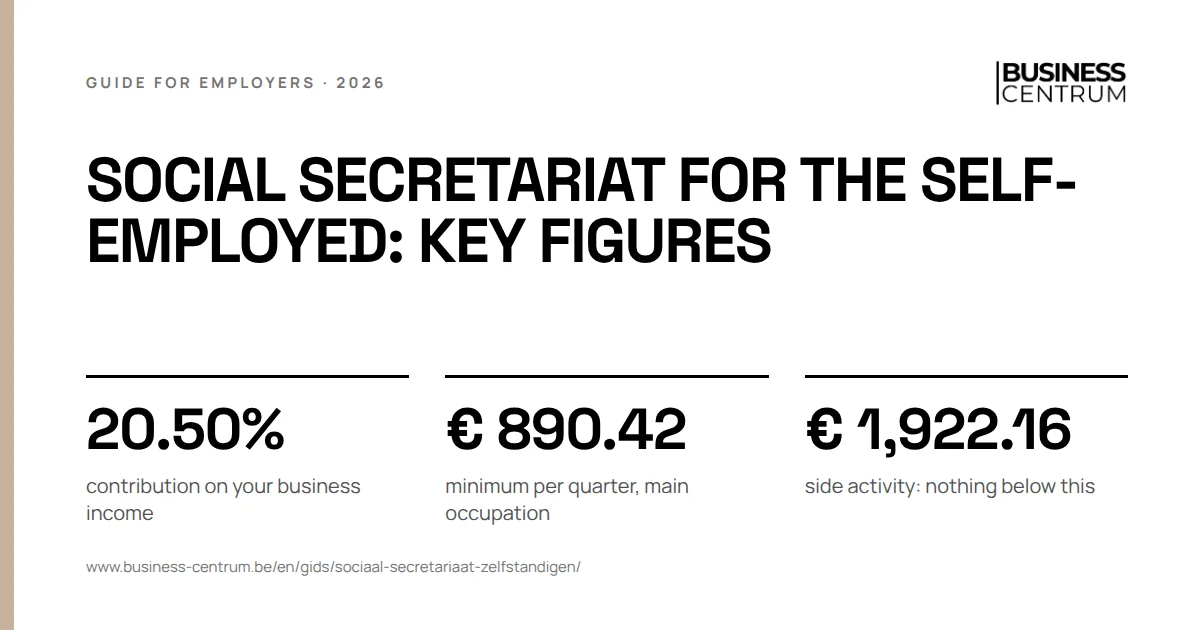
As a self-employed person in Belgium, you do not need a social secretariat for your own social contributions, but a social insurance fund: you must join one before you start, and you pay it 20.50% of your business income every quarter, with a minimum of € 890.42 per quarter in 2026 if it is your main occupation. A social secretariat works for employers: it runs payroll and files the returns for your staff. So you only need both once you take someone on.
Social secretariat or social insurance fund for the self-employed: the difference
Anyone searching for "social secretariat for the self-employed" is almost always looking for the fund. The confusion is understandable: the same groups often offer both, and in everyday Belgian speech both get called "the social office" or "the social fund". Legally they are two separate institutions, each with its own law, its own supervisor and its own clients.
| Social insurance fund | Social secretariat | |
|---|---|---|
| For whom | the self-employed person, the assisting spouse, the company | the employer, for its employees |
| Legal basis | Royal Decree no. 38 of 27 July 1967 | Act of 27 June 1969 and Royal Decree of 28 November 1969 |
| Compulsory? | yes, you join before your activity starts | no, an employer may do everything itself |
| What you pay | your own contributions: 20.50% up to € 75,024.54, then 14.16% | employer contributions, a base of 25% of gross pay, plus the 13.07% withheld from the employee |
| Calculated on | your business income as a self-employed person | your employees' wages |
| Who collects | the fund, which passes it on to NISSE (RSVZ/INASTI) | the secretariat, which passes it on to the NSSO (RSZ/ONSS) |
| Cost of the service | management fee of 3,05-4,25% on top of contributions | a fee set in the contract |
| Number | 8 private funds plus the National Auxiliary Fund | 25 recognised secretariats with an active head office |
| Switching | after 4 years, on 1 January | on the first day of a quarter |
Under article 20 of Royal Decree no. 38, the fund has four statutory tasks: collecting contributions and recovering them through the courts if needed, informing and assisting you on your rights and obligations as a self-employed person, passing data to the authorities, and supporting your mental well-being at work. It passes the money on to the National Institute for the Social Security of the Self-employed (NISSE, RSVZ in Dutch, INASTI in French). Under article 27 of the 1969 Act, a social secretariat has the exclusive right to collect the contributions of its affiliated employers and pass them on to the National Social Security Office (NSSO, RSZ in Dutch).
What a social secretariat does for the self-employed
For you as a self-employed person, a social secretariat does nothing. Your pension, your child benefit, your sickness benefit and your contributions all run through your fund. The secretariat only comes in when you become an employer. It then takes over the tasks the law places on an employer:
- registering you as an employer with the NSSO, with an NSSO number;
- the Dimona declaration for every employee, no later than their first working day;
- calculating pay, the payslip and withholding tax;
- deductions from pay, including the special social security contribution;
- the quarterly DmfA return and collecting the employer's NSSO contributions.
That is not compulsory either: an employer may file its own returns. In practice, most choose a secretariat. According to the NSSO annual report, in 2025 83% of employers were affiliated with a recognised secretariat. Why it is not an obligation is explained in is a social secretariat compulsory?.
What you pay your fund as a self-employed person in 2026
Contributions are set by law and are the same at every fund. NISSE publishes them each year. These are the 2026 amounts, excluding the fund's management fee:
| Situation | Contribution | Minimum per quarter |
|---|---|---|
| Main occupation | 20.50% up to € 75,024.54, 14.16% up to € 110,562.42, nothing above | € 890.42, calculated on a minimum income of € 17,374.08 |
| First-time starter, first four quarters | same rates, on a lower minimum income | € 459.82 |
| Side activity, income below € 1,922.16 | no contribution | none |
| Side activity, above that | 20.50% and 14.16% | € 98.51 |
| Assisting spouse, full status | same rates | € 391.16 |
| All categories above | maximum € 5,103.05 |
Provisional and final. During the year you pay provisional contributions, based on your business income from three years earlier, revalued. If you have just started, you pay the statutory provisional contribution. Only when the tax authorities report your actual income for that year, usually one or two years later, does the fund calculate the final contribution. You then pay the difference or get money back. With objective evidence you can ask the fund to let you pay less; paying more is always allowed.
What counts as income. Royal Decree no. 38 uses your gross business income minus business expenses, as reported by the FPS Finance (article 11). For a company director, that is their director's remuneration.
Due date and surcharges. The contribution must be in the fund's account by the last day of the quarter at the latest. If you are late, you pay a 3% surcharge on the unpaid part, applied again every following quarter. If it is still unpaid at the end of December, a one-off 7% is added. The fund can claim contributions for up to 5 years from 1 January following the contribution year.
Joining. Article 10 of Royal Decree no. 38 requires every self-employed person to join a private fund or the National Auxiliary Fund before starting their activity. Anyone who fails to do so receives a formal notice by registered letter from NISSE and is automatically affiliated to the National Auxiliary Fund after 30 days.
Worked example: the quarterly contribution in a main occupation
Worked example
A self-employed person in a main occupation with 40,000 euros of business income
A fictional joiner in Ghent works as a sole trader. His 2026 business income, after deducting his business expenses, is 40,000 euros. That is below the € 75,024.54 threshold, so all of it falls in the first band.
| Item | Per year | Per quarter |
|---|---|---|
| Social contribution: 40,000 x 20.50% | € 8,200.00 | € 2,050.00 |
| Management fee at 3.05% (lowest rate) | € 250.10 | € 62.53 |
| Management fee at 4.25% (highest rate) | € 348.50 | € 87.13 |
| Total per quarter | € 2,112.53 to € 2,137.13 |
Did he only start in 2026? Then he paid a provisional € 890.42 per quarter. Once the tax authorities report the income of 40,000 euros, the adjustment follows: 4 x (2,050.00 - 890.42) = 4,638.32 euros to pay on top, plus the management fee. If he does not set that amount aside, it arrives in one go a year or two later.
With a higher income. A self-employed person with 90,000 euros of business income pays 20.50% on 75,024.54 euros, which is 15,380.03 euros, and 14.16% on the 14,975.46 euros above it, which is 2,120.53 euros. Together that is 17,500.56 euros a year or 4,375.14 euros a quarter, excluding the management fee.
The management fee percentage is set each year by the minister for each fund, after that fund has given its opinion (article 20, paragraph 4, Royal Decree no. 38). It is the only part of the bill that differs between funds.
Social secretariat for the self-employed with a side activity
If you are an employee and also work as a self-employed person, you are self-employed as a side activity. Like someone in a main occupation, you join a social insurance fund. The difference is the threshold. If you earn less than € 1,922.16 a year from your side activity, you pay no contribution. Above that you pay the same 20.50%, with a minimum of € 98.51 per quarter.
Two fictional examples, excluding the management fee:
- A graphic designer earns 1,500 euros on the side. That is below the threshold: no contribution, but she still has to join a fund.
- A photographer earns 6,000 euros on the side. He pays 6,000 x 20.50% = 1,230 euros a year, or 307.50 euros a quarter.
With a side activity, your social protection comes from your main job as an employee. Here too, you only need a social secretariat if you hire someone yourself, for instance a student worker or a flexi-jobber.
When the self-employed also need a social secretariat
The trigger is always the same: as soon as there is an employee. Who the employer is depends on how your business is set up.
| Situation | Social insurance fund | Social secretariat |
|---|---|---|
| Sole trader without staff | yes, for you | no |
| Sole trader with a first employee | yes, for you | yes, or do it yourself: you are the employer, in your own name |
| Company, director without staff | yes, for the director; the company in principle owes an annual company contribution | no |
| Company with staff | yes, for the director | yes, or do it yourself: the company is the employer |
| Your partner helps in the business | yes: as an assisting spouse they join your fund | no, an assisting spouse is not an employee |
| You hire another self-employed person | no, they have their own fund | no, but watch out for bogus self-employment |
| Side activity with a student worker | yes, for you | yes, or do it yourself, for the student |
Three situations need a word of explanation.
The company director. Anyone holding a mandate in a company is presumed to be self-employed under article 3 of Royal Decree no. 38. So you are not on your own company's payroll, but pay contributions to your fund. How that status works, and what it costs compared with an employee, is set out on the company director. If your company hires staff, the company is the employer; see social secretariat for a BV.
The assisting spouse. The law calls someone who helps a self-employed person without an employment contract a helper. If your spouse or legal cohabitant works with you, article 7bis of Royal Decree no. 38 presumes they are an assisting spouse, with their own status and a minimum contribution of € 391.16 per quarter under the full status. NISSE affiliates them to your fund automatically. They get no payslip and no Dimona, so they do not belong with a secretariat.
The first employee. This is where the self-employed person becomes an employer. If you had no one on staff in the previous 12 months, you get a reduction of up to € 2,000 per quarter on your employer contributions. If you are affiliated with a recognised secretariat, the NSSO adds € 36.45 per quarter towards that secretariat's costs. All about that reduction is in the first-employee reduction, the practical steps in becoming an employer, and what changes for a sole trader in social secretariat for a sole trader.
Would you rather hire another self-employed person than take on an employee? Read bogus self-employment first. If that person in fact works under your authority, the relationship can be reclassified as an employment contract, with contributions due retroactively.
One brand, two services: who offers both fund and secretariat
Search for "social secretariat for the self-employed" with the name of a group and you will notice that many groups have both a fund and a secretariat under the same name. That is true for several, not for all. This table puts two official lists side by side: the list of funds on the NISSE website and the list of recognised secretariats in the Belgian Official Gazette of 20 June 2025. In alphabetical order, with no ranking.
| Name | Social insurance fund (NISSE list) | Recognised secretariat, number |
|---|---|---|
| Acerta | yes | 250 |
| Avixi | yes | not on the list |
| Group S | yes | 100 |
| Liantis | yes | 510 |
| Partena Professional / Partena | yes, as Partena Professional | 300 |
| SD Worx | not on the list | 640 |
| Securex | yes, as Securex-Integrity | 120 |
| UCM | yes | 200 |
| Xerius | yes | not on the list |
| National Auxiliary Fund | yes, the public fund of NISSE | no secretariat |
What else sets the groups apart, such as price, tools and offices, is compared in Acerta, SD Worx, Securex, Liantis and Partena. What recognition means legally and where a social bureau fits in is covered in recognised secretariats and social bureaus. Looking for a secretariat nearby? The eight criteria in choosing the best social secretariat in Ghent will help.
Decision guide: which of the two do you need?
Go through these questions in order.
- Do you run a self-employed activity, as a main or side occupation, or are you a company director? Yes: you need a social insurance fund, and you join before you start. No: no fund.
- Do you have a company? Yes: the company in principle also owes an annual company contribution, paid through a fund. The 2026 amounts had not yet been set when NISSE published its table; ask your fund.
- Does your partner work with you without a contract? Yes: they join your fund as an assisting spouse. No secretariat.
- Are you hiring someone on an employment contract, even a student or a flexi-jobber? No: you do not need a social secretariat. Yes: carry on.
- Do you want to handle the Dimona, payroll and the DmfA yourself? That is allowed, through the social security portals. If not, choose a secretariat, or a social bureau that works with one, and read joining a social secretariat.
- What does it cost? Your fund charges a management fee on your own contributions. A secretariat charges per employee or per payslip; how those prices are built up is explained in the cost of a social secretariat.
If you answered yes to question 4, from that moment you have two: a fund for yourself and a secretariat for your staff.
What Business Centrum does, and what it does not
Business Centrum is a social bureau in Ghent and a recognised partner of Acerta. We only handle the employer side: the payroll, Dimona declarations, contracts and leave of your staff, with Acerta as the secretariat that files the returns and collects the contributions. We are not a social insurance fund; for your own contributions as a self-employed person, you stay with your fund.
Taking on your first employee as a self-employed person? Business Centrum arranges your social secretariat through Acerta and your payroll, with a fixed contact person who knows your file. How that partnership works is explained on social bureau and Acerta. Want to know what your first hire means for you? Ask for a call back.