
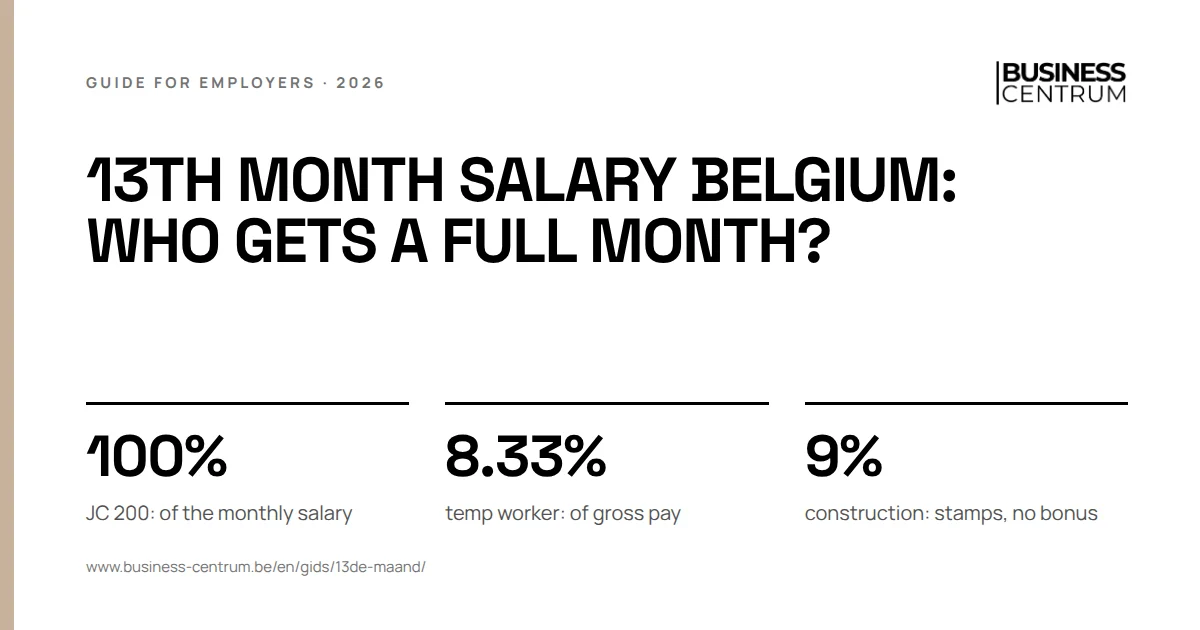
The "13th month" is the everyday name for the end-of-year bonus (eindejaarspremie, prime de fin d'année). No general law in Belgium requires it: the obligation comes from the collective agreement of the joint committee, a company agreement, the employment contract or an established custom. A white-collar employee in JC 200 receives 100% of his monthly salary, a temp worker 8.33% of his gross pay through a fund, a construction worker no bonus but loyalty stamps. Below you will find who is entitled, who gets a full month and what happens on joining or leaving during the year, dismissal, temp work and sickness.
What does 13th month salary mean, and why is it not called that everywhere?
Collective agreements rarely use the words "13th month". They speak of an end-of-year bonus, a Christmas bonus (JC 202), an annual bonus (JC 226) or an annual premium for blue-collar workers (JC 100). In construction there is no end-of-year bonus: blue-collar workers receive loyalty stamps worth 9% of their gross pay. The name "13th month" is therefore only accurate where the bonus really is a monthly salary.
A percentage of 8.33% of annual pay is mathematically one twelfth: a full month, spread over the months in which the employee was paid. 9% sits slightly above that, 4.50% well below.
This guide covers the private sector; in education and the public services the bonus is called an end-of-year allowance. The calculation rules per sector are in calculating the end-of-year bonus.
Is the 13th month salary mandatory in Belgium?
Only if a source that binds your company requires it. Article 51 of the Collective Agreements Act of 5 December 1968 ranks the sources of rights and obligations in an employment relationship. Five of them matter for the 13th month:
| Source | When do you have to pay a 13th month? |
|---|---|
| Sector agreement declared generally binding | Always, if your company falls under that committee. Under article 31, such an agreement binds every employer in the committee, including those not affiliated to an employers' organisation. |
| Company agreement | If you concluded it with the unions. It may be more favourable than the sector, not less. |
| Written employment contract | If the contract or an annex promises a 13th month, even without a sector rule. |
| Work rules | If the work rules set a bonus. |
| Custom | If you paid the same bonus for years, to everyone in the same group and on a fixed calculation. Custom comes last among 9 sources, yet it makes a bonus mandatory that appears nowhere on paper. |
To find your employees' committee, see finding your joint committee. What a collective agreement is and how it binds you: what is a collective agreement and the short answer to is a collective agreement mandatory.
Do you pay a bonus out of goodwill, without any obligation? Then state in writing with every payment that it is one-off and voluntary. Without that sentence, an annual bonus grows into a custom after a few years, and you can no longer stop it unilaterally.
Decision aid: is my employee entitled to a 13th month?
Go through the questions from top to bottom. The first "yes" gives the answer.
| Question | Yes | No |
|---|---|---|
| 1. Is he a temp worker (JC 322)? | The Social Fund for Temporary Workers pays, not you. See temp work below. | Go to 2. |
| 2. Does his joint committee have an end-of-year bonus scheme? | He is entitled under the sector agreement, if he meets the conditions (seniority, employed on a given date, days worked). Find his committee in the table below. | Go to 3. |
| 3. Does a social fund pay the bonus? | You pay nothing on the payslip. The fund calculates on the pay you declared. | Go to 4. |
| 4. Is a 13th month in a company agreement, his contract or the work rules? | He is entitled under that text. | Go to 5. |
| 5. Did you pay a fixed bonus to the whole group for years? | Probably a custom: he is entitled. | No entitlement to a 13th month. |
Who gets a full 13th month salary, and who a flat amount or a percentage?
For a full year, according to the agreements we checked per committee:
| Committee | Employees | Form of the bonus | Who pays |
|---|---|---|---|
| JC 200 | white-collar, auxiliary committee | 100% of the monthly salary | employer |
| JC 201 | white-collar, independent retail | 100% of the monthly salary | employer |
| JC 207 | white-collar, chemicals | 100% of the December base salary | employer |
| JC 209 | white-collar, metalworking | East and West Flanders 100% of the July salary; Brabant and Brussels 8.33% of the annual salary; Hainaut, Namur, Liège and Luxembourg at least 2.36% of declared pay | employer |
| JC 220 | white-collar, food industry | 1 gross December salary plus variable pay | employer |
| JC 226 | white-collar, trade, transport, logistics | 1 monthly salary of the month of payment | employer |
| JC 311 | large retail | the December salary | employer |
| JSC 319.01 | Flemish educational institutions | 100% of the October monthly salary | employer |
| JC 330 | healthcare | indexed flat amount plus 3.03% of annual pay | employer |
| JSC 329.01 | Flemish socio-cultural sector | usually a fixed part plus 5.76% of annual pay | employer |
| JC 100 | blue-collar, auxiliary committee | 31 times the basic hourly wage | employer |
| JC 111 | blue-collar, metalworking | East Flanders 164.67 hours' pay, full time | employer |
| JC 116 | blue-collar, chemicals | 173.33 times the basic hourly wage, less for a shorter week | employer |
| JC 118 | blue-collar, food industry | 4 1/3 weeks' pay | employer |
| JC 119 | blue-collar, food retail and wholesale | 164.66 times the hourly wage | employer |
| JC 121 | cleaning | 9% of gross pay | social fund |
| JC 124 | construction, blue-collar | no bonus: loyalty stamps of 9% | Constructiv |
| JC 140.03 | road transport, blue-collar | 5% of declared pay | SFTL |
| JSC 149.01 | electricians | 8.33% of gross pay | Volta |
| JC 302 | hospitality | at most 4.33 weeks' pay | Fonds Horeca |
| JC 314 | hairdressing, beauty care | 9.50% of gross pay | social fund |
| JC 322 | temp workers | 8.33% of gross pay | social fund |
| JSC 322.01 | service vouchers | 4.50% of gross pay | social fund |
A full 13th month in the literal sense therefore mainly goes to white-collar employees. For blue-collar workers the bonus is also a monthly salary in most committees, but expressed in hours. In JC 111 it is the weekly working time times 52 weeks, divided by 12 months: for a full-time worker 164.67 hours, a full month. Where a fund pays, it is a percentage of declared pay. The conditions and the agreement are on the page of each committee, the overview in end-of-year bonus 2026 per joint committee.
13th month salary for white-collar and blue-collar workers: where is the difference?
The single status harmonised notice periods, not the end-of-year bonus. Blue-collar and white-collar workers in the same company often fall under two committees, with two schemes. A metalworking company in Ghent applies JC 111 to its blue-collar workers and JC 209 to its white-collar staff.
Four differences you see in practice:
- The basis. A white-collar employee usually receives his monthly salary, a blue-collar worker a number of hours times his hourly wage or a percentage of his annual pay.
- Who pays. For white-collar staff it is almost always the employer. For blue-collar workers a social fund pays in cleaning, construction, road transport, hospitality and for electricians.
- Social security. On a bonus you pay yourself, social security for blue-collar workers is calculated on 108% of the amount, as with their normal pay. For white-collar staff, on the gross amount.
- The timing. The salary that counts is often that of December or of the month of payment. An indexation or pay rise during the year therefore counts in full.
A part-time employee receives his bonus on his own part-time pay, with no separate calculation rule. More in the guide on the part-time employment contract.
13th month salary calculation when joining or leaving during the year
An employee who was not employed all year receives one twelfth per month worked in most committees. Check per committee the minimum seniority, and whether the employee must be employed on a specific date.
| Committee | Minimum seniority or service | Pro rata |
|---|---|---|
| JC 200 | 6 months at the time of payment | per month of work |
| JC 201 | 6 months of seniority at year end | by days worked and assimilated |
| JC 202 | 3 months of work in the year, employed at year end | per month worked |
| JC 311 | 3 months of service in the year | by the work done in the year |
| JC 302 | 2 uninterrupted months | per block of days worked |
| funds (121, 140, 322 ...) | a minimum of pay or days in the reference period | follows declared pay |
Worked example: 13th month salary calculation for three employees who joined or left in 2026
White-collar employee in JC 200, joined on 1 May. He earns € 3,000 gross a month. In December he has more than 6 months of seniority and has worked eight months: 3,000 x 8/12 = € 2,000 gross. Had he only started on 1 August, he would not reach the 6 months at the time of payment and the sector agreement would give him nothing.
The same employee, dismissed on 30 September after two years of service. You dismissed him, not for serious cause. He receives nine twelfths in his final settlement: 3,000 x 9/12 = € 2,250 gross. Had he resigned himself, he would have had no entitlement with two years of seniority: the threshold is 3 years.
Blue-collar worker in JC 119, joined on 1 April. He earns € 17 an hour. His bonus for a full year is 164.66 x 17 = € 2,799.22. For nine full months of service: 2,799.22 x 9/12 = € 2,099.42 gross. Social security is calculated on 108% of that.
When a started month counts is set in the agreement. In JC 111 in East Flanders, joining up to and including day 15 of the month counts as a full month; in JC 330, a contract that starts before day 16.
13th month pay on dismissal or resignation: who keeps his share?
When someone leaves during the year, you pay the pro rata share in the final settlement, if the agreement provides for it. The rules for white-collar staff in JC 200:
| How the contract ends | Pro rata 13th month in JC 200? |
|---|---|
| Dismissal by the employer, except for serious cause | yes, with 6 months of seniority |
| Retirement, unemployment with company supplement after dismissal, definitive force majeure | yes, with 6 months of seniority |
| Resignation or termination by mutual agreement | yes, with 3 years of seniority |
| End of a fixed-term contract of at least 6 months | yes |
| Dismissal for serious cause | no |
Other committees differ, above all on resignation:
- JC 311: an employee who leaves of his own accord receives a share with at least 5 years of seniority. Leaving to retire or for unemployment with company supplement does not count as voluntary.
- JC 220: an employee who leaves of his own accord before 1 year of service loses the bonus.
- JC 302: a dismissed employee who does not meet the basic condition keeps his entitlement after 3 years of uninterrupted service. An employee who resigns usually receives nothing.
- Funds: in cleaning, road transport and for temp workers, the bonus follows declared pay. How the contract ends plays no role, and the employee receives his bonus later from the fund.
More on dismissal for serious cause and termination by mutual agreement. The bonus belongs in the final settlement together with the leaving holiday pay and on the social documents on dismissal. Holiday pay itself is not a 13th month, see double holiday pay.
13th month salary for temp workers: who pays?
A temp worker falls under JC 322. He receives his end-of-year bonus from the Social Fund for Temporary Workers: 8.33% of the gross pay he earned as a temp worker between 1 July 2025 and 30 June 2026. He is entitled if he has at least 65 days or 494 hours as a temp worker in that period. The agency funds the fund with a contribution on every wage; that cost is part of the rate the agency invoices you.
If you hire a temp worker on a permanent contract, his threshold at the fund drops to 60 days. From his first day with you, he builds up a bonus under your own committee. In JC 200, his previous temp period in a similar job counts towards the 6 months of seniority, even with breaks of 7 days or less between two assignments. More on the bonus and the payment on the page end-of-year bonus JC 322, on temp workers' pay in joint committee 322.
13th month salary and sickness: which days count as worked?
An absence only reduces the bonus if the agreement does not treat it as work. Holidays, public holidays, short leave, maternity leave and accidents at work count almost everywhere. For sickness and temporary unemployment the committees differ widely:
| Committee | Sickness or non-work accident that counts |
|---|---|
| JC 200 | 60 days a year, plus 5 days of temporary unemployment |
| JC 201 | 60 days a year |
| JC 220 | the first 12 months |
| JC 226 | the first 30 days |
| JC 311 | the first 30 days |
| JC 302 | 7 calendar days a year with a certificate, longer sickness in part |
| funds | no day rule: the bonus follows the pay you declared |
A white-collar employee in JC 200 who was sick for ninety days in 2026 has 60 assimilated days. You may only reduce the bonus for the days above that. Deducting every sick day means paying too little and risking a back payment. What you pay yourself during the first days of sickness: guaranteed pay; how temporary unemployment works: temporary unemployment.
When is the 13th month salary paid in Belgium?
If you pay it yourself, usually in December, in many committees before Christmas. In JC 200 by December at the latest or when the annual accounts are filed. Social funds follow their own calendar for the 2026 bonus:
| Moment | Who pays |
|---|---|
| from 26 October 2026 | construction loyalty stamps, Constructiv |
| 1 December 2026 | service vouchers fund |
| from 20 December 2026 | SFTL, road transport and logistics |
| from 4 January 2027 | temp workers' fund, for those not in a union |
| by 31 January 2027 at the latest | Fonds Horeca |
For a bonus you pay yourself, the minimum wage also plays a role: in JC 200 you make a settlement over the preceding months at the time of payment, and if pay including the bonus falls below the guaranteed minimum monthly income (GGMMI), you pay the difference. How that works is in GGMMI 2026.
13th month salary tax in Belgium
In short: on a bonus you pay yourself, you withhold 13.07% social security, for blue-collar workers on 108% of the bonus. Then withholding tax applies under the scale for exceptional payments: a flat percentage on the whole bonus, zero up to annual pay of € 10,675 and at most 53.50%. A social fund withholds 23.22%. Often about half of the gross bonus remains net, and everything is settled in personal income tax.
The full scale, worked examples and what the bonus costs you as an employer are in end-of-year bonus net calculation. What the normal monthly salary gives in net terms, you calculate with the gross-to-net calculator. What changes for withholding tax in 2027 will follow in our guide on withholding tax 2027.
What Business Centrum does for you
Business Centrum establishes for each employee which scheme applies, calculates the 13th month under the agreement of his committee and includes the pro rata share in the final settlement when someone leaves, together with Acerta, as part of your payroll administration. We track the assimilated days and give you an estimate of what December will cost in the autumn. Not sure whether an employee is entitled to a 13th month? Request a call back.