
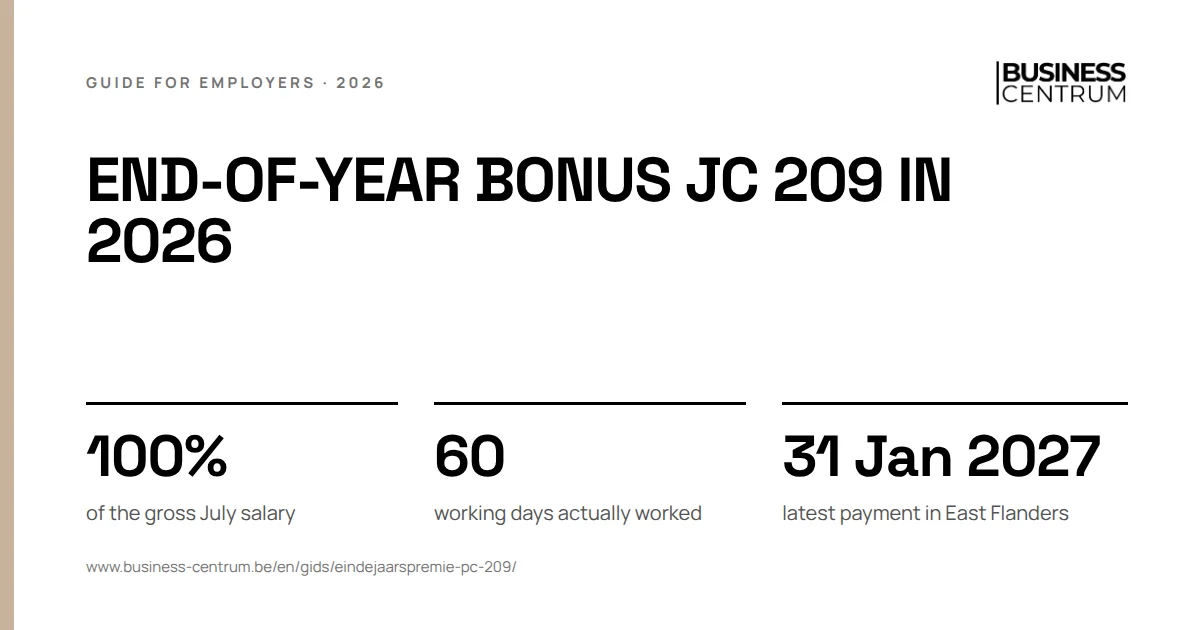
The end-of-year bonus in JC 209 depends on the province where your company is located. In East Flanders it is a thirteenth month: 100% of the individual gross monthly salary of July, which you pay yourself as the employer, no later than 31 January 2027. Your employee must be employed on 30 November 2026 and must have actually worked 60 working days in the reference period.
Which agreement governs the end-of-year bonus in JC 209?
JC 209 has no national amount for the end-of-year bonus. The national collective agreement 140869/CO/209 of 3 July 2017 is a framework. It gives an employee who leaves during the reference period a pro rata bonus, however the contract ends, except on dismissal for serious cause. The amounts and conditions are in the provincial agreements concluded to implement that framework agreement. You apply the agreement of the province where your company is located.
For East Flanders that is agreement 145052/CO/209 of 15 January 2018, which also covers West Flanders. It applies to the white-collar employees on or eligible for the pay scale in JC 209 companies in those two provinces. It does not apply in the Waasland, which has its own agreement, nor to companies that assemble bridges and steel frames, nor to two companies the agreement excludes by name. Whether your employees belong in JC 209 is explained in our guide on joint committee 209.
We checked the collective agreement database of the FPS Employment on the date shown in the box above. It does not yet contain a national agreement 2025-2026 for JC 209; the last agreement ran until the end of 2024. A new agreement may change the end-of-year bonus rules.
Conditions for the end-of-year bonus JC 209 in East Flanders
An employee in East Flanders is entitled to the end-of-year bonus if two conditions are met:
- Employed on 30 November 2026. For the 2026 bonus that is the last day of the reference period. An employee who dies, retires or leaves with unemployment with company top-up (SWT) no longer needs to be employed. Other departures fall under a pro rata rule, further down this page.
- 60 working days actually worked in the reference period, in a full-time five-day week. This condition also lapses on death, retirement and SWT.
If a full-time employee works fewer or more days per week, the agreement converts the threshold in proportion to a five-day week. The example in the agreement: an employee working full-time in a weekend shift on Saturday and Sunday must show 24 working days.
A part-time employee must work a number of hours proportional to the hours of a full-timer over 60 working days. The example in the agreement: a full-timer works 38 hours a week, so 456 hours over 60 days. An employee on 20 hours a week must reach 20 x 456 / 38 = 240 hours.
The agreement sets no minimum length of service in months. There is the threshold of actual working days, which counts real work only.
Reference period of the end-of-year bonus in JC 209
The reference period always runs from December up to and including November. For the 2026 bonus it runs from 1 December 2025 up to and including 30 November 2026. This period is the same in every provincial agreement of JC 209, including the Waasland, Antwerp, Limburg, Brabant, Brussels and the Walloon provinces.
The reference period therefore does not match the calendar year. You count months, days worked and absences from December up to and including November.
How much is the end-of-year bonus JC 209 in East Flanders?
The bonus equals the individual gross monthly salary of July of the reference period, at 100%. The agreement adds: without any possible supplement. Supplements on top of the monthly salary therefore do not count. For a part-time employee it is their own gross July salary; the agreement does not separately cover what happens if the working pattern changes during the year. The minimum monthly salary per category is in the JC 209 pay scale.
Two rules reduce the amount:
- Pro rata. An employee who starts or leaves during the reference period receives 1/12 of the bonus per month worked. The agreement for East and West Flanders does not say how to count an incomplete month.
- Non-assimilated days. For each day of absence not treated as work, the bonus is reduced by 1/261 of its gross amount.
Worked example: an employee in Ghent with three days of temporary unemployment
This is an example, not a calculation for your situation. A technical employee in Ghent earns € 3,200 gross a month in July 2026. He works the whole reference period and was temporarily unemployed for three days. Temporary unemployment is not on the agreement's list of assimilated days. His bonus is 3,200 - 3 x 3,200 / 261 = € 3,163.22 gross.
Had he only started on 1 March 2026, without absences, he would have worked nine months of the reference period: 3,200 x 9/12 = € 2,400 gross.
The bonus goes through the normal payroll calculation, with 13.07% personal social security and withholding tax under the scale for exceptional payments. What your employee keeps net and what the bonus costs you above the basic contribution of 25%, you can check with our explanation on calculating the end-of-year bonus.
Which absences count for the end-of-year bonus in JC 209?
The agreement for East and West Flanders lists the assimilated absences. Anything not on the list costs 1/261 of the bonus per day.
| Absence | Counts for the bonus |
|---|---|
| Work accident | in full |
| Illness and non-work accident | the first 2 periods with guaranteed monthly salary in the reference period, at most 6 months in total |
| Maternity leave | within the same limit, even without guaranteed monthly salary |
| Short leave (klein verlet) | in full |
| Public holidays and annual holidays | in full |
| Temporary unemployment, unpaid leave and other absences | not assimilated |
The assimilation applies to the calculation of the bonus. The threshold of 60 working days remains a separate condition of actual work. For temporary unemployment itself, see our guide on temporary unemployment.
End-of-year bonus JC 209 on dismissal
In East and West Flanders an employee who leaves during the reference period receives a pro rata bonus: 1/12 per month worked, however the contract ends. The only exception is dismissal for serious cause by the employer. The threshold of 60 actual working days still applies, except on death, retirement and SWT.
| Situation | Right to a pro rata bonus |
|---|---|
| Dismissal by the employer | yes |
| Resignation by the employee | yes |
| Termination by mutual agreement | yes |
| End of a fixed-term contract | yes |
| Retirement or unemployment with company top-up | yes, even without the 60 working days |
| Death | yes, even without the 60 working days |
| Dismissal for serious cause | no |
On payment when someone leaves, the agreement says: the bonus is paid no later than 31 January 2027, "provided the employee is employed on 30 November of the reference period or at the employee's departure". The agreement for East and West Flanders does not say who receives the bonus on death. What a dismissal for serious cause requires is set out in our guide on dismissal for serious cause.
The Waasland has its own end-of-year bonus in JC 209
The Waasland is part of East Flanders but has its own agreement: 145054/CO/209 of 15 January 2018. The sector defines the Waasland as Beveren-Waas, Kruibeke, Lokeren, Sint-Gillis-Waas, Sint-Niklaas, Stekene and Temse. The agreement does not apply to the joint section for craft metalworking, to companies that assemble bridges and steel frames, or to three shipyards it names.
The rules differ from the rest of East Flanders on five points:
- Calculation. The thirteenth month is the individual base salary, plus any individual or collective production bonus. You use the salary on 30 November 2026. If the employee leaves during the year, the salary on the first day of the month of departure counts.
- Threshold. 60 working days actually worked in the reference period, except on death or retirement. Work carried out without a break in the previous reference period counts. Part-timers reach a proportional number of hours.
- Incomplete months. Starting up to and including the 15th of the month and leaving from the 16th onwards count as a full month. On leaving, the bonus is pro rata however the contract ends, except on dismissal for serious cause.
- Assimilations. A work accident or occupational disease counts for up to 365 calendar days per case. Illness, maternity leave and non-work accidents count for the first two periods with guaranteed pay, at most 6 months in total. Short leave, holidays, public holidays, credit hours, social promotion, union training, family leave and other paid absences count in full. Strikes and lock-outs do not count. For each day of unauthorised absence you deduct the value of a normal working day.
- Payment. For a full year you pay no later than the last working day before 25 December 2026, so earlier than in the rest of the province. When someone leaves, you pay the bonus with the final settlement. On death the bonus goes to whoever paid the funeral costs.
The end-of-year bonus JC 209 in the other provinces
If your company is outside East or West Flanders, a different agreement applies. The reference period is the same everywhere.
| Province or region | Agreement | Bonus | Conditions | Payment |
|---|---|---|---|---|
| Antwerp | 145053/CO/209 of 15 January 2018 | thirteenth month on the base salary of 1 December 2026 | employed on 30 November 2026, 6 months of service, 60 days worked | no later than 31 December 2026 |
| Limburg | 145051/CO/209 of 15 January 2018 | thirteenth month on the base salary of 1 November 2026 | as in Antwerp | no later than 31 December 2026 |
| Flemish Brabant, Walloon Brabant and Brussels | 156078/CO/209 of 4 November 2019 | 8.33% of the annual gross salary | 1 year of service at the end of the reference period | during December, no later than 31 December 2026 |
| Hainaut, Namur, Liège and Luxembourg | 156079/CO/209 of 4 November 2019, with an identical agreement for Liège and Luxembourg | at least 2.36% of the gross pay declared to social security for the reference period, excluding double holiday pay and the end-of-year bonus | the agreement sets no minimum service | between 15 December 2026 and 31 December 2026 |
In Antwerp and Limburg, reduced-hours days count towards the 60 days. For each non-assimilated day the bonus is reduced by 1/260. Illness counts there for at most 2 months in total, pregnancy and maternity rest for at most 15 weeks and family leave for at most 10 days. Each notified day of unjustified absence costs 10% of the bonus.
In Brabant and Brussels, guaranteed pay for ordinary illness counts up to 1 month and one uninterrupted period per year. In the Walloon provinces the bonus is not due if your company already grants a pay benefit that is at least equivalent, whatever it is called and whenever you pay it.
Converting into days off or a bike lease
Agreement 185714/CO/209 of 19 December 2023 allows part of the bonus to be converted into days off or a bike lease. This is possible in the provinces where the sector bonus is at least one full monthly salary: the Waasland, Antwerp, East and West Flanders, Limburg, Flemish Brabant, Walloon Brabant and Brussels. Five conditions apply together:
- you convert at most 50% of the bonus;
- a company agreement confirms the conversion;
- the employee chooses freely, with an individual agreement on top of the company agreement;
- the conversion is cost-neutral: you count all employer costs of the bonus, at least social security, the contributions to the Subsistence Security Fund, the sector pension for affiliated employers and any company pension plan;
- employees receive prior information on the consequences.
Can your company keep its own scheme?
The agreement for East and West Flanders contains a rule you do not find everywhere. Existing arrangements and practices in your company on the calculation, granting and payment of the bonus that already existed before the agreement was signed remain in force, even if they are less favourable. Arrangements on the level of the bonus only remain in force if they are more favourable. A company in serious economic or financial difficulty can deviate through a company agreement that the joint committee then approves.
Mistakes we see with the end-of-year bonus in JC 209
- The agreement of the wrong province. A company with sites in Ghent and Antwerp applies two agreements, with a different salary base, different assimilations and a different payment date.
- Taking the December salary. In East and West Flanders the basis is the gross July salary, without supplements.
- Treating temporary unemployment as worked. The agreement for East and West Flanders does not list it; each day costs 1/261 of the bonus.
- Forgetting the Waasland. A company in Sint-Niklaas or Lokeren pays no later than the last working day before 25 December 2026, not at the end of January, and uses the base salary of 30 November 2026 plus production bonus.
- No bonus on resignation. In East and West Flanders an employee who leaves of their own accord also receives a pro rata bonus, if they reached the 60 working days.
What Business Centrum does for you
Business Centrum calculates the end-of-year bonus of your JC 209 employees under the agreement of your province, together with Acerta, as part of your payroll administration. We track the assimilated and non-assimilated days and include the bonus in the final settlement when someone leaves. The rules of the other committees are in our overview of the end-of-year bonus in 2026 per joint committee.