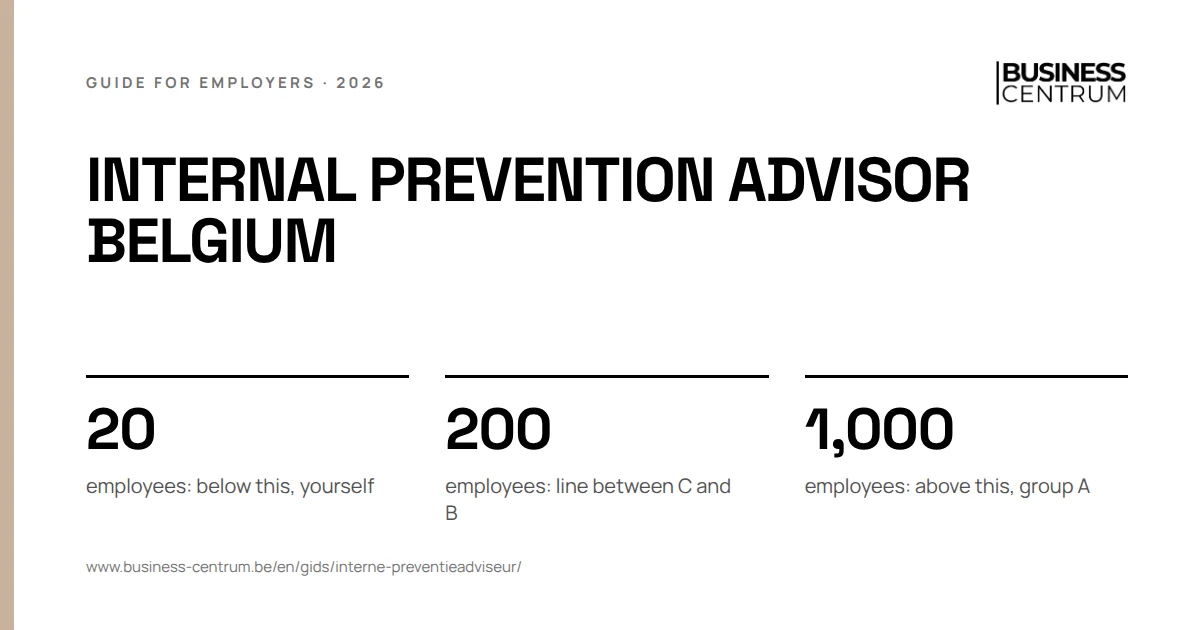
Every employer in Belgium has an internal prevention advisor: that follows from section 33 of the Well-being at Work Act, which requires an internal service for prevention and protection at work with at least one prevention advisor. Below 20 employees, you may take on the role yourself. The training required and the tasks he does himself depend on your company's group: A, B, C or D, based on headcount and sector. Below you will read how to determine your group, what stays internal, what the external service does, and how to appoint someone.
What does an internal prevention advisor do?
The internal prevention advisor assists the employer, managers and employees in applying well-being legislation. It is an advisory role, a staff function in the organisation chart. He acts in full independence from employer and employees and may not suffer any disadvantage from his role (section 43 of the Well-being at Work Act).
His tasks are in article II.1-4 of the code. The main ones for an SME:
- helping identify hazards and advising on the risk analysis, the global prevention plan and the annual action plan;
- taking part in investigating occupational accidents and incidents;
- advising on workstations, equipment, protective gear and instructions;
- making proposals for induction, information and training of employees;
- contributing to emergency procedures and organising first aid;
- being available for any question on well-being;
- acting as secretary of the Committee, if you have one.
On top of that come duties: at least once a year a thorough inspection of the workplaces, drawing up reports, including the annual report, and keeping documentation. All your obligations are in well-being at work act.
Internal prevention advisor mandatory: the four groups
The code divides employers into four groups (article II.1-2). The group determines the training and which tasks must stay internal.
| Group | Who | Required advisor training | What the external service always does |
|---|---|---|---|
| A | More than 1,000 employees, fewer in certain risk sectors | Recognised course at least level II; the head of the service level I with 2 years' experience | Medical surveillance, without your own medical department |
| B | 200 to 1,000 employees; in construction, transport and storage, healthcare and other sectors from 50 | The head of the service: recognised course at least level II | Medical surveillance |
| C | Fewer than 200 employees, outside A and B | No recognised course required, but sufficient knowledge | Without level I or II: the risk analysis and investigating accidents with 4 or more days of incapacity |
| D | Fewer than 20 employees, the employer is the advisor | No recognised course required, but sufficient knowledge | Always the risk analysis and those accident investigations |
Most SMEs are in group C or D. A construction or transport company with 50 employees is already in group B. Headcount is an average over the four previous quarters.
For groups C and D the code requires no recognised course, but sufficient knowledge of well-being legislation and of risk analysis techniques, coordination with the external service, workplace hygiene, first aid and reporting (article II.1-20). A basic course at an institution registered with the FPS Employment (often called level III) is one way to build that knowledge.
What stays internal and what the external service does
| Task | Group C with a level I or II advisor | Group C without, and group D |
|---|---|---|
| Risk analysis | Internal service, helped by the external service | Always the external service |
| Investigating an accident with 4 or more days of incapacity | Internal service | Always the external service |
| Health surveillance and occupational physician | External service | External service |
| Coordination with the external service | Internal service | Internal service |
| Advice on induction, instructions and training | Internal service | Internal service, helped by the external service |
| Annual report of the internal service | Internal service | Internal service |
The internal service always remains the point of contact: it coordinates what the external service does. An SME without its own medical department always relies on the external service for health surveillance. What that costs, with the minimum contributions per rate group, is in external prevention service.
Decision aid: which level does your internal prevention advisor need?
- Do you have fewer than 20 employees and want to take on the role yourself? Then you are group D. No recognised course required. The external service does the risk analysis.
- Are you in a risk sector (construction, transport and storage, healthcare, metal and others in article II.1-2) with at least 50 employees? Then you are group B. The head of the internal service needs at least level II.
- Do you have 200 or more employees? Group B or A. Level II, and for the head in group A level I with experience.
- Otherwise you are group C. No recognised course required. Do consider level II if you want to keep the risk analysis in-house: without level I or II, the external service always does it.
If in doubt about your sector or headcount, ask your external service before choosing a course.
Three practical examples
A bakery with 8 employees. The manager takes on the role of prevention advisor himself. The company is in group D. The external service carries out the risk analysis and investigates every accident with 4 or more days of incapacity. The manager coordinates, keeps the documents and organises first aid.
An office with 40 white-collar employees. The company is in group C. An employee becomes internal prevention advisor, with a basic course and a few hours a month for the task. Without level I or II, the risk analysis stays with the external service. Health surveillance, such as the medical examination on hiring where the analysis requires it, is done by the external service's occupational physician.
A transport company with 60 employees. Transport and storage is one of the sectors where group B starts from 50 employees. The advisor heading the internal service must have completed a recognised course of at least level II. With more than 50 employees there is also a Committee, which gives prior agreement to the appointment. The rules for your sector are under transport and joint committee 140. The same lower threshold applies to construction: see construction.
Appointing the internal prevention advisor
The employer appoints, replaces or removes the prevention advisor after prior agreement of the Committee for Prevention and Protection at Work (article II.1-19). Without agreement, you ask the inspectorate for advice, which tries to reconcile the parties. You have a Committee from 50 employees. Without a Committee, the union delegation takes that role, and otherwise employees take part directly.
If there is more than one advisor, one of them heads the service. An advisor who is a staff member cannot be an employer or staff delegate on the Committee.
Time and training. The advisor must actually be able to carry out his tasks. Time spent on training counts as normal working time and the costs are reimbursed (article II.1-23). Record the role in writing in a job description or an addendum to the employment contract, with the number of hours he spends on it.
Independence and protection. The advisor may not suffer any disadvantage from his role. The Act of 20 December 2002 protects him against dismissal and removal from the role: that is only possible for reasons unrelated to his independence or that show he is not competent, and through a procedure that requires, among other things, the Committee's prior agreement. If you want to dismiss a prevention advisor, have it checked first: see also dismissing an employee.
What you do as an employer: step by step
- Determine your group with the decision aid above.
- Choose the advisor. Yourself below 20 employees, otherwise an employee with the right knowledge or training.
- Submit the appointment to the Committee, the union delegation or the employees.
- Arrange the required training, during working time and at your expense.
- Record time, tasks and means in writing.
- Join an external service and agree who does what.
- Put the details in the work rules: who gives first aid, where the first aid kit is and the contact details of the psychosocial prevention advisor. See drawing up work rules.
Mistakes we often see
- Appointing no one. Even with one employee an internal service is required. That is a level 3 breach of the well-being act: an administrative fine of € 1,000 to € 10,000.
- Misjudging the group. A construction company with 50 employees is not group C.
- An advisor without time. The role exists on paper, but no one does the work.
- Giving psychosocial aspects to the internal advisor when you need a specialised advisor: see psychosocial risks at work.
- No annual report. The inspectorate asks for it.
What the inspectorate checks further is in labour inspection. The short answer on the obligation is in is a prevention advisor mandatory, and for first aid in is first aid mandatory.
What Business Centrum does for you
Business Centrum is not a prevention service and does not provide a prevention advisor. We help with the administration around it: an addendum that records the advisor role for an employee, the well-being details in the work rules we draw up for you, and correct Dimona declarations your external service invoices on, together with Acerta. If your team grows and you move group, we point it out. For small SMEs we list the obligations for a first employee. Unsure about your group? Have it checked.