
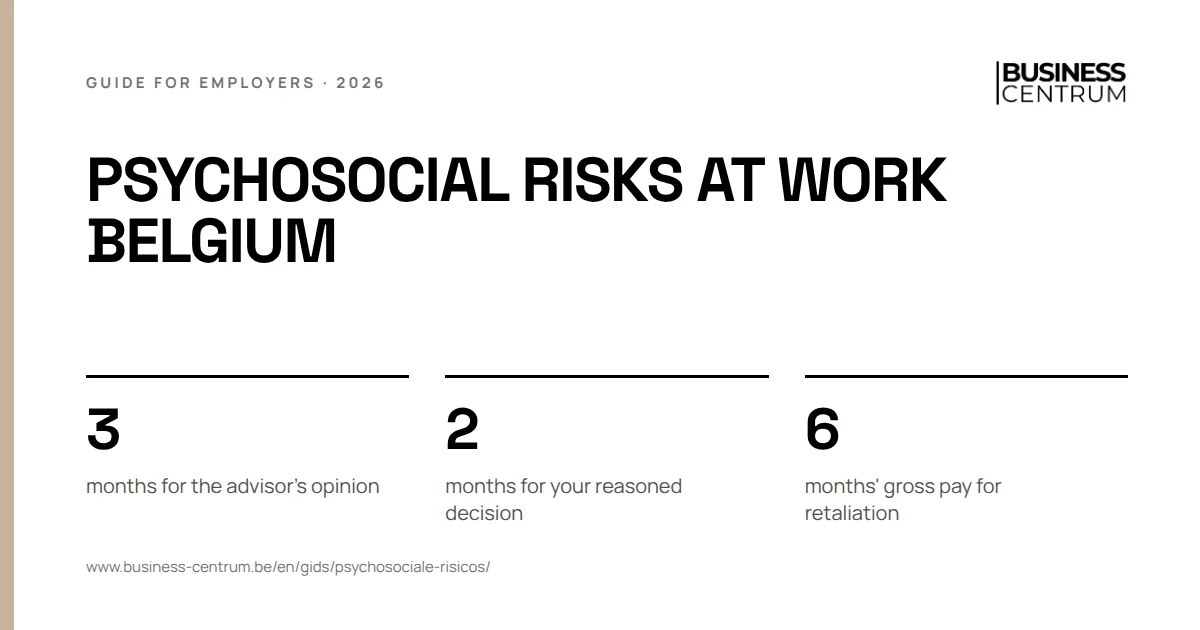
Psychosocial risks at work in Belgium are the risks of psychological harm caused by the organisation of work, its content, working conditions and relationships at work. Every employer must map them in a risk analysis, take prevention measures, appoint a prevention advisor for psychosocial aspects and state in the work rules how an employee can ask for help. If an employee requests a formal intervention, strict deadlines apply: up to 3 months for the opinion, 2 months for your decision and, for violence or harassment, protection against dismissal. Below you will find what you need to arrange and what you do when things go wrong.
What are psychosocial risks at work?
Section 32/1 of the Well-being at Work Act defines psychosocial risks as the likelihood that one or more employees suffer psychological harm, with or without physical harm, due to exposure to elements of:
- work organisation: structure, division of tasks, procedures;
- work content: the tasks themselves, complexity, emotional load;
- employment conditions: schedules, contracts, pay, career;
- working conditions: the workplace, noise, equipment;
- interpersonal relationships at work: with colleagues, managers and third parties such as customers.
Only elements you can influence as an employer and that objectively pose a danger count. Stress, burnout, conflicts, violence, harassment and unwanted sexual behaviour all fall under it. Psychosocial risks are one of the areas of well-being at work. All your obligations are in our guide on the well-being at work act.
Psychosocial risk analysis: mandatory for every employer
The employer identifies the situations that can lead to psychosocial risks and assesses the risks (section 32/2 of the Well-being at Work Act), paying particular attention to stress, violence, harassment and unwanted sexual behaviour. That analysis is part of your general risk analysis and ends up in the global prevention plan and the annual action plan.
If your employees deal with customers, patients or other third parties, you take that into account. Employees can have acts of violence or harassment by third parties recorded in a register. The confidential counsellor or the prevention advisor keeps it, and you keep those statements for 5 years.
Based on the analysis, you take prevention measures, at least:
- material and organisational measures to prevent violence, harassment and unwanted sexual behaviour;
- procedures for those who feel victimised: reception, advice and fast, impartial intervention;
- specific protection for employees who deal with third parties;
- the duties of managers in prevention;
- information and training for employees;
- information for the Committee for Prevention and Protection at Work, if you have one.
In a small SME, the external prevention service often does most of the analysis. How that works is in external prevention service.
The actors: prevention advisor for psychosocial aspects and confidential counsellor
Prevention advisor for psychosocial aspects. Every employer has one. With fewer than 50 employees, he always comes from your external service. He handles requests for informal and formal intervention and advises on the risk analysis and measures.
Confidential counsellor. From 50 employees you appoint one. Below that it is not mandatory, unless the union delegation or all employees ask for one. At least one confidential counsellor comes from your own staff from 50 employees, or from 20 employees if the prevention advisor for psychosocial aspects comes from an external service. The exact rules are in is a confidential counsellor mandatory.
The employee chooses whom to approach. The conversation takes place during working hours and counts as working time. Travel costs are yours. You put the contact details of both in the work rules and somewhere every employee can find them, such as the intranet. Who your internal prevention advisor is and what training he needs is covered in internal prevention advisor.
Psychosocial risks in the work rules
The work rules state:
- the contact details of the prevention advisor for psychosocial aspects or of the external service he works for;
- the contact details of the confidential counsellor, if you have one;
- the procedures for reporting violence, harassment or unwanted sexual behaviour.
Leaving these out is, under section 201 of the Social Penal Code, a level 1 offence: an administrative fine of € 100 to € 1,000. How to amend the work rules is in drawing up work rules. Our work rules template includes the chapter on well-being.
The internal procedure: informal or formal
An employee who believes he is suffering harm can always talk to you or his manager, or to a Committee member or union delegate. In addition, there is a dedicated procedure with two routes.
| Step | Who | Deadline | Effect |
|---|---|---|---|
| First contact | Confidential counsellor or prevention advisor | Interview no later than 10 calendar days after first contact | The employee chooses: informal, formal or nothing |
| Informal intervention | Confidential counsellor or prevention advisor | No fixed deadline | Conversations, intervention with a manager, conciliation |
| Mandatory interview before a formal request | Prevention advisor | Within 10 calendar days | Document confirming the interview |
| Acceptance or refusal of the formal request | Prevention advisor | Within 10 calendar days | Without an answer the request counts as accepted |
| Opinion to the employer | Prevention advisor | At most 3 months, extendable by 3 | Analysis and proposed measures |
| Announcing an individual measure | Employer | No later than 1 month after the opinion | In writing and in advance, with a hearing if working conditions change |
| Reasoned decision | Employer | No later than 2 months after the opinion | In writing to the advisor, the requester and the other party |
Both routes are open for any psychosocial situation, not only harassment: also for stress, burnout or a conflict. If the request is mainly collective, for example excessive workload across a department, the advisor follows a separate collective procedure.
Dismissal protection after a formal request
If an employee files a formal request about violence or harassment, or testifies in such a case, you may not dismiss or disadvantage him for reasons related to that request (section 32terdecies of the Well-being at Work Act). If it happens within 12 months after you learned of the request, you must prove that the dismissal or measure is unrelated.
If the court finds you breached the protection, you pay, at the employee's choice, a lump sum of 6 months' gross pay or the actual damage. A proportionate and reasonable prevention measure to stop the danger remains possible. For facts linked to a ground of discrimination, this provision does not apply. In case of abuse of the procedure, the protection lapses.
If you want to dismiss an employee who filed a complaint, have the file checked first. A dismissal with a well-documented reason stands stronger: see dismissing an employee and statement of reasons under CLA 109.
Decision aid: what do you do when you see a signal?
| Signal | First step | Then |
|---|---|---|
| Employee complains about workload or stress | Manager discusses tasks and planning | Refer to the prevention advisor if it persists; review the risk analysis |
| Conflict between two colleagues | Refer to the confidential counsellor for an informal intervention | Formal request if it is not resolved |
| Report of harassment or unwanted sexual behaviour | Take it seriously, record the report, refer to the prevention advisor | Precautionary measures if the advisor proposes them; no adverse measure for the reporter |
| Aggression by a customer | Arrange support and psychological care | Have it recorded in the third-party register; adjust prevention |
| Employee goes off with burnout | Follow the rules in employee off sick | See employee burnout |
A disciplinary sanction for the perpetrator may be needed, but wait for the opinion and follow the rules on disciplinary sanctions. A first written warning is often the right step. If the fault makes cooperation impossible, the deadline for dismissal for serious misconduct applies.
What you do as an employer: step by step
- Appoint the prevention advisor for psychosocial aspects, through your external service if you have fewer than 50 employees.
- Decide on a confidential counsellor. Mandatory from 50 employees, otherwise on request.
- Have the psychosocial risk analysis carried out and include the measures in your prevention plan.
- Amend the work rules with the contact details and procedures, and make them visible.
- Inform and train your managers. They see the first signals.
- Respond to an opinion within the deadlines: individual measures within 1 month, your decision within 2 months.
- Protect the reporter and witnesses. Take no adverse measure without a reason unrelated to the request that you can prove.
Mistakes we often see
- No contact details in the work rules. That is an offence in itself, whatever happens next. What changes for fines from 2026 is in Social Penal Code 2026.
- Limiting the risk analysis to physical risks. Psychosocial risks always belong in it.
- Dismissing a complaint as a personal conflict. Conflicts also fall under the procedure.
- Transferring the reporter without checking whether it is a prevention measure or an adverse one.
- Letting the deadline for your decision pass. The employee can then go to the inspectorate.
- Using camera footage or e-mails without following the rules. See cameras in the workplace and right to disconnect for availability outside hours.
What Business Centrum does for you
Business Centrum is not a prevention service and does not carry out psychosocial risk analyses or interventions: that is your prevention advisor's job. We put the contact details of your prevention advisor, your confidential counsellor and the procedures correctly in the work rules, and update them if you change service. In case of absence or dismissal after a report, we process payroll and documents, together with Acerta, and point out the protection period. To see where your personnel policy carries risks, our personnel analysis helps. Unsure after a report? Have it checked before you take a measure.