
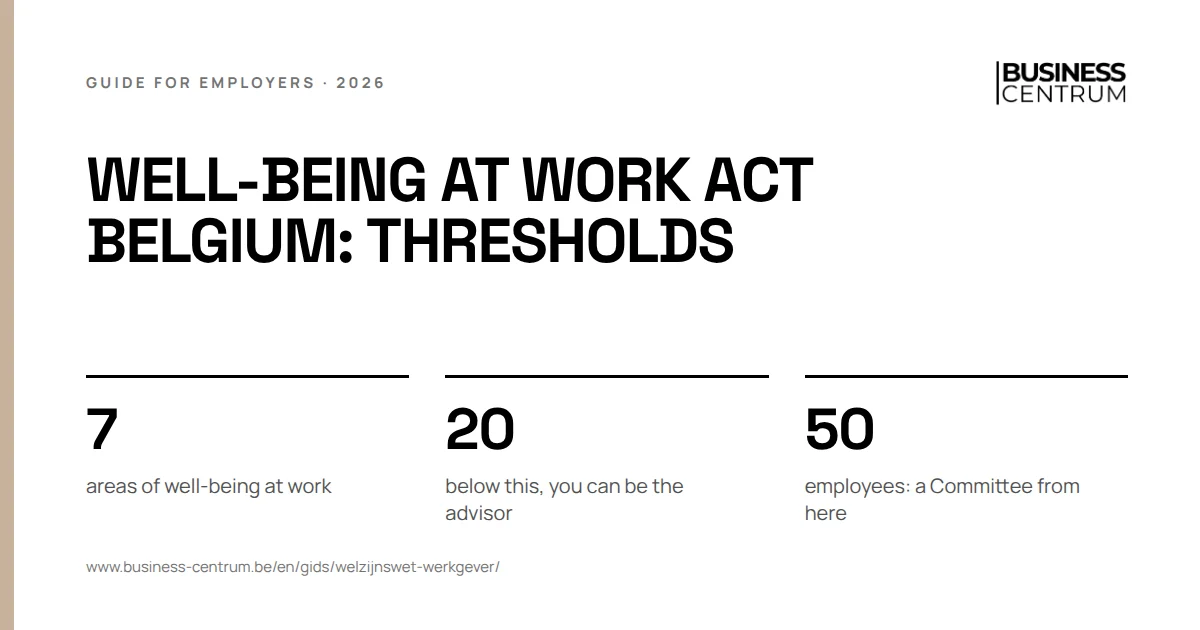
The well-being at work act in Belgium of 4 August 1996 requires every employer, from the first employee, to prevent risks at work in 7 areas: safety, health, psychosocial aspects, ergonomics, occupational hygiene, embellishment of the workplace and environment. In practice you carry out a risk analysis, draw up a prevention plan, set up an internal service with a prevention advisor, join an external service, organise first aid and induct new employees. How much you do yourself depends on your size: below 20 employees you may be your own prevention advisor, from 50 a Committee is set up. Below are the obligations and what they mean for an SME.
What is the well-being at work act?
The Act of 4 August 1996 on the well-being of employees in the performance of their work is the basis. The code on well-being at work sets out the rules in books and titles: general principles, organisation of prevention, workplaces, risks by type, specific groups. Together we call this the well-being legislation.
The act starts from a simple idea: the employer is responsible for the well-being of his employees and must prevent risks rather than repair damage. To do so, he applies 10 general prevention principles (section 5): avoid risks, assess what cannot be avoided, tackle risks at source, replace the dangerous with the less dangerous, give priority to collective protection, adapt work to the person and inform employees. The measures may never impose financial costs on employees.
The well-being act is separate from the employment contract and payroll, but touches them at many points: the work rules, absence after an occupational accident, health surveillance on hiring.
The seven areas of well-being at work
| Area (section 4) | What it means | What you do in practice |
|---|---|---|
| 1. Occupational safety | Preventing accidents | Safe machines and installations, instructions, protective equipment |
| 2. Health | Preventing occupational diseases | Health surveillance by the occupational physician where the analysis requires it |
| 3. Psychosocial aspects | Stress, burnout, harassment, violence | Risk analysis, psychosocial prevention advisor, procedures in the work rules |
| 4. Ergonomics | Adapting work to the person | Workstations, screen work, lifting |
| 5. Occupational hygiene | Exposure to substances, noise, vibrations | Measurements, ventilation, replacing hazardous substances |
| 6. Workplace embellishment | A decent working environment | Sanitary facilities, canteen, changing room, order |
| 7. Environment | Environmental measures affecting the other areas | Storage and waste organised without risk to employees |
Well-being at work act Belgium: the core is the risk analysis
Everything starts with the risk analysis. The code describes a dynamic risk management system: you identify hazards, determine and assess the risks, and take measures at three levels: the whole organisation, each group of workstations or jobs, and the individual. Measures follow a fixed order: first avoid risks, then avoid damage, then limit damage.
In an SME you do not do the analysis alone. Your internal prevention advisor and above all the external service do most of the work. The results go into the global prevention plan, drawn up for 5 years, and an annual action plan. How to draw up those plans, with an example, is in our guide on the global prevention plan.
The psychosocial risk analysis is a mandatory part. What it involves and which procedures you need is in psychosocial risks at work.
Obligations by company size
| Number of employees | Prevention advisor | Psychosocial aspects | Consultation |
|---|---|---|---|
| From 1 | Internal service required; below 20 you may be the advisor yourself | Advisor from the external service | Direct participation of employees if there is no Committee and no union delegation |
| From 20 | An employee as internal prevention advisor | Advisor from the external service | Union delegation takes over the Committee's tasks, if there is one |
| From 50 | Training level according to your group | Internal or external | Committee for Prevention and Protection at Work from 50 employees, confidential counsellor from own staff from 50 |
An external prevention service is mandatory for almost every employer, even with one employee, because health surveillance requires a medical department that an SME does not have. What it costs and does is in external prevention service. What training your internal advisor needs and when you can take on the role yourself is in internal prevention advisor and is a prevention advisor mandatory.
The other obligations from the code
First aid. You organise first aid based on the risk analysis: a first aid kit, designated first aiders with basic training of at least 15 hours, and a register of each intervention. Details are in is first aid mandatory.
Induction of new employees. You take measures to welcome each new employee and appoint an experienced employee to guide him. Whoever organises the induction signs a document confirming that the necessary information and instructions on well-being were given. Combine it with the rest of the start: Dimona, contract and work rules.
Information and training. Every employee receives sufficient and appropriate training on well-being, during working time and at no cost to him.
Emergency plan. Where the risk analysis requires it, you draw up an internal emergency plan with procedures for alarm, evacuation and firefighting.
Occupational accidents. You report an occupational accident to your insurer within 8 days and investigate it to prevent repetition. How that works is in reporting an occupational accident.
Specific groups. Own rules apply to pregnant employees, young workers, interns and temps. For pregnancy, read maternity protection. The act also applies to teleworkers: see structural telework.
Work rules. The work rules state where the first aid kit is, who gives first aid, the contact details of the psychosocial prevention advisor and the procedures for violence or harassment. See drawing up work rules.
Consultation: Committee, union delegation or employees
With on average at least 50 employees, you set up a Committee for Prevention and Protection at Work through the social elections. The Committee advises on the prevention plan, the annual action plan and the choice of prevention advisors. Without a Committee, the union delegation takes over those tasks. Without either, employees take part in well-being consultation directly. When the next elections are is in social elections Belgium 2028.
Checklist: do you comply with the well-being at work act?
| Question | Yes | No: what you do |
|---|---|---|
| Are you affiliated with an external prevention service? | Choose a service and join before the first employee starts | |
| Is there an internal prevention advisor, or are you it below 20 employees? | Appoint someone and arrange the required training | |
| Is there a written risk analysis, including psychosocial? | Ask your external service for it | |
| Is there a global prevention plan no older than 5 years and an action plan for this year? | Draw them up with your prevention advisor | |
| Are there trained first aiders and a first aid kit? | Appoint them and have them follow the basic training | |
| Are the well-being details in the work rules? | Amend the work rules | |
| Are new employees inducted with a signed document? | Create an induction procedure | |
| Do you have occupational accident insurance? | Take it out: see is occupational accident insurance mandatory |
What you do as an employer: step by step
- Join an external prevention service before the first employee starts.
- Set up the internal service. Appoint a prevention advisor, or take on the role yourself below 20 employees.
- Have the risk analysis carried out, for all areas, including psychosocial.
- Draw up the global prevention plan and annual action plan and submit them to the Committee or the employees.
- Organise first aid, induction and training.
- Update the work rules with the mandatory well-being details.
- Evaluate every year. Accidents, incidents and the internal service's annual report drive the next action plan.
What do you risk?
A breach of the well-being act or the code is, as a rule, a level 3 sanction under the Social Penal Code: an administrative fine of € 1,000 to € 10,000. If health damage or an occupational accident follows, it is heavier. The inspectorate can also set a deadline or halt work. What changes this year for fines is in Social Penal Code 2026, and what the inspectorate checks during a visit in labour inspection.
Mistakes we often see
- Thinking the act only applies from a certain size. It applies from the first employee.
- A prevention plan older than 5 years. Or none at all.
- Forgetting psychosocial risks in the analysis.
- No induction procedure and no signed document.
- Charging the employee for protective equipment or training. That is not allowed.
- Choosing an external service and then doing nothing. Responsibility stays with you.
What Business Centrum does for you
Business Centrum is not a prevention service and does not draw up risk analyses or prevention plans: your prevention advisor and external service do that. We handle the administration linked to it: the correct Dimona your external service invoices on, the well-being details in the work rules we draw up for you, and processing absence after an occupational accident, together with Acerta. Hiring staff for the first time? We go through the first steps with you, see becoming an employer. Unsure whether you comply? Have it checked before the inspectorate visits.