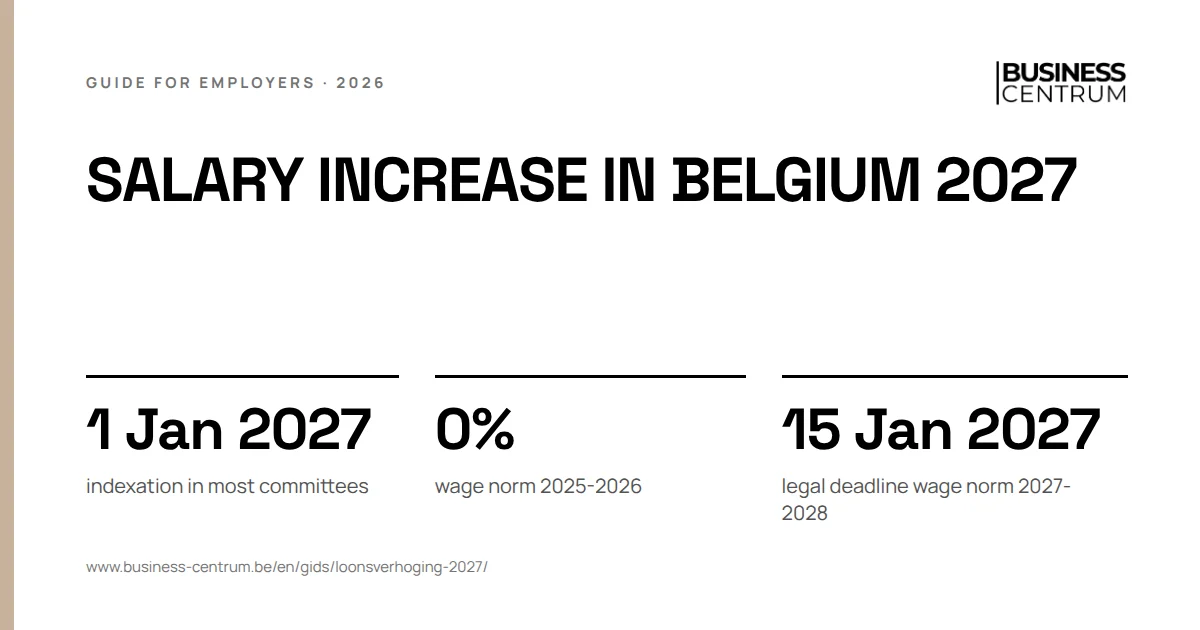
In Belgium, salaries rise in 2027 in three ways: automatic indexation, the scale increases (baremieke verhogingen) in the sector agreement and, if there is room, the 2027-2028 wage norm (loonnorm). The first two are guaranteed. The third is not yet fixed on 25 October 2026: the Central Economic Council still has to issue its report, and the social partners legally have until 15 January 2027 to reach an agreement. For 2025-2026 the norm was 0%. If you want to give an employee a raise on top of indexation in 2027, you need to know what counts and what does not.
Salary increase in Belgium 2027: what rises automatically and what does not
The wage norm act of 26 July 1996 sets every two years how much wage costs in the private sector may rise at most. Article 6, § 4 states it without reservation: "Indexations and scale increases are always guaranteed." Everything on top must fit within the norm, unless article 10 excludes it. This table sets out the building blocks of a salary increase in 2027.
| Building block | Counts towards the wage norm? | What is fixed on 25 October 2026 |
|---|---|---|
| Automatic indexation | no, guaranteed | date and formula per committee; not the January 2027 percentages |
| Scale increase (seniority, age, normal promotion under the agreement) | no, guaranteed | the pay scales per committee |
| GGMMI (minimum wage) | not the rise with indexation | € 2,233.61 per month since 1 July 2026 |
| Individual raise or one-off gross bonus | yes | 2027-2028 norm not yet set |
| CLA 90 bonus | no | 2026 ceiling € 4,255, 2027 ceiling not yet published |
| Profit premium | no | conditions of the employee participation act |
| Higher meal voucher (employer share up to € 2 more) | no if granted by 31 December 2026, yes after that | maximum employer share € 8.91 |
| Contributions to a supplementary pension | no | conditions of the supplementary pensions act |
The norm is measured per employer, so per legal entity, and also applies to individual agreements. A raise for a single employee therefore counts.
Indexation in 2027: a different moment and formula per committee
According to the Federal Public Service Employment, there is no general Belgian law requiring all salaries to be indexed automatically. Indexation is laid down in the agreements of the joint committees, and each committee has its own formula. In most committees with a January indexation, salaries rise on 1 January 2027, but the percentage differs:
- November against November. Hospitality (JC 302), the food industry and road transport compare November 2026 with November 2025. Their percentage can be calculated as soon as Statbel publishes the November index on 27 November 2026.
- The average of November and December. The auxiliary committee for white-collar employees (JC 200) takes the average of two months. That percentage follows the December index on 23 December 2026. Food retail (JC 119) uses a reference index based on the same months.
- More than one step a year. Cleaning (JC 121) indexes in January and July, construction (JC 124) every quarter. Their January step is therefore smaller.
The full overview per committee, with the formula from the agreement and the date on which the percentage can be calculated, is in our guide to the January 2027 indexation. Other committees index at another moment, such as metalworking in July. To find out which committee applies to your staff, see finding your joint committee.
For salaries above € 4,000 gross per month, the cents index has applied since 1 June 2026: the first 2% of indexation only applies to € 4,000. After that, indexation applies to the full salary again. How this works out per employee and which contribution you pay to the NSSO in the meantime is explained in our article on the cents index.
The 2027-2028 wage norm: how it is set
Since the reform of 19 March 2017, the wage norm follows a fixed procedure with statutory deadlines.
- The CRB report. In even years, the Central Economic Council (CRB) issues a technical report on the maximum available margin before 15 December 2026. It compares expected wage cost growth in Germany, France and the Netherlands with expected indexation in Belgium.
- The interprofessional agreement. Based on that report, the social partners set the margin before 15 January 2027. It is laid down in a collective agreement of the National Labour Council, which is declared generally binding.
- Mediation. If there is no agreement within 2 months of the report, the government brings the social partners together and makes a mediation proposal.
- Royal decree. If there is no agreement within 1 month of that consultation, the government sets the norm by a decree deliberated in the Council of Ministers.
- Sector and company. The sectors then conclude their agreements on wage cost growth, legally before 15 May 2027, and companies before 30 June 2027.
The deadlines are not always met. In the previous round, the CRB report only appeared on 19 February 2025, and the 2025-2026 norm was set by the royal decree of 12 September 2025, published in the Belgian Official Gazette on 22 September 2025. This is how the CRB arrived at 0%:
| Step in the CRB calculation, 2025-2026 margin | Value |
|---|---|
| Expected wage cost growth in Germany, France and the Netherlands | 6.40% |
| Minus expected indexation in Belgium | 5.50% |
| Minus correction term | 0.50% |
| Minus safety margin (25% of the remainder, at least 0.50%) | 0.50% |
| Maximum available margin | 0% |
High inflation in Belgium therefore shrinks the margin: indexation absorbs the room the neighbouring countries leave. The norm cannot fall below zero, because the law guarantees the forecast indexations.
What the coalition agreement announces
The federal coalition agreement of 31 January 2025 keeps "the principle of the 2017 wage norm act" and the principle of automatic indexation. It does ask the social partners for advice, by 31 December 2026, on reforming the wage act and automatic indexation, with a new benchmark that takes into account a broader definition of wage costs and the historical wage cost handicap. That is a request, not a change in the law: until a new act appears in the Official Gazette, the procedure above applies.
What falls outside the wage norm
Article 10 of the wage norm act lists what is not counted when calculating wage cost growth. For an SME, these are the main items:
- The profit premium under the employee participation act: in total at most 30% of the gross wage bill, with 13.07% solidarity contribution and 7% tax for the employee. See profit premium for employees.
- CLA 90 bonuses. The Federal Public Service Employment treats collective bonus plans as profit sharing. You pay a special contribution of 33%; in 2026 the bonus is free of ordinary social security up to € 4,255. See our guide to the CLA 90 bonus.
- Contributions to a supplementary pension that comply with the supplementary pensions act.
- More staff. A higher wage bill because you employ more full-time equivalents does not count.
- One-off innovation premiums and the one-off purchasing power premium from the 2023-2024 wage round.
- The meal voucher exception. The act of 19 November 2025 keeps a higher employer share, of at most € 2, outside the norm if it is granted between 1 January 2026 and 31 December 2026. In 2027 it counts; see meal vouchers 2027.
An ordinary one-off gross bonus is not on that list and therefore counts. According to the Federal Public Service Employment, benefits you already granted in the previous two years may be continued, possibly in another form, but without an increase. Check this before you introduce a cafeteria plan.
The minimum wage in 2027: what is already fixed
The guaranteed average minimum monthly income (GGMMI) for a full-time employee aged 18 or over has been € 2,233.61 gross per month since 1 July 2026. It rises by 2% each time the pivot index is exceeded. Statbel sets the next pivot index for benefits and public sector salaries at 102.29 points; when it will be reached is not known on 25 October 2026.
No increase beyond indexation has been set for 2027. The last one was the step of € 35.70 in April 2026, the third and last from the 2021 arrangement. The coalition agreement announces "in 2028" a new, similar step of € 35 gross. That is an announcement: no National Labour Council agreement lays it down yet.
The GGMMI is a floor; most sector pay scales are higher. Amounts by age and per hour are in minimum wage Belgium 2026, this year's steps in GGMMI 2026.
Scale increases and seniority
The law defines a scale increase as "the existing pay increase due to length of service, age, normal promotions or individual changes of category, laid down in collective labour agreements". So two conditions: the increase must be in a collective agreement, and it must already exist. A pay scale you introduce yourself without an agreement is not a scale increase within the meaning of the law.
An example from the auxiliary committee for white-collar employees: in scale I, class B, the minimum monthly wage is € 2,336.26 without experience and € 2,349.65 after one year. An employee who gains a year of experience in 2027 moves up to the higher amount, regardless of the wage norm. The pay scales per committee are in our overview of pay scales, the rules of JC 200 in our guide to joint committee 200.
A long-service bonus at a service anniversary is something else, with its own social security and tax rules.
Decision aid: can you give a raise on top of indexation in 2027?
| What you want to give | Allowed in 2027? | Counts towards the norm? |
|---|---|---|
| Indexation under your sector agreement | Required, on the date in the agreement | No |
| The next step on the sector pay scale (experience, age, category) | Required, under the agreement | No |
| A promotion to a higher job category under the agreement | Yes | No, if the agreement provides for it |
| An individual raise, for example €50 gross per month | Yes, within the 2027-2028 norm | Yes |
| A one-off gross bonus | Yes, within the norm | Yes |
| A collective bonus on measurable targets | Yes, with a CLA 90 plan | No |
| A share of the profits | Yes, with a profit premium | No |
| A higher employer share in the meal voucher | Yes, up to € 8.91 | Yes, unless granted by 31 December 2026 |
| A contribution to a supplementary pension | Yes, under the supplementary pensions act | No |
The hardest case is an individual raise in the first months of 2027. The norm covers 2027 and 2028 together, even if it is only set later. If you promise a raise in January and the norm then comes out at zero, you are above it. A raise in December 2026 is no way out: it then counts for the 2025-2026 norm, which is 0%.
What you can do: only fix the raise once the norm is known, choose a results-based bonus through a CLA 90 plan, or still raise meal vouchers in 2026. For a CLA 90 plan with a first reference period from January to March 2027, the filing deadline is 31 January 2027; for a plan covering all of 2027 it is 30 April 2027.
Worked example: what a 50 euro raise costs in 2027
Worked example: a JC 200 employee with a fictitious salary of 3,000 euros
An employee earns €3,000 gross per month in December 2026, below the cents index threshold. The January 2027 index percentage is not yet known: we call it i. The employer wants to give €50 gross per month on top of indexation from January.
| Without a raise | With a €50 raise | |
|---|---|---|
| Monthly salary December 2026 | €3,000 | €3,000 |
| Monthly salary January 2027 | €3,000 x (1 + i) | €3,000 x (1 + i) + €50 |
| What counts towards the norm | nothing, indexation is guaranteed | €50 per month, about 1.7% of the salary before indexation |
The extra cost of the raise over a full year, with employer contributions and the bonuses based on the monthly salary:
| Item | Calculation | Cost per year |
|---|---|---|
| Twelve monthly salaries | 12 x €50 | €600 |
| End-of-year bonus JC 200 (100% of the monthly salary) | 1 x €50 | €50 |
| Employer social security contributions (about 25%) | 25% x €650 | €162.50 |
| Double holiday pay (92% of the monthly salary, no employer contributions) | 92% x €50 | €46 |
| Total | €858.50 |
The raise therefore costs about €858.50 a year, or seventeen times the monthly amount. At the next indexation, the raise also rises with your committee's percentage; from then on it costs €858.50 x (1 + that percentage). Of €50 gross, the employee keeps €43.47 taxable after 13.07% personal social security. What remains net after withholding tax depends on salary and family situation.
Employer contributions are rounded, without small special contributions or reductions. For a blue-collar worker the cost differs, because holiday pay runs through the holiday fund. See also withholding tax 2027, holiday pay 2027, end-of-year bonus net calculation and the gross-net calculator.
Calendar: what to follow for the salary increase in Belgium 2027
| Date | What happens |
|---|---|
| 27 November 2026 | Statbel publishes the November index: percentage can be calculated for committees based on November |
| 15 December 2026 | Statutory deadline for the CRB report on the 2027-2028 margin |
| 23 December 2026 | Statbel publishes the December index: percentage can be calculated for JC 200, among others |
| 31 December 2026 | Last day to raise the employer share of the meal voucher outside the norm; deadline for the social partners' advice on the wage norm act |
| 1 January 2027 | Indexation in most committees with a January indexation |
| 15 January 2027 | Statutory deadline for the interprofessional agreement on the 2027-2028 norm |
| 31 January 2027 | Filing deadline for a CLA 90 plan with a first reference period from January to March 2027 |
| 30 April 2027 | Filing deadline for a CLA 90 plan covering all of 2027 |
| 15 May 2027 | Statutory deadline for sector agreements on wage cost growth |
| 30 June 2027 | Statutory deadline for company agreements |
An employer that exceeds the wage norm risks an administrative fine of € 250 to € 5,000, multiplied by the number of employees concerned, up to 100 employees. Everything that changes for employers on 1 January 2027 is brought together in what changes in 2027.
What Business Centrum does for you
Business Centrum applies the January 2027 indexation under the agreement of each employee's committee and applies the scale steps on the right date, together with Acerta, in your payroll. Want to give someone a raise? In a staff analysis we work out what it costs you per year and whether a CLA 90 plan, a profit premium or a higher meal voucher fits better than a gross raise. As soon as the 2027-2028 wage norm is set, we will tell you how much room there is. Have it checked.