
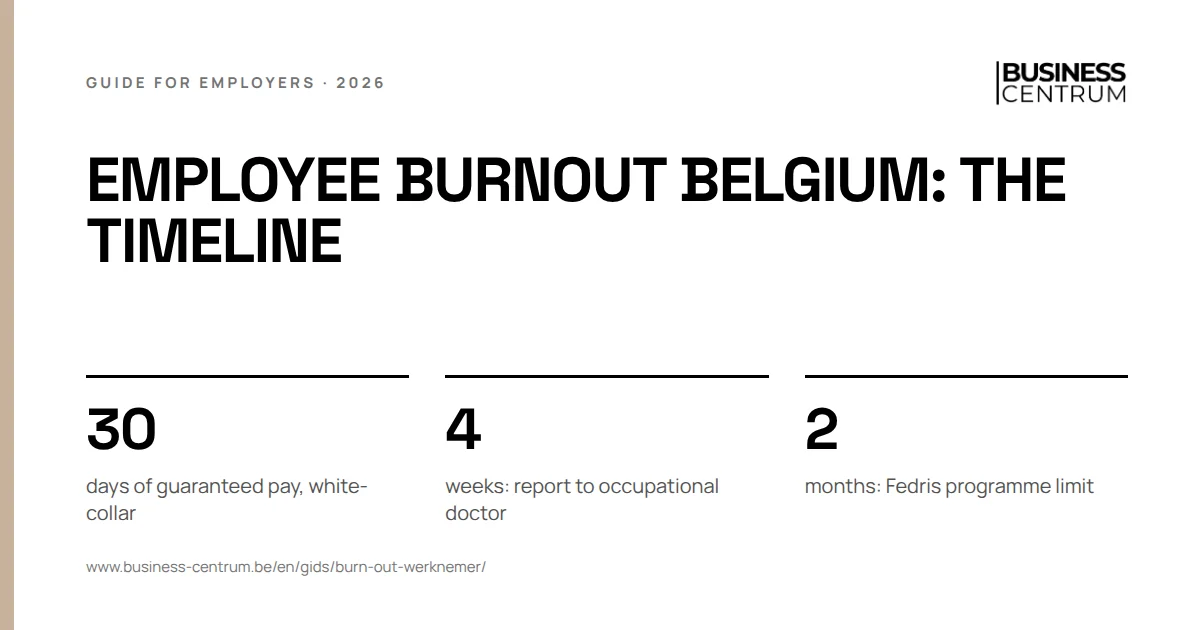
An employee with burnout in Belgium is unfit for work like with any illness: you first pay guaranteed pay, 30 calendar days for a white-collar employee, then the health insurance fund takes over. After 4 weeks you report the absence to the occupational physician, who makes contact. If the burnout is at an early stage, unfit for less than 2 months or still working, the employee can join the free prevention programme of Fedris. Below you will read what you do during the absence, on return, in case of dismissal, and what the well-being act requires to prevent burnout.
Employee burnout in Belgium: what is it legally?
Burnout is not a separate category in employment law. An employee who cannot work because of burnout is unfit for work. The contract is suspended, as with any illness, and the normal rules apply: the medical certificate, guaranteed pay, the medical inspector and reintegration. What a suspension means is in suspension of the employment contract.
You do not know the diagnosis either. The doctor only states on the certificate that and for how long the employee is unfit, not why. Do not ask: see may an employer ask for the diagnosis. If the employee tells you it is burnout, that is his choice, and you treat it discreetly.
Burnout does have a place in well-being law. It is a psychosocial risk: harm from work organisation, workload or relationships at work. As an employer you have obligations to prevent it. They are in psychosocial risks at work.
The timeline of an absence due to burnout
| Period | Who pays | What you do |
|---|---|---|
| First days | You, guaranteed pay | Receive the medical certificate, possibly send a medical inspector |
| Until day 30 (white-collar) | You, guaranteed pay | Pass on the absence for payroll |
| After that | The health insurance fund, 60% of capped pay in the first period | Follow up the absence in the returns |
| After 4 weeks | Health insurance fund | Report to the occupational physician, who contacts the employee |
| From 8 weeks | Health insurance fund | Assessment of work potential possible; with at least 20 employees you request it yourself |
| Partial return | You for hours worked, the fund for the rest | Adapted work with the medical adviser's permission |
| After 6 months | Health insurance fund | Medical force majeure procedure possible, if return is permanently impossible |
For a blue-collar worker, guaranteed pay runs in steps. Day-by-day details are in guaranteed pay, what you do on day one in employee off sick. If the employee relapses within 8 weeks after returning, you only pay the balance of guaranteed pay, unless a certificate shows a different illness.
Contact during the absence
An employee with burnout must not work. He need not read e-mails, answer questions about files or be reachable. Contact is allowed, but in moderation:
- Agree on one contact person, preferably not the source of the strain.
- Ask how and how often the employee wants contact, and stick to it.
- No work questions. Hand over the work to colleagues, not to the sick employee.
- Show interest in the person, not in the return date.
You may send a medical inspector, as with any illness. The employee must then, within the limits of the rules, be available for up to 4 hours a day for the check. With burnout, use it when you have real doubts, not as routine. How it works is in sending a medical inspector. Your rules on availability outside working hours are in your arrangements on the right to disconnect.
The Fedris burnout prevention programme
Fedris, the federal agency for occupational risks, offers free support for employees with the first signs of burnout caused by long exposure to psychosocial risks at work. The programme is open to private-sector employees who are still working or have been unfit for less than 2 months. It lasts at most 2 years and targets both the person and the work environment. Travel costs are reimbursed too.
The employee submits a registration form signed by himself and by his treating doctor, the occupational physician or the psychosocial prevention advisor. After a diagnosis, Fedris decides whether the programme fits. The employee decides who is informed within the programme.
What you can do: point an employee showing signs of overload to the programme, to your psychosocial prevention advisor and to the occupational physician. How fast it starts depends on early signalling.
Gradual return: adapted work and reintegration
Adapted work with the health insurance fund's permission. During his incapacity, an employee can partially resume work, for example half-time. He notifies his fund and asks the medical adviser for permission no later than working day 1 before resuming. The medical adviser then has 30 working days to give written permission. The employee must retain a reduction in capacity of at least 50% on medical grounds. The permission is valid for up to 2 years and renewable. You pay for the hours worked, the fund pays a benefit for the rest. Record the adapted schedule in an addendum to the employment contract.
Reintegration process. Through the occupational physician, a reintegration process can start, aimed at adapted or other work with you. What changed in 2026 in that process and in the report after 4 weeks is in reintegration 2026.
On the return itself: look with the employee at what caused the overload, adjust tasks or planning, and schedule a conversation after a few weeks. The return is also the time to have the psychosocial risk analysis of that job reviewed.
Dismissal during or after burnout
Illness does not prohibit dismissal. Three points need attention:
- Discrimination. Dismissing because of someone's health may be discrimination. If you dismiss during illness, make sure you have an unrelated reason you can demonstrate.
- Notice stops running. If you give notice during illness, it does not run while the employee is unfit. Ending the contract with compensation may then cost less: see dismissing an employee during illness and sick during notice.
- Protection after a complaint. If the employee filed a formal request about violence or harassment, special protection under the well-being act applies.
If return is permanently impossible, the medical force majeure procedure can start after 6 months. It ends the contract without notice, but follows strict steps through the occupational physician.
Preventing burnout: what the employer must and can do
The well-being act requires you to identify, assess and prevent the risks of psychosocial harm. In practice:
| Obligation | What it means against burnout |
|---|---|
| Psychosocial risk analysis | Map workload, unclear roles, conflicts and emotional load per job |
| Prevention measures | Planning and staffing, realistic targets, clear tasks, manager support |
| Psychosocial prevention advisor | Point of contact for employees, often from the external service |
| Procedures in the work rules | Informal and formal intervention, also for stress and burnout |
| Training managers | Recognising signals: fatigue, cynicism, withdrawal, mistakes |
| Working time and availability | Limit overtime, arrangements on disconnection |
A confidential counsellor is mandatory from a certain size and helps you hear signals early: see is a confidential counsellor mandatory. All your well-being obligations are in well-being at work act.
Step by step: an employee goes off with burnout
- Receive the medical certificate and process the absence. Do not ask for the diagnosis.
- Arrange the handover of work to colleagues, not to the sick employee.
- Agree on a contact person and rhythm, or leave the employee alone if he asks.
- Point to help: the psychosocial prevention advisor, the occupational physician and the Fedris programme if it is still early.
- Report the absence after 4 weeks to the occupational physician.
- Prepare the return: adapted work with the medical adviser's permission, an adapted schedule, a conversation about the causes.
- Adjust prevention: have the job's risk analysis reviewed and include measures in the annual action plan.
Mistakes we often see
- Sending work questions during the absence.
- Asking for the diagnosis or sharing it with colleagues.
- Demanding a full return when adapted work is possible.
- Dismissing during illness without a file. Risk of a discrimination claim and notice that stops running.
- Not tackling the cause. The same workload leads to relapse.
- No psychosocial risk analysis. Then you lack the basis to prevent it.
What Business Centrum does for you
We process the absence in payroll: guaranteed pay, the transition to the health insurance fund, relapse and, on a partial return, pay for the hours worked and the adapted schedule, together with Acerta. We point out the deadlines for reporting to the occupational physician and the rules on dismissal. Supporting the employee is up to the occupational physician, the prevention advisor and Fedris. Day-to-day management sits in leave and absence. Unsure about a return or a dismissal? Have it checked.