
During a suspension of the employment contract the employee temporarily does not work and you in principle pay no wages, but the contract continues to exist. Whether you still pay depends on the ground: for sickness you first pay guaranteed pay, for short leave and public holidays normal wages, for temporary unemployment the ONEM pays, and for unpaid leave nobody does. Below you find every ground with who pays, and what a suspension does to the notice period and public holidays. The types of leave themselves are in our overview of the types of leave in Belgium.
What is a suspension of the employment contract?
During a suspension the two main obligations fall away temporarily: the employee does no work and you in principle pay no wages. The contract itself does not end. After the suspension it carries on as before, with the same job, the same pay and the same seniority.
The causes are statutory or contractual. Most are listed in the Employment Contracts Act of 3 July 1978: sickness and accident, annual holiday, short leave, force majeure, temporary unemployment and more. Other suspensions are agreed by employer and employee themselves, such as unpaid leave. Each cause has its own consequences for pay.
A suspension is not the end of the contract. An event of force majeure that makes work only temporarily impossible suspends the contract. If it makes work permanently impossible, it can end it. For an employee who can never do his job again for medical reasons there is a separate procedure: medical force majeure, at the earliest after 6 months of incapacity.
Suspension of the employment contract: the grounds and who pays
| Ground for suspension | Legal basis | Who pays |
|---|---|---|
| Sickness or non-work accident | Article 31 | You the guaranteed pay, then the health insurance fund |
| Workplace accident or occupational disease | Article 31 | You the guaranteed pay, then the insurer: 90% of the basic pay for temporary total incapacity |
| Maternity leave | Labour Act, article 39 | The health insurance fund, 15 weeks for a single birth |
| Birth leave | Article 30, paragraph 2 | You the first 3 days, then the health insurance fund, 20 days in total |
| Annual holiday | Article 28 | White-collar: you, with holiday pay. Blue-collar: the holiday fund |
| Public holidays | Public Holidays Act | You, 10 a year |
| Short leave for family events | Article 30, paragraph 1 | You, from 1 to 10 days per event |
| Leave for compelling reasons | Article 30bis | In principle nobody, 10 days a year |
| Temporary unemployment: economic, bad weather, technical breakdown | Articles 49 to 51 and 77/1 to 77/8 | The ONEM, 60% of capped pay, and you a supplement |
| Temporary unemployment due to force majeure | Article 26 | The ONEM, 65% of capped pay |
| Time credit, parental leave and other thematic leave, full-time | Collective agreement no. 103 and the 1985 Recovery Act | The ONEM, if the employee is entitled to a benefit |
| Sitting as a lay judge in the labour courts | Article 28 | Not you: the State pays attendance fees |
| Paid educational leave | Article 28 | You the normal wages, which are reimbursed later |
| Pre-trial detention | Article 28 | Nobody |
| Strike or lock-out | Case law | Not you |
| Unpaid leave, by mutual agreement | Agreement between both parties | Nobody |
| Disciplinary suspension | Work rules | Nobody |
A suspension for time credit or parental leave only exists with a full interruption. If the employee keeps working half-time or less, the contract simply runs with fewer hours. How to answer a request is in can an employer refuse holiday in Belgium.
Suspension of the employment contract due to sickness or accident
If an employee cannot work because of sickness or an accident, his contract is suspended from the first day of incapacity. You first pay guaranteed pay:
- a white-collar employee gets his full wages from you for 30 calendar days;
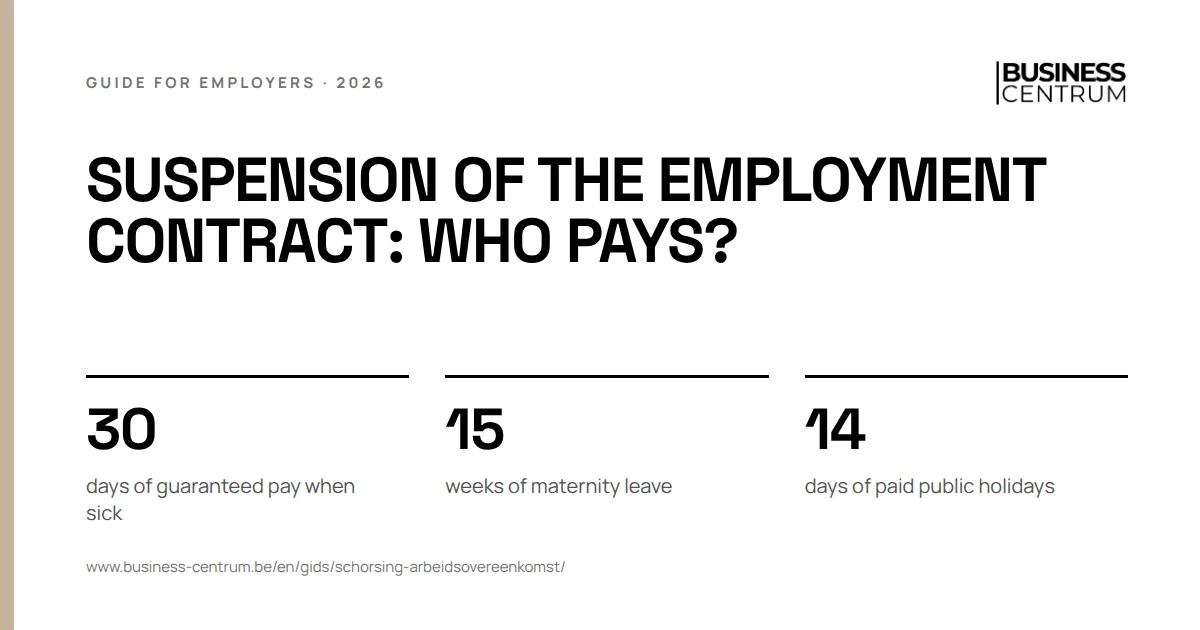
- a blue-collar worker gets his full wages for the first 7 days, from day 8 to 14 85.88% of normal pay and from day 15 to 30 25.88% of pay up to the health insurance ceiling, alongside the benefit from the health insurance fund.
The health insurance fund then takes over, with a benefit of 60% of capped pay in the first year. The employee reports his incapacity to the health insurance fund himself: within 14 calendar days for a blue-collar worker, within 28 for a white-collar employee.
For a workplace accident or occupational disease you also pay guaranteed pay first, after which the workplace accident insurer pays, and Fedris for an occupational disease. Never process a workplace accident as ordinary sickness. How to report it is in report a workplace accident in Belgium. The amounts per day, the certificate and relapses are in our guide on guaranteed salary in Belgium, and what you do on day one in sick leave in Belgium.
If an employee recognised as incapacitated temporarily does adapted or other work with your agreement, the contract is not suspended during that work. That is what article 31/1 of the Employment Contracts Act says.
Suspension of the employment contract due to force majeure
Force majeure is an event outside the will of both parties that makes work impossible: a fire, a flood, a power cut. If it is temporary, the contract is suspended. You pay no wages. The employee can receive a temporary unemployment benefit for force majeure: 65% of his capped pay instead of the 60% for economic unemployment.
A drop in orders is never force majeure. For a lack of work the rules on economic unemployment apply. For blue-collar workers you may introduce up to 4 weeks of full suspension per scheme, for white-collar staff up to 16 weeks per calendar year, but only if your company is in difficulty. The whole scheme is in economic unemployment for white-collar workers and in our guide on temporary unemployment.
Suspension of the employment contract by mutual agreement: unpaid leave
Employer and employee can always agree to suspend the contract temporarily. It is usually called unpaid leave. You set all the terms together. According to the Federal Public Service Employment, three consequences apply:
- you pay no wages;
- the employee has no protection at all against dismissal during that period;
- it affects his social security, especially sickness insurance and unemployment insurance.
So put the agreement in writing, even though the law imposes no form: the start and end date, the reason if you want to record it, what happens to benefits such as a company car or phone, and whether the employee may come back earlier. Let the employee check with his health insurance fund what the leave means for him.
A contractual suspension differs from statutory leave. Time credit, parental leave or leave for compelling reasons are rights of the employee with their own rules. Unpaid leave is a favour you may refuse.
Suspension of the employment contract as a sanction: only through the work rules
You may suspend an employee without pay for one or more days as a disciplinary penalty, but only if your work rules provide for that penalty. The Work Rules Act is strict:
- Only the penalties in the work rules may be imposed (article 16). If suspension is not in them, you cannot impose it.
- Notify the penalty on time, at the latest on working day 1 after the day you established the misconduct, or it is void (article 17).
- Enter the penalty in the register before the next wage payment, with the date, the reason and the nature of the penalty.
You pay no wages for the days of the disciplinary suspension. Pass them on for payroll, because they appear on the payslip and in the return. Use a disciplinary suspension only for misconduct listed in the work rules, not to cool down a conflict. The step before it is explained in written warning to an employee, and how to include penalties in work rules in Belgium.
What a suspension does to the notice period
The rules are in articles 38 and 37/7 of the Employment Contracts Act. It depends on who gives notice.
- The employee gives notice. He may also do so during a suspension, and his notice period keeps running.
- You give notice. You may also do so during a suspension, but your notice period stops running during annual holiday, maternity leave, birth leave, adoption leave, leave for compelling reasons, pre-trial detention and sickness or accident. Your period also stops during temporary unemployment for economic reasons or bad weather.
During a period of economic unemployment the employee may even end the contract without notice. For bad weather that is possible if the suspension lasts longer than a month.
The consequence for you: every suspension after your notice pushes back the end date. If an employee falls sick during your notice period, the contract lasts longer and you pay guaranteed pay again. When terminating becomes cheaper is in sick during notice period in Belgium.
Public holidays during a suspension
A public holiday that falls during a suspension is sometimes still paid:
- for sickness, an accident or maternity leave: the public holidays in the first 30 days of the suspension;
- for other suspensions: the public holidays in the first 14 days;
- public holidays during annual holiday are always paid.
After that you no longer pay them. What applies to next year's public holidays is in replacement public holiday in Belgium.
What you do as an employer during a suspension
- Establish the ground and ask for proof. A sick note, a request for time credit, a written agreement on unpaid leave or the temporary unemployment notice.
- Check who pays. If the suspension results from sickness, guaranteed pay starts. If it is temporary unemployment, the ONEM deadlines apply.
- Process it in the payslip and the returns. In the quarterly return to the NSSO you declare the days of suspension with the code for that absence. For temporary unemployment the social risk returns to the ONEM are added.
- Look at the consequences. Is a notice period running, does the end date move? Does a public holiday fall in the suspension? Does the period count for next year's end-of-year bonus or holiday pay? That depends on the ground and on the collective agreement of your joint committee.
- Plan the return. After a long sickness the occupational physician can start a return-to-work pathway. After unpaid leave the employee returns on the agreed date.
Mistakes we often see
- Processing a workplace accident as ordinary sickness. You then pay the wrong amount and miss the insurer.
- Agreeing unpaid leave orally. In a dispute about the end date or benefits you have nothing on paper.
- Imposing a disciplinary suspension that is not in the work rules. It is then void and you pay the wages.
- Forgetting that your notice stops. Sickness or holiday during your notice period pushes the end back.
- Not paying public holidays in the first days of a suspension.
- Sending an employee home without a legal suspension. The wages then remain due.
What Business Centrum does for you
We process every suspension in payroll: the guaranteed pay, public holidays paid during the suspension, the right code in the NSSO return and the returns to the ONEM for temporary unemployment, together with Acerta. For each suspension we tell you who pays and what it does to a running notice period. Unsure about unpaid leave or a disciplinary suspension? Have it checked before you decide.