
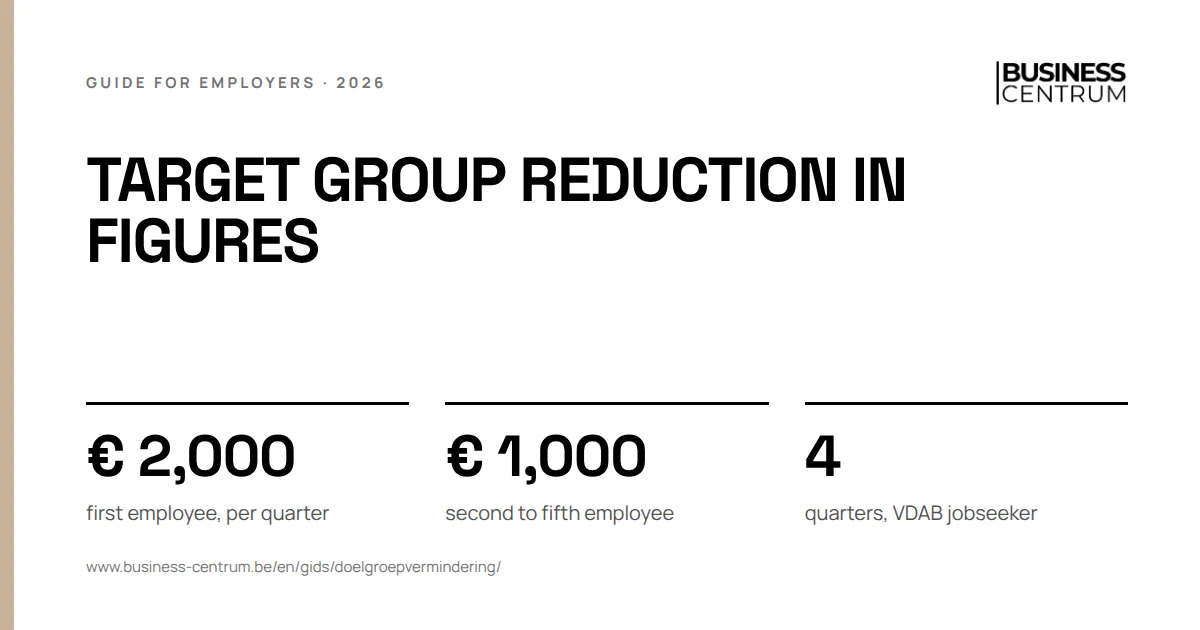
A target group reduction in Belgium is a fixed discount per quarter on your employer social security contributions for an employee from a specific group. It comes on top of the structural reduction, with at most one per employee. For your first employee it is € 2,000. Since 1 July 2026 the hospitality reduction and the Brussels older worker reduction are gone.
This guide is for the employer who wants to know which target group reduction he still gets in 2026, and for whom. The rules changed a lot in a short time: the programme law of 30 May 2026 scrapped and lowered federal reductions, and the regions closed their measures for older workers. Everything below comes from the administrative instructions of the NSSO (RSZ) for the third quarter of 2026. What you pay to the NSSO in total is in employer social security contributions.
How a target group reduction works
A target group reduction is a flat rate: a fixed amount that the NSSO labels with a code from G1 to G21. You deduct it from the employer contributions due for that employee. The NSSO calculates the amount as the flat rate times the employee's working time fraction, times a fixed factor that corrects for part-time work. Anyone who works at least 80% gets the full amount. Anyone who works less than 27.50% gets nothing, except with an employment contract of at least half time.
| Flat rate | Amount per quarter | Example of use in 2026 |
|---|---|---|
| G21 | € 2,000 | first employee |
| G1 | € 1,000 | second to fifth employee, VDAB jobseeker |
| G8 | € 1,500 | oldest group in the German-speaking Community |
| G2 | € 400 | running rights working time reduction |
| G3 | € 300 | older employee aged 55 in the German-speaking Community |
Three rules apply to every target group reduction:
- One per employee. Per employment line, the structural reduction plus at most one target group reduction counts.
- The region follows the workplace. Each region funds the target group reductions on its territory. The NSSO looks at the establishment unit where the employee works, not at the company's registered office.
- No other discount on top. The structural reduction and the target group reduction cannot be combined with any other reduction of employer contributions, except the social maribel.
If you do not enter a valid establishment unit number in the DmfA, or if the Crossroads Bank for Enterprises does not know that number for the quarter, the NSSO refuses the reduction. Watch out for this when you open a first establishment as a new employer.
Target group reduction for first hires: the biggest one left
The reduction for first hires is the main target group reduction for a small business in 2026. It applies to private sector employers whose staff fall under the social security scheme for employees. New amounts apply since 1 July 2026, also to rights already running.
| Rank | Amount per quarter | Duration | Condition |
|---|---|---|---|
| first employee | € 2,000 | unlimited | no employee in the 12 months before the hire |
| second to fifth employee | € 1,000 | 12 quarters | to be used within 20 quarters |
| sixth employee and beyond | none | dropped for employment from 1 July 2026 |
The reduction is not tied to one specific employee. Each quarter you choose who you apply it to, as long as enough employees were in service at the same time in that quarter. For the second employee, at least two people must have worked at the same time. The extra employment must last at least 1 month. A short peak in the reference period does not count up to 5 days.
The right for the first employee lapses if you have nobody in service who qualifies for 12 consecutive months. If you are affiliated with a social secretariat, you also get € 36.45 per quarter towards the affiliation costs, in every quarter in which you claim the reduction for the first employee. All conditions and exceptions are in first employee and social security reduction; the hiring steps are in hiring your first employee.
Target group reduction for older workers: per region
For older workers, the region of the workplace decides everything. In 2026 the picture is short for most employers: no new reduction opens.
| Region | Position in the fourth quarter of 2026 | Amount |
|---|---|---|
| Flanders, older existing employees | ended on 1 July 2025, without transition | none |
| Flanders, older jobseekers | no new right for hires from 1 July 2024, running rights until 31 March 2026 | none left |
| Brussels | ended on 1 July 2026, decree of 18 June 2026 | none |
| Wallonia | no new hires since 1 July 2026, existing rights until 31 December 2029 at the latest | € 400 to € 1,500 depending on age |
| German-speaking Community | running, quarterly wage below € 13,942.47 | € 300 to € 1,500 |
In Brussels the reduction applied, until it ended, from age 61. In Wallonia, hires from 1 April 2026 had a wage ceiling of € 13,770 per quarter, with a minimum age of 57 for a jobseeker or 60 with no condition. Employers who opened a right before the end keep the rules that applied at the time.
In the German-speaking Community the amount rises with age: € 300 at 55, up to € 1,500 from 62 until the quarter in which the employee reaches pension age. If your older employee works in Ghent, Antwerp or Bruges, there is no older worker reduction for him in 2026.
The target group reduction in Flanders that still runs
Flanders has one target group reduction that still opens new rights: the one for people without recent sustained work experience. It exists since 1 October 2023 and applies to the private and the public sector, for employment in a Flemish establishment unit.
| Condition | What the NSSO asks |
|---|---|
| Registration | at least 2 years as an unemployed jobseeker with VDAB before the hire, and registered until at least the day before |
| Wage | reference quarterly wage below € 10,000 |
| Amount | € 1,000 per quarter |
| Duration | the quarter of hire and the 3 following, 4 quarters in total |
| Proof | VDAB checks the conditions and certifies through Ecaro |
| Code in the DmfA | 6340 |
A quarter in which the wage goes over the ceiling still counts towards the 4 quarters. Some periods count as registration, such as illness or a break of at most three months for a short job. The former Flemish measures for low-skilled young people and older jobseekers open no new rights since 1 July 2024. If you hire young people, also look at the first job agreement.
Target group reduction in hospitality: scrapped from July 2026
The target group reduction for permanent staff in hospitality ended from 1 July 2026, without transitional measure. Anyone who had it in the payroll budget must take it out from the third quarter of 2026.
| What applied until the second quarter of 2026 | Rule |
|---|---|
| Who | employers under joint committee 302 with on average at most 49 employees |
| For whom | at most 5 permanent full-time employees per quarter |
| Amount under 26 | € 800 per quarter |
| Amount other employees | € 500 per quarter |
| Condition | registered cash register and daily attendance registration |
| From the third quarter of 2026 | nothing |
What remains in hospitality: the reduction for a first employee and the structural reduction. Occasional work and flexi-jobs have their own rules, with flat-rate contributions instead of reductions. What a flexi-jobber costs you is worked out in flexi-job cost for the employer; extras are in extras in hospitality. For payroll in the sector, see hospitality payroll and hospitality sector.
Two target group reductions one after the other: a worked example
Because only one target group reduction at a time counts per employee, it pays to plan the order. That matters most for a small business in Flanders hiring a second employee.
Worked example
Target group reduction for a second employee registered with VDAB
A fictional small business in Ghent has one employee, A, with the first employee reduction of € 2,000 per quarter. On 1 October 2026 it hires B, full time at € 3,000 a month. B was registered for 2 years as an unemployed jobseeker with VDAB. His quarterly wage is € 9,000, below the ceiling of € 10,000.
| Quarters | Reduction for B | Per quarter | Total |
|---|---|---|---|
| 1 to 4: fourth quarter 2026 to third quarter 2027 | people without recent sustained work experience | € 1,000 | € 4,000 |
| 5 to 16: fourth quarter 2027 to third quarter 2030 | second employee | € 1,000 | € 12,000 |
| together | € 16,000 |
If the business starts straight away with the second employee reduction, it stops after 12 quarters at € 12,000, and the VDAB reduction is lost. If it moves the second employee quarters later, it gets € 16,000 over 16 quarters. That works because the right for a second employee stays open for 20 quarters from the quarter of hire, and the employer picks the quarters.
Two conditions still apply: in every quarter with the second employee reduction, at least two employees must have been in service at the same time, and the VDAB certificate must be in place. The example leaves out the structural reduction; that comes on top for B.
Target group reduction and the contributions you owe
A target group reduction can never yield more than the contributions you pay for that employee. If the structural reduction and the target group reduction together exceed the employer contributions, the NSSO caps the target group reduction first and then the structural reduction. With a small part-time job or a low wage this can happen, and you then get less than the flat rate. How part-time work counts is in part-time employment contract.
| Step in the calculation | What happens |
|---|---|
| 1 | the NSSO calculates the employer contributions on the gross wage |
| 2 | the social maribel is deducted, if your sector falls under it |
| 3 | the structural reduction is deducted |
| 4 | the target group reduction is deducted, up to the remaining balance |
| 5 | what is left, you pay through the social security advance payments and the settlement after the DmfA |
The employee's net pay does not change because of a target group reduction: the discount sits entirely on the employer side. The difference between gross and net is in gross to net. Current contribution rates and amounts are on figures.
Five mistakes with a target group reduction
- Counting on the hospitality reduction. A 2027 budget with € 800 or € 500 per permanent employee is no longer right.
- Expecting an older worker reduction in Flanders or Brussels. For an employee who works there, it no longer exists.
- Forgetting the establishment unit number. Without a valid number in the DmfA, the NSSO refuses the reduction, even if every other condition is met.
- Claiming two reductions at once. Per employee only one counts. Plan the order, as in the worked example.
- Not checking the VDAB registration before the hire. Registration must run until at least the day before the start. Someone who registers only after the hire does not qualify.
Since 1 July 2026 a criminal court can also take reductions an employer received away for certain offences, on top of other sanctions. A wrong reduction is not a small mistake.
Target group reduction with Business Centrum and Acerta
Business Centrum is a social bureau in Ghent, founded in 2013, and a recognised partner of Acerta. We handle the employer side: the payroll, the Dimona declarations, the contracts and the leave of your staff. Acerta, recognised under number 250, files the declarations and collects the contributions. The target group reduction goes into the DmfA that the secretariat files every quarter. How that works with payroll for one employee or for a small business is on those pages; how we work with Acerta is on social bureau Acerta.
Planning a hire and want to know which target group reduction fits? Request a call back and Business Centrum will look with you at which reduction fits your next employee.