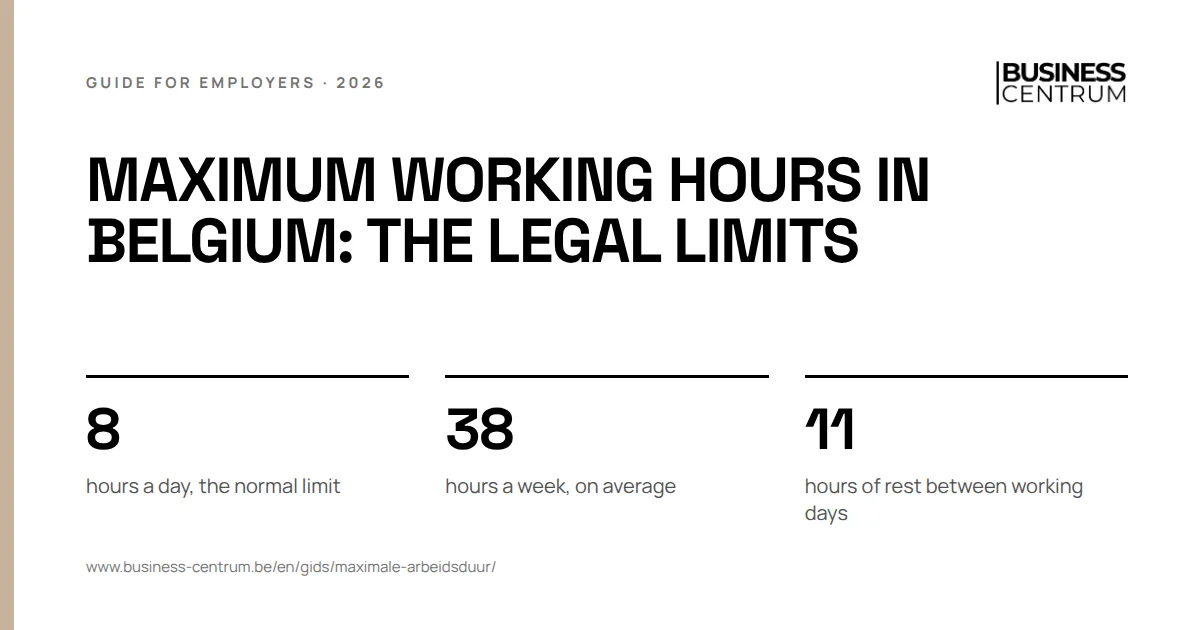
Maximum working hours in Belgium are 8 hours a day and 40 hours a week under the Labour Act, with a compulsory reduction to an average of 38 hours a week. Schedules may depart from those figures within fixed limits, and between two working days there must be at least 11 hours of rest. Overtime is an exception with its own rules.
The question "how many hours may my employee work?" therefore has three layers: the normal limit, the permitted deviations in the schedule and the absolute limits for overtime. This guide sets them out as they stand on 1 November 2026, with the articles of the Labour Act of 16 March 1971. How you pay overtime is covered separately in paying overtime.
Maximum working hours per day and per week: the basic rule
Article 19 of the Labour Act keeps it short: working hours may not exceed 8 hours a day or 40 hours a week. Since 2003 every company must also have reduced the working week to 38 hours. That does not have to be an actual week of 38 hours: many companies work 40 hours and give compensatory rest. How those days work is explained in ADV days.
An average is calculated over a reference period. That period is in principle a quarter and can be extended to 1 year. Over that period the average week must respect the limit. Within the period, the number of hours above the average may never exceed the internal limit of 143 hours.
Working time is the time during which the employee is at the employer's disposal. Breaks in which the employee is free do not count. Travel between clients during the shift does. If you have to record working time, read is time registration compulsory.
Exceptions to the maximum working hours per day in the schedule
A schedule may exceed the daily limit of 8 hours in a number of schemes without the hours counting as overtime. The weekly limit usually stays the same.
| Scheme | Maximum per day | Maximum per week | Legal basis |
|---|---|---|---|
| Normal scheme | 8 hours | 40 hours, 38 on average | art. 19 Labour Act |
| English week (free half day or day) | 9 hours | unchanged | art. 20, § 1 |
| Remote workplace | 10 hours | unchanged | art. 20, § 2 |
| Four-day week | 9.50 hours, up to 10 hours only through a collective agreement | unchanged | art. 20bis/1 |
| Minor flexibility | 9 hours | 45 hours | art. 20bis, work rules |
| Flexitime | 9 hours | 45 hours | work rules or collective agreement |
| Successive shifts | 11 hours | 50 hours | art. 22, 1° |
| Continuous work for technical reasons | 12 hours | 50 hours | art. 22, 2° |
| Construction, increase under Royal Decree no. 213 | 9.50 hours | 47.50 hours | Royal Decree no. 213 |
A flexitime system has its own rules for core hours and for carrying hours over. In construction the sector rules come on top; see construction sector.
Minor flexibility: variable weeks around an average
With minor flexibility (article 20bis) you alternate busy and quiet weeks without overtime. The scheme is set out in the work rules.
- A working day may be up to 2 hours longer or shorter than the normal schedule, with a maximum of 9 hours.
- A week may be up to 5 hours longer or shorter, with a maximum of 45 hours.
- Over the reference period, usually a calendar year, the average must match the normal weekly working hours.
- The schedules you may use are listed in advance in the work rules, and the employees know them beforehand.
Worked example
A wholesaler has a normal schedule of 5 days of 7.6 hours, 38 hours in total. In the autumn there is more work.
- Busy weeks: 5 days of 8.6 hours, 43 hours in total. That is 1 hour a day and 5 hours a week extra, below 9 hours a day and 45 hours a week.
- Quiet weeks in the spring: 5 days of 6.6 hours, 33 hours in total.
- Ten busy and ten quiet weeks cancel each other out: on average the week stays at 38 hours over the year.
The extra hours in the busy weeks are not overtime and carry no overtime pay, as long as they stay within the schedules in the work rules and are compensated.
Major flexibility goes further and requires a collective agreement, usually of the joint committee. Hospitality and transport each have their own rules; see hospitality sector and transport sector. If you want to introduce a flexible scheme, that is an amendment of the work rules under the normal procedure.
Overtime: the absolute limits on working hours
Overtime is any hour above the limits of the schedule. It is only allowed in the cases the law permits, such as an exceptional increase in work, an unforeseen necessity or voluntary overtime.
| Limit | Value | Source |
|---|---|---|
| Absolute maximum per day for most excess hours | 11 hours | art. 27 Labour Act |
| Absolute maximum per week | 50 hours | art. 27 Labour Act |
| Average week, overtime included, over 4 months | 48 hours | EU Working Time Directive |
| Hours above the average, at any moment of the reference period | 143 hours | internal limit |
| Voluntary overtime per calendar year | 360 hours, in hospitality with a registered cash system 450 | art. 25bis Labour Act |
| Notice of a changed schedule during a peak in work | 24 hours in advance | posting of the notice |
A peak in work is therefore no free pass. Even with permitted overtime an employee may not work more than 11 hours a day, except in the schemes with a higher limit. How voluntary overtime works is set out in voluntary overtime 2026. Overtime pay and compensatory rest are covered in paying overtime.
Rest periods and breaks alongside the maximum working hours
The maximum working hours say how long someone works. The rest periods say how much free time has to lie in between.
- Daily rest. In every 24-hour period the employee is entitled to at least 11 consecutive hours of rest (article 38ter). Someone who closes an evening shift at 11 pm therefore does not open at 7 am.
- Exceptions to that rest. Split shifts, a change of shift and schemes set by a collective agreement declared generally binding.
- Weekly rest. The daily rest is added to Sunday rest or compensatory rest. That gives the employee a break of 35 consecutive hours every week.
- Break. Nobody works more than 6 hours without a break (article 38quater). Without a collective agreement or royal decree, the break lasts at least 15 minutes. Whether it is paid is explained in is a break paid.
- Sunday. Sunday work is in principle prohibited, with exceptions. Anyone who works more than 4 hours on a Sunday gets a full day of compensatory rest. More in Sunday work.
Night work has its own limits and its own procedure; see night work 2026. For being reachable outside working hours, the right to disconnect applies.
Who is exempt from the maximum working hours?
Article 3 of the Labour Act excludes a number of employees from the provisions on working hours:
- employees in a managerial position or a position of trust, as designated by the King;
- sales representatives;
- homeworkers.
A title such as "manager" is not enough. The position must be on the list set by royal decree. If in doubt, treat the employee as someone who is covered by the rules.
Part-time employees are subject to the same maximum limits, with their own additional rules for schedules and for making them known. See part-time employment contract and the template part-time schedule. In structural telework the employee organises the work himself, but within the working hours that apply to him; see structural telework.
Decision guide: is this schedule allowed?
- Is the schedule in the work rules or within the framework of normal working time? If not, you must amend the work rules first. See changing the work schedule as an employer.
- Does a day go above 8 hours? Check whether one of the schemes in the table applies: English week, remote workplace, four-day week, minor flexibility, shifts or a sector agreement.
- Does a week go above the average? Then the reference period must offset it, and you stay below the internal limit of 143 hours.
- Are there at least 11 hours between the end of one shift and the start of the next? If not, check whether an exception applies.
- Is there a break after 6 hours at most?
- Is it overtime? Check whether there is a legal ground and whether the absolute limits of 11 and 50 hours are respected.
Mistakes we often see with working hours
- A 10-hour schedule without a scheme. A long day is only allowed in a scheme that the law or a collective agreement permits.
- Forgetting the rest after a late shift. Closing at midnight and opening at 8 am is too short.
- Minor flexibility without work rules. Variable weeks that are not in the work rules count as overtime.
- Overtime without a legal ground. "There was a lot of work" is not enough. The law lists the cases.
- Excluding managers too broadly. Only the positions on the list fall outside the rules.
What Business Centrum does for you
Business Centrum is a social bureau in Ghent, founded in 2013, and a recognised partner of Acerta. You supply the work data, and we process them through Acerta, the recognised secretariat with number 250. Your fixed contact person checks with you whether your schedules are in the work rules, whether the hours stay within the limits and which hours go into payroll as overtime. More on the processing is on payroll administration. How the work is divided between Business Centrum and Acerta is set out in Business Centrum and Acerta.
Want to introduce a flexible schedule, a four-day week or a seasonal scheme, and not sure which limits apply? Request a call back and Business Centrum goes through your schedules with you. For a legal dispute about working time, we refer you to a lawyer or your sector federation.