
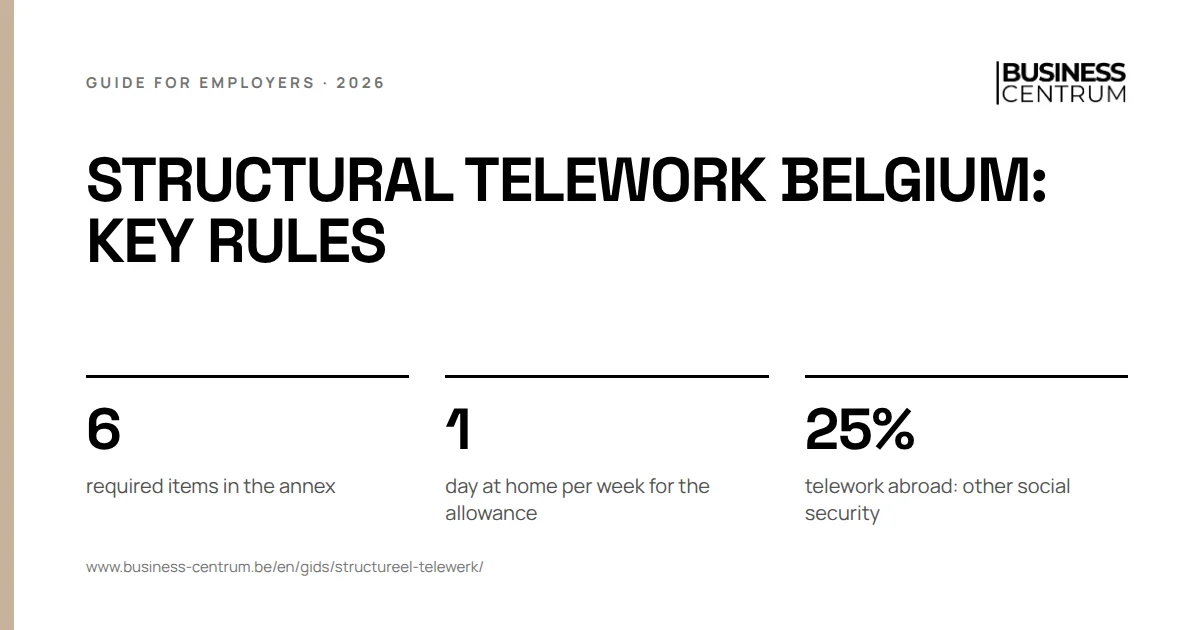
Structural telework in Belgium is work that the employee regularly does outside your premises, usually at home, even though it could be done at your place. The rules are in CLA no. 85 of 9 November 2005. In short: telework is voluntary, you record it in writing for each employee with 6 required items, and you bear the costs of equipment and connections. Occasional telework, now and then and for a specific reason, follows a lighter framework from the Act of 5 March 2017. Below you will find the difference, what goes in the annex and how to introduce a telework policy that also holds up in case of an accident or a cross-border worker.
What is structural telework in Belgium?
CLA no. 85 defines telework as a way of organising work in which an employee, using information technology, regularly and not incidentally does tasks elsewhere that could be done at your premises. The employee chooses the place: his home or another location.
Two groups fall outside it:
- mobile workers for whom travelling is part of the job, such as sales representatives or technicians at customers;
- work in a satellite office of the employer, a room you provide yourself.
An employee who works from home on fixed days each week is a structural teleworker. Someone who works from home now and then because of a train strike or a plumber's visit teleworks occasionally.
Structural and occasional telework side by side
| Structural telework | Occasional telework | |
|---|---|---|
| Basis | CLA no. 85 | Act of 5 March 2017, sections 22 to 28 |
| When | On a regular basis | Incidentally, due to force majeure or for a personal reason |
| Who decides | Both parties voluntarily | The employee asks, you may refuse with a written reason |
| Written document | Required, per employee, at the latest at the start | No required document, but mutual arrangements |
| Costs | Employer pays: equipment, connections, communication | Agreement on any allowance |
| Company framework | CLA, work rules or individual agreement | Possible via CLA or work rules, not required |
| Working conditions | Same as at the premises | Same as at the premises |
For both forms, well-being legislation applies, and the teleworker keeps the same rights as his colleagues at the office: the same pay, the same meal vouchers where they apply to his working days, the same training opportunities and the same collective rights.
Structural telework is voluntary
Telework is voluntary for employee and employer. It can be part of the original job, or you agree on it later. If you offer telework, the employee may refuse. If he asks for it, you may refuse. There is no statutory right to structural telework.
If telework was not part of the original job description, the decision can also be reversed by an individual or collective agreement. So set out in the annex how and with what notice a return to the office works. A unilateral change of workplace or schedule could otherwise conflict with the contract: see may an employer change the schedule.
The written annex for structural telework
For each teleworker you draw up a written agreement, at the latest when he starts teleworking. If the contract is already running, it becomes a written annex to the employment contract. Without a written document, the employee may work at your premises or return to them.
These 6 items must at least be included:
| Item from section 6 of CLA 85 | What you fill in |
|---|---|
| 1. Frequency of telework | For example two days a week, and possibly which days at home and which at the office |
| 2. Availability | Between which hours and through which channels the teleworker can be reached |
| 3. Technical support | When he can reach the helpdesk |
| 4. Costs | Which costs you reimburse or pay, and how: flat rate, allocation key or on proof |
| 5. Return to the premises | The conditions, the notice period, the duration and renewal of telework |
| 6. The telework location | The address or addresses the employee chooses |
The annex can also state the period of the day in which telework is allowed. That looks like a detail, but it helps determine whether an accident at home is presumed to be an occupational accident. You need not repeat all working conditions: you may refer to a CLA and to the work rules. Our addendum to the employment contract is a good starting point. When a written contract is required in general is covered in is a written employment contract mandatory.
Costs: what the employer pays for structural telework
CLA no. 85 divides the costs clearly:
- You provide the equipment, install and maintain it, and pay the costs of connections and communication for telework.
- If the employee uses his own equipment, you pay for software installation, operation, maintenance and depreciation for the telework part.
- Loss or damage to equipment and data in the context of telework is at your expense.
- If the equipment fails or force majeure prevents the work, you continue to pay wages.
In practice, many employers pay a flat-rate office allowance. It is free of social security and tax up to € 164.21 a month if the employee works from home structurally at least 1 working day a week on average. On top of that, an allowance for private internet up to € 20 and for a private PC up to € 20 a month is possible. The conditions and history of those amounts are in home working allowance 2026. Other expense allowances are covered in flat-rate expense allowance. On home working days there is no commuting: see commuting allowance.
Worked example
A white-collar employee works from home two days a week with a company laptop and uses his own internet.
| Item | Per month | Social security and tax |
|---|---|---|
| Flat-rate office allowance | up to € 164.21 | Exempt, more than 1 day a week at home on average |
| Internet allowance | up to € 20 | Exempt within the maximum |
| PC allowance | none, the laptop belongs to the company | Not applicable |
Record the amount and the condition in the annex. If home working drops below the minimum, the exemption goes too.
Well-being, occupational accidents and monitoring
Well-being. Well-being legislation also applies at home. You inform the teleworker of your health and safety policy, especially for screen work, and he applies it. The internal prevention service may visit the telework location to check that the rules are followed, but in an inhabited space only when announced and with the teleworker's consent. What your external service does is covered in external prevention service, all your obligations in well-being at work act.
Occupational accidents. Section 7 of the Occupational Accidents Act presumes that an accident of a teleworker happened during the performance of the contract if it occurs at the place stated in writing as the telework location and during the agreed period of the day. If no place is stated, the presumption applies to his residence or where he usually teleworks. If no period is stated, during the hours he would work at the office. An accident elsewhere can still be an occupational accident, but the victim must then prove it. How to report an accident is in reporting an occupational accident.
Monitoring and data. You take measures to protect work data and inform the teleworker of the rules on IT use and the sanctions for misuse. For monitoring e-mail and internet, CLA no. 81 applies: see may an employer monitor e-mails.
Working time. The teleworker organises his own work within your company's working hours, with the same workload and performance standards as at the office. What that means for time registration is in time registration belgium. From 20 employees, you also set out arrangements on the right to disconnect.
Telework from abroad
If your employee teleworks from his home in another country, his social security and tax can change. If he works at least 25% of his time in his country of residence, that country's social security applies in principle. For pure telework under 50%, a European framework agreement allows him to stay insured in Belgium, at a joint request. The rules and the NSSO application are in cross-border worker Belgium Netherlands and applying for an A1 form.
Telework from a holiday address abroad is not a formality. State in your telework policy whether it is allowed, and for how long.
Introducing a telework policy in seven steps
- Decide which jobs qualify. Telework must be compatible with the work. Set the criterion so you treat equal cases equally.
- Choose the framework. A telework policy as an annex to the work rules for the general rules, and per employee an individual annex for the days and the place. Changing the work rules follows the procedure with 15 days for comments.
- Inform and consult employee representatives, if you have them, on introducing telework.
- Set the costs. Company equipment or own equipment, and which flat rates you pay.
- Draw up the annex for each employee with the 6 items, at the latest on the first telework day.
- Arrange well-being and safety. Inform about screen work and ergonomics, and agree how the prevention service can check the workplace.
- Follow up. If someone teleworks from abroad or the number of days changes, check the allowance and social security again. Also prevent isolation: CLA 85 lets you call the teleworker back to the office at specific times.
Mistakes we often see
- Home working without an annex. The employee can then always return to the office, and the telework location is not fixed for the accident presumption.
- An office allowance without structural home working. Without 1 day a week on average, it is not exempt.
- Putting the costs on the employee. CLA 85 puts them on you.
- Allowing telework from abroad without checking. Above 25%, social security on the whole salary can shift.
- Assessing or paying a teleworker differently from his office colleagues.
- Ending telework unilaterally without following the agreement on the return.
What Business Centrum does for you
We write your telework policy as an annex to the work rules and draw up the individual annex with the required items for each employee. In payroll we put the office allowance and flat rates correctly and exempt on the payslip, together with Acerta, and monitor the structural home working condition. If someone works from abroad, we work out which country is competent. More on our help with contracts is under employment contracts. Unsure about a telework arrangement? Have it checked before you introduce it.