
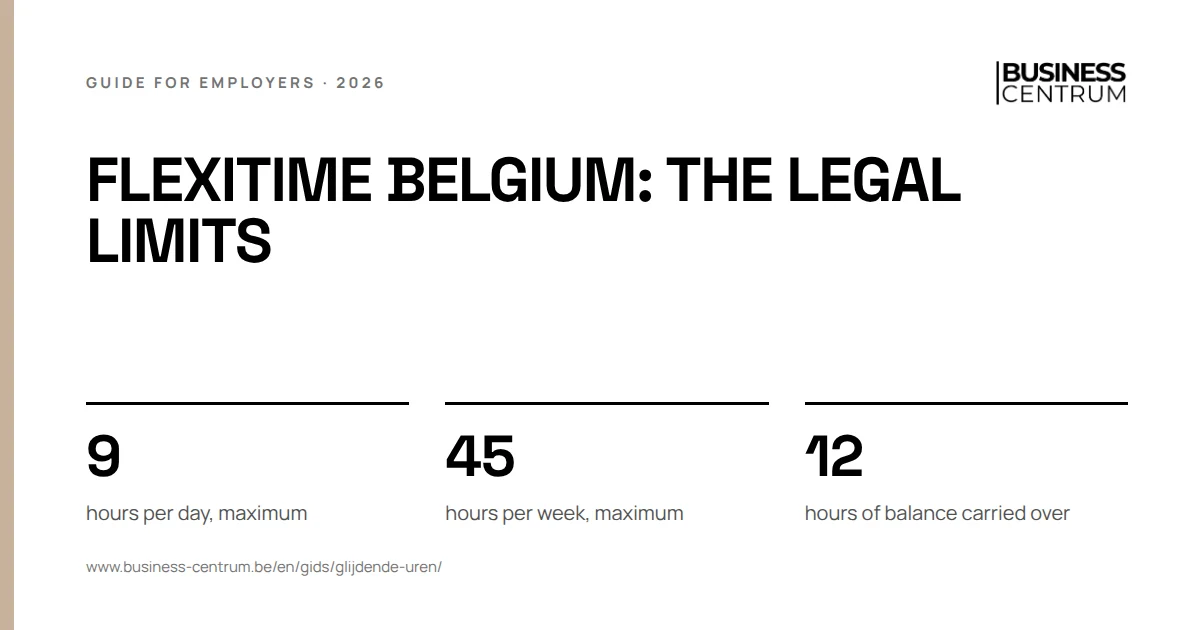
Flexitime lets an employee choose when to start, finish and take breaks, within a framework you set. Since section 20ter of the Labour Act, it is a legal regime with clear limits: core time when everyone is present, flexible time around it, at most 9 hours a day and 45 hours a week, a reference period of 3 months by default in which the average must be reached, and a balance of at most 12 hours that can move to the next period. You introduce it through a CLA or the work rules and must register each employee's time. Below is how to set it up correctly, with a worked example of the balance.
What is flexitime?
Flexitime divides the working day into two kinds of periods:
- Core time: fixed hours when the employee must be present and available, for example 9.30 to 12.00 and 13.30 to 16.00.
- Flexible time: variable periods when the employee chooses his arrival, departure and breaks, for example between 7.00 and 9.30 and between 16.00 and 19.00.
Over a reference period the employee must reach, on average, your company's weekly working time, for example 38 hours. One day he works longer, another shorter. The law allows this without those variations becoming overtime, as long as the limits of the schedule are respected.
Before 2017 many companies already used flexitime, but without a legal framework. The Act of 5 March 2017 on workable and agile work introduced section 20ter into the Labour Act and made the regime legally secure, with mandatory items and mandatory time registration.
Flexitime in Belgium: the limits of section 20ter
| Concept | Legal rule | What you set |
|---|---|---|
| Reference period | 3 calendar months by default, at most 1 year via CLA or work rules | Your period length |
| Average weekly working time | Must be reached on average over the period | For example 38 hours |
| Core time | Mandatory presence | The hours |
| Flexible time | Employee chooses arrival, departure and breaks | The hours |
| Maximum per day | 9 hours | Possibly lower |
| Maximum per week | 45 hours | How many hours below or above the average |
| Balance to the next period | At most 12 hours, more via CLA | The allowed balance |
| Making up after force majeure | Within 3 months after the period ends |
Public holidays and periods of suspension, such as illness or holiday, count as working time for the average. You count them at the average daily working time in the work rules.
Flexitime in the work rules
Flexitime can only exist through a CLA or the work rules. The work rules state at least:
- the average weekly working time and the reference period;
- the core time;
- the flexible time;
- the number of hours the employee may work below or above the average, within 45 hours a week;
- the balance that may be carried over at the end of the period.
Leaving these out is, under section 201 of the Social Penal Code, a level 1 offence. If you introduce or change flexitime, you follow the procedure to amend the work rules, with 15 days for employees' comments. How that works is in drawing up work rules. A full example is in our work rules template.
Flexitime and time registration
With flexitime you must have a time tracking system (section 20ter, paragraph 5). It records per employee:
- the employee's identity;
- per day, the duration of his work;
- for a part-time employee with a fixed schedule: the start and end of his work and his breaks.
Every employee must be able to consult his data and exact balance for the current period. You keep the data for 5 years. No proper time tracking is a level 2 offence: an administrative fine of € 250 to € 2,500, multiplied by the number of employees concerned. The broader plans on time registration are in time registration belgium.
Worked example: the balance over a reference period
A white-collar employee works in a company with an average of 38 hours a week and a reference period of 3 months, 13 weeks. The work rules allow a balance of 12 hours.
| Situation | To work | Worked | Balance | Consequence |
|---|---|---|---|---|
| Plus hours | 13 x 38 = 494 hours | 500 hours | +6 hours | Carried over to the next period, within 12 hours |
| Minus hours | 494 hours | 486 hours | -8 hours | Carried over and made up in the next period |
| Minus hours on leaving | 494 hours | 486 hours | -8 hours, contract ends | Overpaid wages may be deducted, within 20% of net pay per payment |
| Too many hours in one day | Maximum 9 hours | 10 hours at the employer's request | The hour above the limit follows the overtime rules |
Public holidays and sick days in the period count as worked, at the average daily duration in the work rules. The wage protection act expressly allows deducting wages overpaid for minus hours not made up (section 23, 6°).
Flexitime compared with other arrangements
| Flexitime | Small flexibility | Overtime | Fixed schedule | |
|---|---|---|---|---|
| Who chooses the hours | The employee, within core and flexible time | The employer, using schedules in the work rules | The employer, for an exceptional reason | Fixed in the work rules |
| Limits | 9 hours a day, 45 a week | According to the schedules in the work rules | Own limits and overtime pay | The schedule |
| Overtime pay | No, within the limits | No, within the limits | Yes, 50% on weekdays | Not applicable |
| Time registration | Mandatory | General rules | General rules | General rules |
Hours you request beyond the limits of the flexitime schedule are overtime. How overtime pay and compensatory rest work is in paying overtime. If you want to change an employee's schedule unilaterally, first read may an employer change the schedule. Part-time employees have their own schedule rules: see part-time employment contract.
Flexitime in practice: five questions we often get
Do breaks count? No, breaks are in principle not working time. With flexitime the employee chooses his break within flexible time, but the registration must correctly show the duration of work per day. More in must an employer pay for breaks.
What about absence during core time? An employee who must be away during core time for a family event falls under the ordinary rules of short leave. A short absence outside core time he settles himself within his flexible time.
How do illness and public holidays count? They count as working time, at the average daily duration in the work rules. A week with a public holiday or a sick day reduces the hours the employee has to work himself. How to follow up a sick employee is in employee off sick.
How does it relate to the 38-hour week and ADV days? The average to reach over the period is your company's working time. If you work 40 hours a week with compensatory rest days, the work rules state how those days fit into flexitime. See ADV days and, for white-collar staff, the rules of joint committee 200.
Can an employee voluntarily work more? Within the flexitime limits, that is not overtime. Above the daily limit of 9 hours or at your request, the overtime rules apply. A new system of voluntary overtime also exists since this year, with its own conditions.
Introducing flexitime in six steps
- Choose the jobs that can work with flexitime. Shifts, shops with fixed opening hours and production lines are less suited.
- Set core and flexible time based on operations: when must everyone be there for meetings or customers?
- Decide the reference period and balance: 3 months and 12 hours by default, or otherwise via CLA or work rules.
- Choose a time tracking system that records duration per day, shows employees their balance and keeps data for 5 years.
- Amend the work rules with the mandatory items and follow the amendment procedure.
- Follow up: check balances at the end of each period, talk to employees with large balances, and make sure the daily and weekly limits are respected.
If your employees also telework, combine the rules with your telework policy: see structural telework. And set availability outside flexible time in your arrangements on the right to disconnect.
Mistakes we often see
- Flexitime without mention in the work rules. The fixed hours in the rules then apply, and every hour outside them may be overtime.
- No time registration, or a system that does not show employees their balance.
- Exceeding the limit of 9 hours a day because the system allows it.
- Building up balances above 12 hours without a CLA that allows it.
- Deducting all minus hours on leaving without respecting the limit of 20% of net pay per payment.
- Not counting public holidays or sick days as worked in the average.
What Business Centrum does for you
We write the flexitime rules into your work rules, with core time, flexible time, reference period and balance, and guide the amendment procedure through to filing. In payroll we process the hours from your time registration, overtime beyond the schedule's limits and, on departure, the settlement of a negative balance within the legal limit, together with Acerta. More on our help with contracts and work rules is under employment contracts. Unsure about your setup? Have it checked before you introduce it.