
Thematic leave in Belgium is the collective name for four types of leave that let an employee stop or reduce work to care for someone: parental leave, medical assistance leave, palliative leave and carer's leave. Each has its own deadlines. Parental leave is requested 2 to 3 months in advance, medical assistance and carer's leave 7 days in advance, and palliative leave starts on the basis of a doctor's certificate. You do not pay the hours that drop out, the NEO pays a benefit and the employee is protected against dismissal. Below you will find the four types side by side, what you may refuse or postpone, and what you do administratively.
What is thematic leave in Belgium?
Thematic leave is a form of career break for a specific care task. The employee fully suspends the contract, or works half-time or one fifth less. The basis is the Recovery Act of 22 January 1985, with a separate royal decree for each type. The FPS Employment sets out the rules per type, the NEO (RVA/ONEM) pays the benefits.
Three things apply to all four:
- You pay no wages for the hours not worked. The employee applies to the NEO for an interruption benefit.
- The employee is protected against dismissal, from the written request until 3 months after the leave ends.
- The contract continues. After the leave, the employee returns to the same job and normal schedule.
Thematic leave is not time credit. Time credit comes from CLA no. 103 and depends on thresholds in your company: see time credit for employers. Nor is it the short care leave or leave for compelling reasons. An overview of all leave is in types of leave.
The four types of thematic leave side by side
| Parental leave | Medical assistance | Palliative leave | Carer's leave | |
|---|---|---|---|---|
| Who does the employee care for? | His child, until age 12 | A seriously ill household or family member | A person with an incurable illness, no family tie needed | A person in need of care, as a recognised carer |
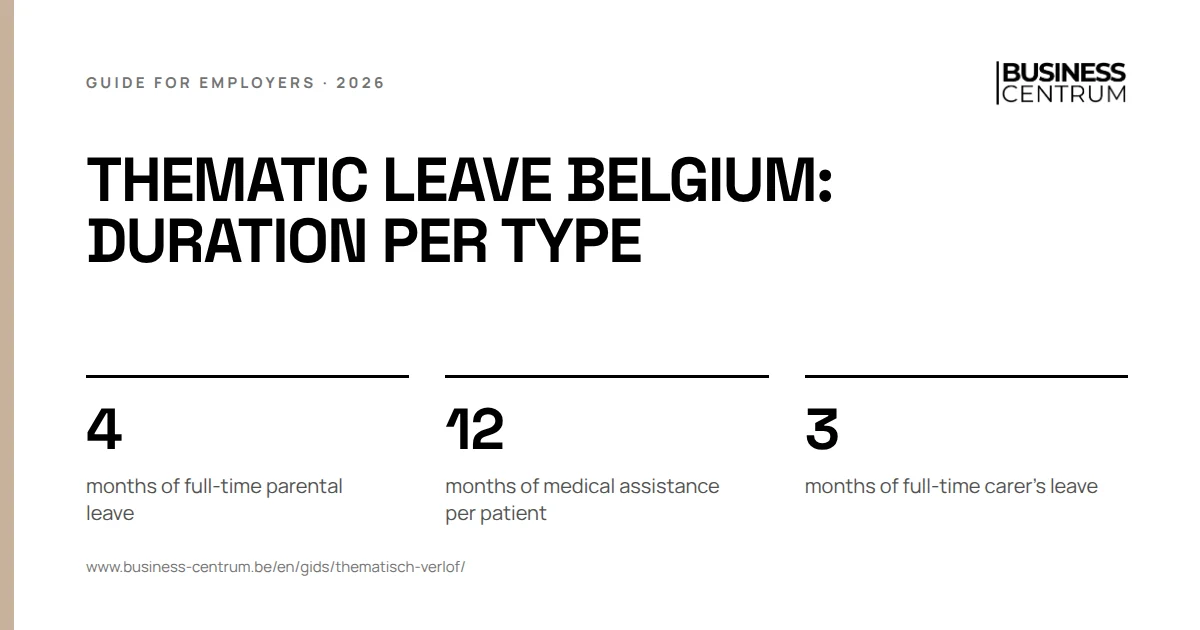
| Full suspension | 4 months per child | 12 months per patient | 1 month, extendable 2 times | 3 months per person |
| Half-time or 1/5 | 8 months half-time, 20 months 1/5 | 24 months | 1 month, extendable 2 times | 6 months |
| 1/10 | 40 months, with your agreement | No | No | No |
| Seniority | 12 months in the last 15 | None | None | None |
| Request | 2 to 3 months in advance | 7 days in advance, with certificate | Certificate from the treating doctor | 7 days in advance, with proof of recognition |
| Refusal | Only 1/10 and taking it in weeks | Only in an SME, after a certain period | No | No |
| Postponement | Up to 6 months | 7 days | No | No |
The half-time and 1/5 forms are for full-time employees. A part-time employee can only take parental leave and carer's leave as a full suspension. For medical assistance and palliative leave, a part-time employee working at least three quarters of a full-time job can also go half-time.
Parental leave: the largest group of requests
Every employee with a child under 12 can request parental leave, provided he was under contract with you for at least 12 months in the 15 months before the request. Periods as a temp at your company as user count. The right applies per child and per parent.
The employee chooses the form: 4 months full-time, 8 months half-time, 20 months one fifth less or, with your agreement, 40 months one tenth less. He may switch forms: one month full-time equals two months half-time, five months 1/5 or ten months 1/10. With your agreement he can also take the full-time leave in weeks, 16 weeks in total.
He notifies you 2 to 3 months in advance, by registered letter or by a letter of which you sign a copy. You then have 1 month to respond:
- refusing full-time, half-time or 1/5 leave is not allowed, but you can postpone the start in writing with reasons by at most 6 months if the absence would seriously disrupt operations. For full-time leave you must then offer an alternative;
- you may refuse 1/10 or taking it in weeks, with written reasons within the same month. Silence counts as agreement.
How to word a postponement or refusal, with two template letters, is in refusing parental leave as an employer. Whether the employee is paid is in is parental leave paid.
Thematic leave for medical assistance
With medical assistance leave, an employee cares for a seriously ill household or family member: someone living with him, or relatives up to the second degree and in-laws in the first degree. The doctor decides whether the illness is serious.
The employee takes the leave in blocks of 1 to 3 months, up to 12 months full-time or 24 months part-time per patient. For a single parent with a seriously ill child aged 16 or under, those maximums double. For a hospitalised minor child, the employee can take one week, extendable by one week.
Three rules matter to you as an employer:
- The request arrives 7 days in advance, in writing and with a doctor's certificate. For an unforeseen hospital admission of a child, it can be faster.
- You can postpone the start by 7 days for operational reasons, if you notify this in writing within 2 working days of the request.
- Refusal is only possible in an SME with at most 50 employees, and only once the employee has already taken 6 months full-time or 12 months part-time, for organisational reasons you explain in writing and in detail.
If you employ fewer than 10 people, the employee is only entitled to a full interruption, not a part-time one.
Palliative leave
Palliative leave is for caring for someone with an incurable illness in the terminal phase. That person need not be family. The employee hands over a certificate from the treating doctor, without the patient's name. The leave starts on the first day of the week after the week the certificate was handed over, or earlier if you agree.
The leave lasts 1 month per patient and can be extended 2 times by one month, each time with a new certificate. You can neither refuse nor postpone palliative leave. So plan the replacement immediately.
Carer's leave
Carer's leave is for an employee recognised by his health insurance fund as the carer of a person in need of care. He attaches proof of that recognition to his request, which arrives 7 days in advance unless you agree otherwise in writing.
The employee can fully interrupt for 3 months per person cared for, or work half-time or one fifth less for 6 months. Over the whole career, the maximum is the equivalent of 6 months of full interruption. You cannot refuse or postpone carer's leave if the conditions are met.
Dismissal protection during thematic leave
Protection starts on the day of the written request and lasts until 3 months after the leave ends. During that period you may only dismiss the employee for a reason unrelated to the leave, as explained in dismissing an employee. You must prove that reason, and give it in writing if the employee asks.
A dismissal after the protection period can also be covered if you prepared it during the protection, for example by advertising for a permanent replacement. If you do not respect the protection, you pay a lump sum of 6 months' wages on top of the ordinary notice pay.
For parental leave, the explanation with examples is in dismissal during parental leave. If you give notice during a full interruption, the notice does not run during the leave. During a partial interruption it keeps running. Notice pay is calculated on the wage as if the employee worked full-time. How to calculate a period is in employer notice period and our notice period calculator.
A worked example: half-time parental leave
A white-collar employee works full-time, 38 hours a week, and earns 3,600 euros gross per month. She takes 8 months of half-time parental leave.
| Item | Before the leave | During half-time leave |
|---|---|---|
| Hours per week | 38 | 19 |
| Gross wage you pay | 3,600 euros | 1,800 euros |
| Benefit | None | Interruption benefit from the NEO, on application |
| Dismissal protection | None specific | From the request to 3 months after the leave |
| Notice pay on dismissal | On 3,600 euros | On 3,600 euros, the wage without leave |
For the hours she works, you pay wages as before. Whether the leave counts for the end-of-year bonus depends on the CLA of your joint committee: see end-of-year bonus 2026.
What you do as an employer when a thematic leave request comes in
- Record the date of receipt. Dismissal protection and the response deadline run from that day.
- Check which leave it is and the conditions. For parental leave, seniority and the child's age. For medical assistance and palliative leave, the certificate. For carer's leave, proof of recognition.
- Decide within the deadline. 1 month for parental leave, 2 working days to postpone medical assistance leave. Too late means no postponement, and for 1/10 parental leave it means agreement.
- Confirm in writing. Record start, end and form. For a part-time form, adjust the schedule with an addendum to the employment contract.
- Complete your part for the NEO. The employee applies for the benefit. That application must reach the NEO no later than 2 months after the start, or he loses benefits.
- Adjust payroll and the returns. Fewer hours or a full suspension go on the payslip and the quarterly return. What a suspension does further is in suspension of the employment contract.
- Plan the replacement. A fixed-term replacement contract is possible. Hiring a permanent replacement for a job you later want to cut can count as preparing a dismissal.
Mistakes we often see
- Responding too late to a request. For parental leave you then lose your right to postpone, for 1/10 your silence counts as agreement.
- A postponement without concrete reasons. A general reference to workload is not enough.
- Trying to postpone palliative or carer's leave. That is not possible.
- Not pointing out the NEO deadline to the employee. A late application costs him benefits.
- Hiring a permanent replacement during the leave and then dismissing. That counts as dismissal during protection.
- Not adjusting the schedule for a part-time form. Also read part-time employment contract.
Which leave you may refuse is in can an employer refuse leave. For birth leave, see is birth leave paid, and for the rights of a pregnant employee maternity protection.
What Business Centrum does for you
For every thematic leave request we check the conditions and the deadline, and prepare your response: a confirmation, a reasoned postponement or, where allowed, a refusal. We adjust the schedule and payroll, complete your part of the NEO application and process the suspension in the returns, together with Acerta. Day-to-day management of leave and absence sits in leave and absence. Unsure about a request? Have it checked before the deadline passes.