
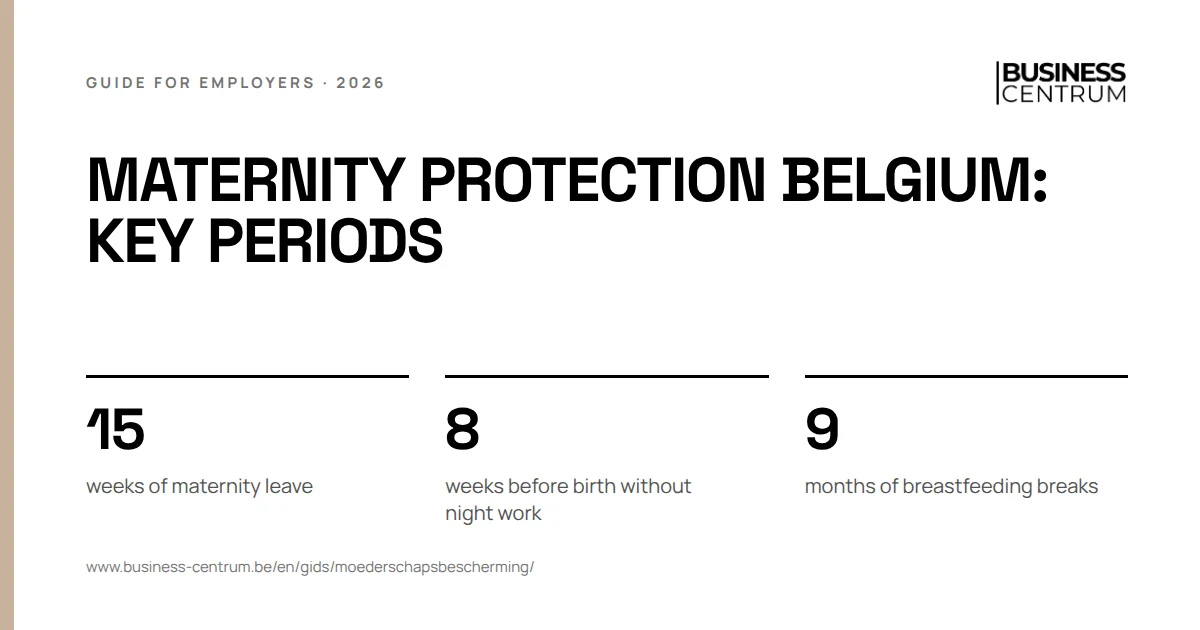
Maternity protection in Belgium is the set of rules protecting a pregnant or breastfeeding employee. As soon as you know an employee is pregnant, you carry out a risk analysis of her job with the occupational physician, adapt her work or remove her from it if the risk is too great, and dismissal protection applies until 1 month after postnatal rest. She is entitled to 15 weeks of maternity leave, cannot be made to work nights in the 8 weeks before the birth, and has a right to breastfeeding breaks until 9 months after the birth. Below you will read what you do at each stage and who pays what.
What does maternity protection involve?
The rules are in two places. The Labour Act of 16 March 1971 covers maternity rest, prenatal check-ups, dismissal protection, night work and risk assessment. Title 5 of Book X of the code on well-being at work sets out the risk analysis, with lists of agents and working conditions. CLA no. 80 covers breastfeeding breaks. Maternity protection is part of your obligations under the well-being at work act.
The protection applies to every female employee, full-time or part-time, blue-collar or white-collar. It only takes effect once you are informed. An employee need not announce her pregnancy immediately, but she has every interest in doing so: the FPS Employment advises sending a medical certificate by registered post or handing it over against a receipt. No later than 7 weeks before the expected date of birth, she must give you a certificate stating that date.
When hiring, you may in principle not ask about a pregnancy, unless it is relevant to the nature of the job. Pregnancy may never lead to discrimination.
From notification to return: the stages and who pays
| Stage | What applies | Who pays |
|---|---|---|
| Notification of pregnancy | Dismissal protection starts; you inform the occupational physician | Normal wages by you |
| Pregnancy | Risk analysis, adaptation, other work or removal; paid prenatal check-ups | Wages by you; in case of removal a benefit from the health insurance fund |
| From 8 weeks before the birth | No compulsory night work | Wages or, if day work is impossible, a benefit |
| 7 days before the expected date | Mandatory rest | Maternity benefit from the health insurance fund |
| Maternity leave | 15 weeks, 17 for a multiple birth, of which 9 weeks mandatory after the birth | Maternity benefit from the health insurance fund |
| Return and breastfeeding | Breastfeeding breaks, removal still possible if there is a risk | Wages by you, breaks included |
| Until 1 month after postnatal rest | Dismissal protection ends |
How maternity leave relates to other leave, such as birth leave and parental leave, is in types of leave and thematic leave.
Protecting a pregnant employee: risk analysis and removal from work
Together with the occupational physician, you carry out a risk analysis of all jobs that may carry a specific risk for the pregnancy, breastfeeding or the child's health (section 41 of the Labour Act). The code contains a list of agents, processes and working conditions to assess, and a second list of exposures that are always prohibited.
As soon as you know of the pregnancy, you inform the occupational physician. If the analysis shows a possible health risk, he examines the employee and informs you and her of his decision via the health assessment form.
If he finds a risk, you take one of these measures on his proposal, in this order (section 42):
- A temporary adaptation of working conditions or risk-related working hours.
- Other work compatible with her condition, if adaptation is technically or objectively impossible.
- Suspension of the contract, if other work is not possible either. That is removal from work.
For exposure to a prohibited risk, you apply a measure immediately. During removal from work you pay no wages: the employee receives a benefit from the health and disability insurance through her fund. You file a declaration with Fedris, online via socialsecurity.be. When the measure ends, the employee resumes work under the same conditions as before. The cost of the medical examinations is yours. What your external service does is in external prevention service.
Decision aid: adaptation, other work or removal?
| Situation | What you do |
|---|---|
| Office work without specific risks | No measure needed; attention to ergonomics and breaks |
| Heavy lifting or long standing | Adaptation: aids, other tasks, more breaks |
| Contact with certain chemical or biological agents on the list | Other work without exposure; otherwise removal |
| Exposure to a risk on the list of prohibited exposures | Immediate measure, usually other work or removal |
| Night work in the 8 weeks before the birth | Day work; otherwise suspension |
This is a tool to prepare the conversation with the occupational physician. The decision on the risk is his.
Night work and overtime
You may not oblige a pregnant employee to work nights in the 8 weeks before the expected date of birth (section 43). With a medical certificate she can also refuse night work in other periods of the pregnancy and up to 4 weeks after postnatal rest. Night work here means work done mainly between 20 and 6 hours. You then give day work or, failing that, the contract is suspended.
According to the FPS Employment, pregnant and breastfeeding employees may also not work overtime, apart from a few exceptions such as positions of trust or management. How overtime works otherwise is in paying overtime, and what changed for night work in 2026 in night work 2026.
Prenatal check-ups with pay
A pregnant employee who has informed you may be absent on normal pay for the time needed for prenatal check-ups, if they cannot take place outside working hours (section 39bis). Only check-ups before the birth count, and only the time of the check-up and travel, not a full day. She notifies you in advance. If a CLA or your work rules require it, or if you ask, she provides a medical certificate. That is not a sick note: a prenatal check-up is not illness.
Dismissal protection
From the moment you are informed of the pregnancy until 1 month after the end of postnatal rest, you may take no step to end the contract unilaterally, except for reasons unrelated to the physical condition resulting from pregnancy or birth (section 40). You must prove that reason and give it in writing if she asks. A dismissal after that period which you prepared during the protection also counts.
Without a valid reason you pay a lump sum of 6 months' gross pay on top of the ordinary notice pay. The short version is in may you dismiss a pregnant employee. If you want to dismiss for another reason, have the file checked first: see dismissing an employee and statement of reasons under CLA 109.
Maternity rest
Maternity leave lasts 15 weeks, and 17 weeks for a multiple birth, with a possible extension. The employee may not work from 7 days before the expected date until 9 weeks after the birth. She chooses the other weeks before or after the birth. During the leave the contract is suspended and the health insurance fund pays a maternity benefit. What a suspension means for notice and public holidays is in suspension of the employment contract. Whether maternity rest counts towards the end-of-year bonus depends on your committee's CLA. For the partner, see is birth leave paid.
Breastfeeding breaks
An employee who breastfeeds or expresses milk is entitled under CLA no. 80 to:
- one break of 30 minutes on a working day of at least 4 hours;
- two breaks on a working day of at least 7.50 hours, taken at once or in two parts;
- until 9 months after the birth.
The breaks are included in working time. You agree together when they fall; without agreement they are just before or after the rest periods in the work rules. The employee notifies you 2 months in advance, less if you agree, and provides proof of breastfeeding. During breastfeeding too, the occupational physician can propose adaptation or removal.
What you do as an employer: step by step
- Record the date of notification and ask for a medical certificate. Protection runs from now.
- Inform the occupational physician of your external service and review the risk analysis of her job.
- Take the proposed measure: adaptation, other work or removal. For removal, file the declaration with Fedris.
- Plan the work without night shifts in the periods she can refuse them, and without overtime.
- Pass on prenatal check-ups for payroll: that absence is paid.
- Prepare maternity leave: replacement, handover, the date based on the certificate.
- Arrange the return: breastfeeding breaks, a place to express milk, and a new assessment by the occupational physician if risks remain.
Mistakes we often see
- Not informing the occupational physician. Without an assessment, a risk goes unnoticed.
- Deciding on removal yourself, without the occupational physician's proposal.
- Continuing to pay wages during removal or omitting the declaration, so the employee gets no benefit.
- Keeping her on night shift in the 8 weeks before the birth.
- Preparing a dismissal during the protection and giving it afterwards.
- Deducting breastfeeding breaks from pay. They count as working time.
What Business Centrum does for you
We process every stage in payroll: paid absence for prenatal check-ups, suspension for removal from work and maternity leave with the right code in the returns, and breastfeeding breaks as working time, together with Acerta. We point out dismissal protection if a dismissal is on the table. The risk analysis and the decision on removal lie with your occupational physician. Day-to-day leave management sits in leave and absence. Unsure about a measure or a dismissal? Have it checked.