
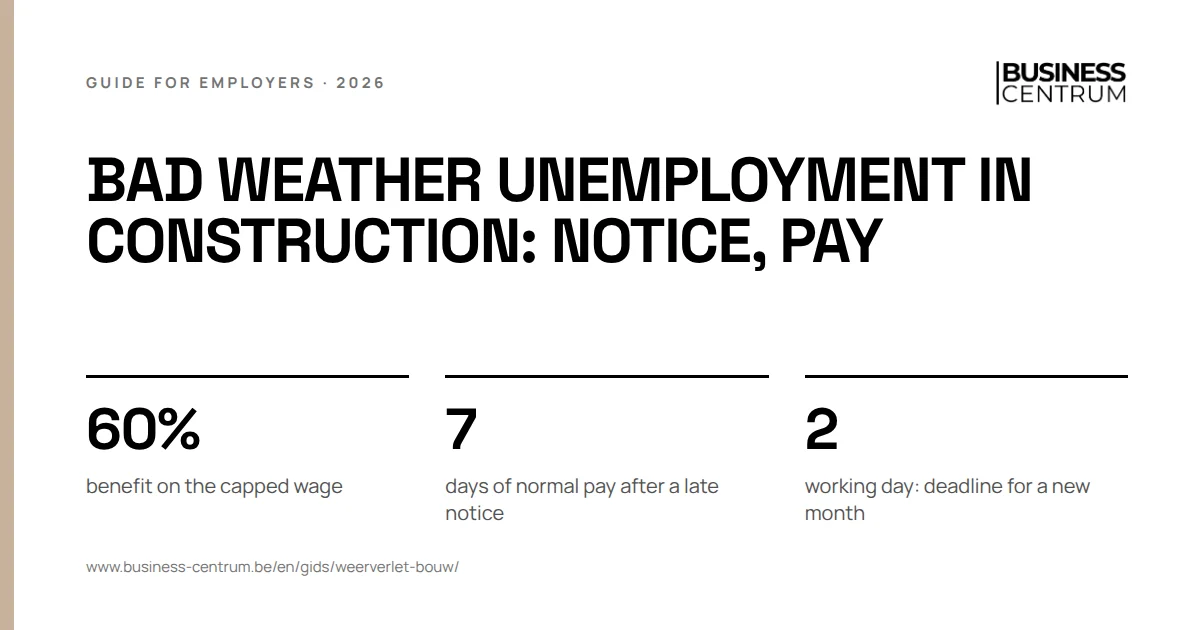
Bad weather unemployment in construction is the temporary unemployment of blue-collar workers due to bad weather. When frost, rain or, in exceptional cases, heat makes the work impossible, you suspend the contract. Every month you notify the National Employment Office (ONEM) electronically of the first day. Your workers then receive 60% of their capped wage. If you notify too late, you pay the wages yourself.
This guide sets out the rules for employers as they stand on 1 November 2026: when bad weather counts, who is covered, the notification deadlines, pay on a day of bad weather and the returns. It follows Article 50 of the Employment Contracts Act of 3 July 1978 and ONEM info sheet E29 for the construction sector. The amounts of the benefit and the sector top-up are in our guide on temporary unemployment and the one on joint committee 124.
What is bad weather unemployment in construction?
Article 50 of the Employment Contracts Act provides that bad weather suspends the performance of the contract, as long as the work becomes impossible and on condition that the worker was told not to report for work. Bad weather unemployment is therefore not leave and not a favour. It is a suspension: the worker does not work, you pay no wages, and ONEM pays a benefit.
For the construction sector, ONEM has its own info sheet, E29. Other sectors follow info sheet E26. The core is the same, but construction has its own arrangements: the rule for the day the worker arrives on site, the scheduled winter training and the additional allowance from the sector fund. We describe the sector itself on our page for the construction sector.
When does the weather count as bad weather in construction?
According to ONEM, bad weather means weather conditions that you show in your notification make the work impossible, given the nature of that work. The rules set no temperature threshold and no amount of rain. What matters is the link between the weather and the work planned for that day.
| Situation | Bad weather unemployment possible? | Why |
|---|---|---|
| Frost that makes masonry or structural work impossible | Yes | ONEM example |
| Heavy rain on a structural works site | Yes | ONEM example |
| Rain that only slows the work down | No | harder is not impossible |
| Very hot weather that truly prevents the work | Exceptionally | ONEM accepts it, with a reasoned explanation |
| Materials not delivered because of bad weather | No, possibly force majeure | no direct link with the work |
| Indoor work on a closed site in the rain | Usually no | the weather does not make that work impossible |
ONEM states it explicitly: there must be a direct causal link between the bad weather and the work being carried out. If work stops indirectly, for example because raw materials are not delivered, you may be able to apply for another form of temporary unemployment, such as force majeure. If there is simply less work, it is economic unemployment; see temporary unemployment and, for white-collar staff, economic unemployment for white-collar workers.
Who does bad weather unemployment apply to?
According to ONEM, temporary unemployment due to bad weather can be applied to:
- blue-collar workers;
- temporary agency workers who replace blue-collar workers who are unfit for work, or who work because of a temporary increase in workload;
- apprentice workers with a work-based training contract in the Flemish Community or a work-study contract in the French Community.
Students cannot be placed on temporary unemployment while they follow a full-time study programme, except in July, August and September after their studies end. White-collar staff do not fall under this scheme. For agency workers, the temporary work agency always makes the notifications and returns, using your company's enterprise number; see joint committee 322.
Notifying ONEM of bad weather unemployment
From the start of the unemployment, you report the first actual day of bad weather for each employee every month. The notification goes electronically, through the social security portal or by batch, to the ONEM office for the place where your business is established. That is the operating seat, not the registered office.
| When you send it | Result |
|---|---|
| More than 1 working day before the first day | Too early: counts as no notification, no benefits for that month |
| The working day before, if you are sure no work will be possible | On time |
| On the first actual day | On time |
| The next working day | On time |
| More than 1 working day after the first day | Too late: unemployment accepted from the working day before sending |
| Bad weather continues into the next month | New notification, at the latest on the 2nd working day of that month |
Working days are all days of the week, except Sundays, public holidays, replacement public holidays and bridge days. If the working day before or after falls on a Saturday, ONEM accepts the Friday before or the Monday after. An ONEM example: if Wednesday is the first day of bad weather, you may notify on Tuesday, Wednesday or Thursday. How a public holiday that falls at the weekend moves is explained in replacement public holiday, and the collective bridge days in bridge days 2027.
The notification states, among other things, the full address of the site where the employees would have worked that day, the type of bad weather, the work that was planned and why it is impossible. Several employees can go in one notification if it is the first day for all of them, they would work on the same site and their work becomes impossible to the same extent. If you have already reported a first day of economic unemployment or technical breakdown for that employee in the same calendar month, you are exempt.
Pay on a day of bad weather
The moment the weather turns decides whether you pay wages.
| Situation | Pay | Temporary unemployment that day? |
|---|---|---|
| The worker starts and has to stop during the day | Normal wage for that day (guaranteed day's wage) | No |
| The worker finds on arrival at the site that he cannot work | No pay | Yes, still possible |
| The worker was told not to come | No pay | Yes |
| You did not notify, or notified too early or too late | Wages up to the day ONEM accepts | Only from that day |
If work stops during the day, that is the guaranteed day's wage under Article 27 of the Employment Contracts Act; see guaranteed salary. According to ONEM, you may pay a reduced wage for the hours not worked. You do not report that day as unemployment. If you are sure the next day will also be unworkable, you may already send the notification on the day for which you owe the guaranteed wage.
If the worker finds on arrival that work is impossible, he has no right to wages and you can still put him on temporary unemployment for that day. Any mobility allowance for that day does not count as wages and can be combined with the benefit. This rule only exists in construction. Placing someone on temporary unemployment for half a day is not possible. More on suspension in general is in suspension of the employment contract.
Worked example
A roofer in Ghent has three workers on a site. On Wednesday 13 January 2027 it freezes so hard that the roofing work is impossible. He tells his workers on Tuesday evening not to come, but forgets the notification. He only sends it on Monday 18 January.
- The notification comes more than 1 working day after the first day: it is late.
- ONEM accepts the unemployment from the working day before sending. Following the ONEM example, that is Friday 15 January.
- For Wednesday 13 and Thursday 14 January, the employer pays the wages himself. Those days fall within the first 7 days, so at the normal wage.
- From Friday 15 January, the workers receive their benefit.
Had he sent the notification on Tuesday, Wednesday or Thursday, everything from Wednesday would have been covered.
Heat and bad weather unemployment
ONEM explicitly names heat as an unfavourable weather condition, alongside rain and frost. According to info sheet E26, very hot weather can also, exceptionally, make work impossible. The word exceptionally carries weight. ONEM also states that when bad weather only makes the work harder or lowers productivity, the employer cannot claim temporary unemployment due to bad weather.
If you report bad weather unemployment because of heat, you explain in the notification which work was planned, what the conditions were and why the work could not be done. On top of that, you remain responsible as employer for well-being on the site. The measures against heat belong in your risk analysis and the global prevention plan. The limits and rest periods the code imposes are set out in working in heat. An earlier start to the day has to fit within the limits of the maximum working hours and your work rules.
Returns and control card
Besides the monthly notification, there are two social risk returns (ASR) and the employee's control card.
- ASR scenario 2 at the employee's first temporary unemployment in your business, after a break in benefits of at least 36 months, after a change in his working arrangements and at the first temporary unemployment after the end of September. You give the employee a copy.
- ASR scenario 5 after the end of each month, with the hours of temporary unemployment and the code for bad weather. In principle one ASR per month and per employee, even with several forms of unemployment.
- Control card eC3.2. Since 1 January 2025, employees fill in the control card electronically. You may no longer hand out the paper card.
- Registration as a jobseeker. From 1 March 2026, the employee registers with VDAB, Actiris, Forem or ADG after 3 months of temporary unemployment. A full return to work for 2 consecutive weeks starts a new period.
Days for which you pay wages, such as the guaranteed day's wage or wages after a late notification, are not reported as unemployment. If the suspension is invalid, you pay the normal wage and repay the benefits wrongly received to ONEM, gross.
Winter training with bad weather benefit
Employers in joint committee 124 can have a worker follow scheduled training in winter with a benefit for bad weather. This is possible for at most 4 weeks per employee, from December up to and including March. Agency workers are not covered.
- In the notification of the first day, you state the address of the site where the employee would otherwise work.
- In ASR scenario 5, you give bad weather as the reason and fill in the start and end date of the training.
- If the employee has built up compensatory rest days, for example through overtime, he takes those first.
- Only full days of training are paid.
What bad weather unemployment costs and brings in
Money is not the main subject of this guide, but it belongs in the decision. The worker receives from ONEM 60% of his capped average wage, without a waiting period, with 26.75% withholding tax. In construction, the sector fund adds a top-up; the rules and amounts are in joint committee 124 and the wages in the pay scale for JC 124. With employers in category A and B, the worker also receives bad weather stamps worth 2% of his gross pay; see construction loyalty stamps.
Decision aid: bad weather unemployment or another form?
- Does the weather make the planned work itself impossible? Yes: bad weather unemployment. No, it only slows things down: no bad weather unemployment, keep working with adjusted measures.
- Does work stop because of a consequence of the weather, such as a delivery that does not arrive? Look at force majeure.
- Is there simply less work? Then it is economic unemployment, with advance notice.
- Is the employee a blue-collar worker, an apprentice worker or an agency worker replacing a blue-collar worker? If not, bad weather unemployment does not apply.
- Has work already started today? Then you pay the day's wage and bad weather unemployment starts tomorrow at the earliest.
- Is it the first day of bad weather in the month for that employee? Send the notification no later than the next working day.
Mistakes we often see with bad weather unemployment
- Forgetting the notification on the first day. A late notification costs wages for the days before.
- Notifying in advance for the whole week. More than one working day ahead counts as no notification.
- Not notifying again for a new month. The notification is valid until the last calendar day of the month.
- Bad weather unemployment after half a day of work. For that day you pay the day's wage.
- Reporting heat without a reasoned explanation. ONEM asks you to show the work was impossible: describe the weather, the work and why it could not be done.
- Mixing up the operating seat and the registered office. The notification goes to the office for the place where the business operates.
What Business Centrum does for you
Business Centrum is a social bureau in Ghent, founded in 2013, and a recognised partner of Acerta. You pass on the days of bad weather and the sites, and Business Centrum processes them through Acerta, the recognised secretariat with number 250, which files the returns. Your fixed contact person helps you with the notification deadline, the difference between a day of wages and a day of unemployment, and the processing in the payroll. More on construction is on payroll for construction and payroll. How the work is divided between Business Centrum and Acerta is set out in Business Centrum and Acerta.
Do you run a construction business with workers on site and want to be sure every day of bad weather is reported on time? Request a call back and Business Centrum goes through the procedure with you. For a dispute with ONEM about a refused suspension, we refer you to a lawyer or your sector federation.