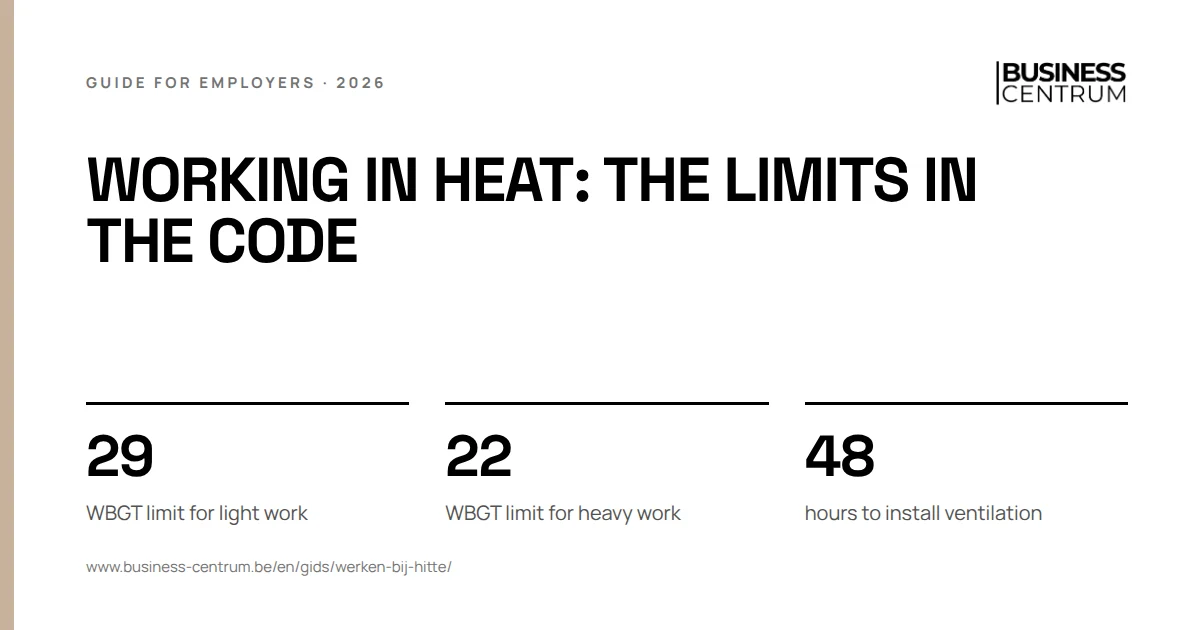
Working in heat is governed by the code on well-being at work, book V, title 1 (thermal environments). You measure heat with the WBGT index, not with an ordinary thermometer. Above 29 for light work, 26 for moderate work, 22 for heavy work and 18 for very heavy work, you must act: free refreshing drinks, protection from the sun, ventilation within 48 hours and then rest periods.
Every summer the same question comes back: how hot may it get at work, and what do I have to do as an employer? This guide sets out the rules as they stand on 1 November 2026. The text of the code was last amended by the royal decree of 12 May 2024. The guide describes the law. For your own workstations, you still need the advice of your prevention adviser and your occupational physician.
Working in heat: what the law asks of the employer
The basis lies in the well-being at work act of 4 August 1996. The employer takes care of the well-being of its employees while they carry out their work. For heat and cold, the code works this out in four steps.
- Risk assessment. Article V.1-1 requires you to analyse the thermal environment at the workplace, from the weather and from your installations. You take into account the air temperature, the humidity, the air flow, heat radiated by the sun or machines, the physical workload, the working methods, the work clothing and the personal protective equipment. The assessment also follows the seasons and the changing conditions during the working day.
- Prevention measures. Article V.1-2 calls for suitable measures based on that assessment.
- Action values. Article V.1-3 sets the limits above which you are required to step in.
- Programme of measures. If temperatures can exceed the action values, article V.1-4 requires you to draw up a programme of technical and organisational measures in advance. That programme belongs in your global prevention plan.
You assess the conditions and measure them "where necessary". You choose the measuring method after advice from the prevention adviser-occupational physician or the prevention adviser for occupational hygiene, and with the agreement of the Committee for Prevention and Protection at Work. If the committee does not agree, you choose a method whose references are published by the FPS Employment.
WBGT: how to measure heat at work
An ordinary thermometer is enough for cold, not for heat. Thirty degrees in dry air is not the same as thirty degrees in heavy, humid air. That is why the code uses the WBGT index (wet bulb globe temperature). It combines air temperature, humidity, air flow and radiant heat. You can measure the WBGT directly with a wet globe thermometer, or calculate it from separate measurements.
Few companies own such a device. The FPS Employment therefore publishes conversion tables: you measure with an ordinary thermometer and a hygrometer and read off the WBGT. A few examples the FPS gives itself:
| Thermometer | Humidity 35% | Humidity 55% | Humidity 80% |
|---|---|---|---|
| 30 °C | 22.70 WBGT | 25.40 WBGT | 28.20 WBGT |
| 35 °C | 26.80 WBGT | 29.80 WBGT | 32.90 WBGT |
In very humid air, around 95 percent, the WBGT is close to what the ordinary thermometer shows. In drier air it is lower. If heat radiates from the sun, an oven or a machine, that load comes on top. The tables therefore give an approximation. For a workstation with a lot of radiant heat, it is better to ask your external prevention service for a measurement.
Physical workload: how heavy is the work?
The limit depends on the physical effort. Article V.1-1 expresses it in watts, for continuous work over eight hours. The FPS gives examples to help you assess the work. It is about physical effort, not about how mentally demanding a job is.
| Workload | Energy in watts (code) | Examples (FPS Employment) |
|---|---|---|
| Very light | less than 117 watts | secretarial work |
| Light | from 117 watts to just below moderate | manual work at a table, driving a vehicle |
| Moderate | from 235 watts | standing work, carpentry, driving a tractor |
| Heavy | from 361 watts | digging, sawing by hand, planing, pushing wheelbarrows |
| Very heavy | more than 468 watts | heavy digging and excavating, climbing ladders and stairs |
According to the FPS, the occupational physician determines how much effort a type of work requires. Include that classification in your risk assessment, per workstation or per job. In July you then know straight away which limit applies to the warehouse worker, the driver and the office employee.
The action values for heat at work per workload
Article V.1-3, paragraph 2, states that the WBGT index may not exceed these values:
| Workload | Maximum WBGT index |
|---|---|
| Very light or light work | 29 |
| Moderate work | 26 |
| Heavy work | 22 |
| Very heavy work | 18 |
These are action values. Working above them is not forbidden, but the mandatory measures of the code then apply. The heavier the work, the lower the limit. Someone doing heavy work therefore quickly goes over the limit on a warm summer day, even when the office next door is still within the norm.
What you must do when heat exceeds the action values
The code distinguishes by where the heat comes from: the weather (climatic heat) or your installations, such as ovens, foundries or presses (technological heat).
| Source of the heat | Mandatory measures | Article |
|---|---|---|
| The weather, indoors | persistent excess: artificial ventilation in the workrooms within 48 hours; if it continues after that: limited presence and rest periods; free refreshing drinks at all times | V.1-11 |
| Direct sun | protection by an installation or a different work organisation; collective or personal protective equipment | V.1-12 |
| Machines, convection | artificial ventilation or extraction | V.1-8 |
| Machines, radiation | protective screens or reflective or cooled protective clothing | V.1-9 |
| Technological, measures not enough | shorter exposure by alternating work and rest, free refreshing drinks | V.1-10 |
For heat from the weather there are therefore three steps. First the ventilation within 48 hours after the excess is established, if it persists. Then, if it stays too hot, the system of limited presence and rest periods. And from the start, the refreshing drinks, at no cost to the employees and on the advice of the occupational physician. Drinking water must always be there, even without heat: see must the employer provide water.
If the heat comes from both the weather and your installations, you apply the rules for technological heat, articles V.1-8 to V.1-10.
Protective clothing against radiant heat is personal protective equipment, not ordinary work clothing. You can read the difference in must the employer provide work clothing.
Rest periods when working in hot weather: who sets the rotation?
If you have to alternate work and rest, article V.1-4 determines how, in this order:
- You apply one of the standards NBN EN ISO 7243, 7933 or 9886. You are then presumed to have set suitable rest periods.
- If you do not apply those standards, you set the rotation after advice from the occupational physician and with the prior agreement of the employee representatives in the committee, or otherwise of the union delegation.
- If that fails, you follow a collective agreement of your joint committee that has been declared generally binding, provided it protects at least as well as the annex to the code.
- If none of these exists, annex V.1-1 of the code applies.
| Rotation | Light work | Moderate work | Heavy work | Very heavy work |
|---|---|---|---|---|
| 45 minutes work, 15 minutes rest | from 29.50 WBGT | from 27 WBGT | from 23 WBGT | from 19 WBGT |
| 30 minutes work, 30 minutes rest | from 30 WBGT | from 28 WBGT | from 24.50 WBGT | from 21 WBGT |
The rest is taken on site or in a rest room that meets the rules of the code. A cooler room is best, the FPS writes. You may work out your own variant, but it may not offer less protection. If the WBGT is far above the last row of the table, the annex provides no further regime. In that case, decide with the occupational physician what can still be done safely, and schedule heavy work for a cooler moment.
The code does not say whether rest periods are paid. That depends on your sector collective agreement, your work rules and whether the employee stays at the employer's disposal during the rest. Settle it in advance and discuss it if it is unclear.
Worked example
A wholesaler in Ghent has a warehouse with order pickers (moderate work) and two employees who load bags and crates by hand (heavy work). On Monday 5 July 2027 at 2 pm, the manager measures 30 °C and 55 percent humidity.
- According to the conversion table, that is 25.40 WBGT. For moderate work the limit is 26: the order pickers are just below it. For heavy work the limit is 22: the loaders are above it.
- The employer hands out free refreshing drinks straight away. If the excess persists, the artificial ventilation is in place by Wednesday 7 July at 2 pm at the latest, 48 hours after the excess was established.
- There is no collective agreement and no arrangement with the committee, so the annex applies. For heavy work, 45 minutes of work and 15 minutes of rest apply from 23 WBGT, and 30 minutes of work and 30 minutes of rest from 24.50 WBGT. At 25.40, the loaders therefore get 30 minutes of work and 30 minutes of rest per hour. Article V.1-11 makes that regime mandatory if the excess continues after the deadline for the ventilation, but nothing stops the employer from introducing it straight away.
- On Thursday 8 July it is 35 °C at 55 percent humidity: 29.80 WBGT. Now the order pickers are above their limit too, and even above 28 WBGT: for them as well, 30 minutes of work and 30 minutes of rest. The heavy loading moves to the early morning, as far as the working hours in the work rules allow.
The programme of measures: before the heatwave at work, not during it
You draw up the programme of article V.1-4 before the summer, not on the first hot day. It describes, per workstation or group of workstations, per job or group of jobs, which measures you take. The code lists, among others:
- technical measures on temperature, humidity, radiation and air flow, such as ventilation, extraction of hot vapours and reflective screens;
- reducing the physical load with other work equipment or working methods;
- limiting the duration and intensity of exposure;
- adapting working hours or the work organisation, with rest periods where needed;
- protective clothing;
- suitable free refreshing drinks.
You submit the programme for advice to the competent prevention adviser and to the committee, and add it to the global prevention plan. You update it every time something changes, such as a new machine or a new workstation. And you carry it out "as soon as the action values are exceeded". In a small company without its own expert, the internal prevention adviser takes care of it, together with the external service.
Article V.1-16 also requires information. Employees exposed to heat receive an explanation of the results of the risk assessment, the action values, the measures, the physical signs of overheating, the influence of personal characteristics and safe working methods. Plan that briefing before the summer, with who does what.
Working in heat outdoors and on site
For people who work outdoors, the sun matters most. Article V.1-12 states that employees are protected against solar radiation by an installation or by adapting the work organisation. Anyone working in direct sun receives collective or personal protective equipment. The FPS gives a sunshade and headwear as examples.
Employees who usually work outdoors receive appropriate health surveillance under article V.1-14. The same applies to those regularly exposed to heat from machines above the action values: the examination then takes place before they start the job and is repeated. How that surveillance works is explained in health surveillance for the employer and the occupational physician.
In construction a second question arises: can the work stop? ONEM accepts temporary unemployment due to bad weather in hot weather too, but only if the work truly becomes impossible. Info sheet E26 of the National Employment Office (ONEM, RVA in Dutch) says, in translation: "Very hot weather can also, exceptionally, make work impossible." Work that only becomes slower or harder does not count. How to notify it is set out in bad weather in construction. For other sectors, the general rules are in temporary unemployment, and for construction companies on the sector page construction.
Vulnerable employees and heat at work
Article V.1-15 asks for extra attention for employees in particularly sensitive risk groups. The employer adapts the measures against heat to their needs, after advice from the occupational physician. The title gives no fixed list. For ozone, the FPS mentions employees with breathing problems or a strain on the heart, pregnant employees and older employees.
For pregnant employees, the risk assessment follows the rules on maternity protection. If an employee is doing adapted work after illness, see gradual return to work, you also review their workstation with the occupational physician. Go through the workstations with the occupational physician in advance, so you do not have to improvise in the first heatwave.
Working hours and heat: starting earlier
Many employers want to start earlier during a heatwave. That is possible, but not just like that. Every work schedule must be in the work rules. A new summer schedule is therefore added in advance, using the procedure in amending the work rules. If you work with variable schedules or flexitime, that already gives room within what the work rules allow: see flexitime and changing work schedules as an employer.
Starting earlier does not change the limits on maximum working hours or the rest between two working days.
Ozone during prolonged heat
When hot weather lasts, ozone often rises too. The FPS Employment writes that employment regulations have no separate rules for ozone from the weather, but that exposure is an occupational risk against which you take preventive measures. It mainly affects people who work outdoors.
The FPS lists organisational measures: heavy work in the morning, avoiding overtime, lighter work, working indoors or in the shade, rest breaks indoors and shielding outdoor workplaces with a sun roof. The information threshold of 180 µg/m³ and the alert threshold of 240 µg/m³, announced by IRCEL-CELINE and the media, give you a reference point.
What does an employer risk by doing nothing about heat?
The code is an implementing decree of the well-being at work act. Under article 127 of the Social Criminal Code, a breach of it is a level 3 offence. The administrative fine then ranges from € 1,000 to € 10,000. If the breach causes damage to health or a workplace accident, it is punished more heavily. More on the amounts is in Social Criminal Code 2026.
Supervision lies with the Well-being at Work Inspectorate of the FPS. If an employee falls ill because of the heat, give first aid and check whether it is a workplace accident: see reporting a workplace accident as an employer.
Common mistakes with heat at work
- Using an ordinary thermometer as the limit. The code works with the WBGT. Without the humidity and the radiation, you do not know whether you are over the limit.
- One limit for everyone. Heavy work has a much lower limit than office work. Classify the workstations in advance.
- Only starting when it is hot. The programme of measures should be ready before the summer, as part of the global prevention plan.
- Charging for drinks. Refreshing drinks in hot weather are free for the employees.
- A summer schedule without work rules. You may not apply a schedule that is not in the work rules.
- Temporary unemployment because the work goes slower. ONEM requires that the work was impossible.
What Business Centrum does for you
Business Centrum is a social bureau in Ghent, founded in 2013, and a recognised partner of Acerta. In hot weather, Business Centrum helps with the social side: adding a summer schedule to the work rules, processing the hours worked and the rest periods, and notifying and processing temporary unemployment due to bad weather through Acerta, the recognised secretariat with number 250, which files the returns. The risk assessment and the measurements remain work for your prevention adviser and your external service. More on the processing is on payroll administration. How the work is divided between Business Centrum and Acerta is set out in Business Centrum and Acerta.
Want a summer schedule in your work rules before the summer, or to know how to notify bad weather in a heatwave? Request a call back and Business Centrum goes through it with you. For the risk assessment and the measurements we refer you to your prevention adviser or external service, and for a dispute to a lawyer or your sector federation.