
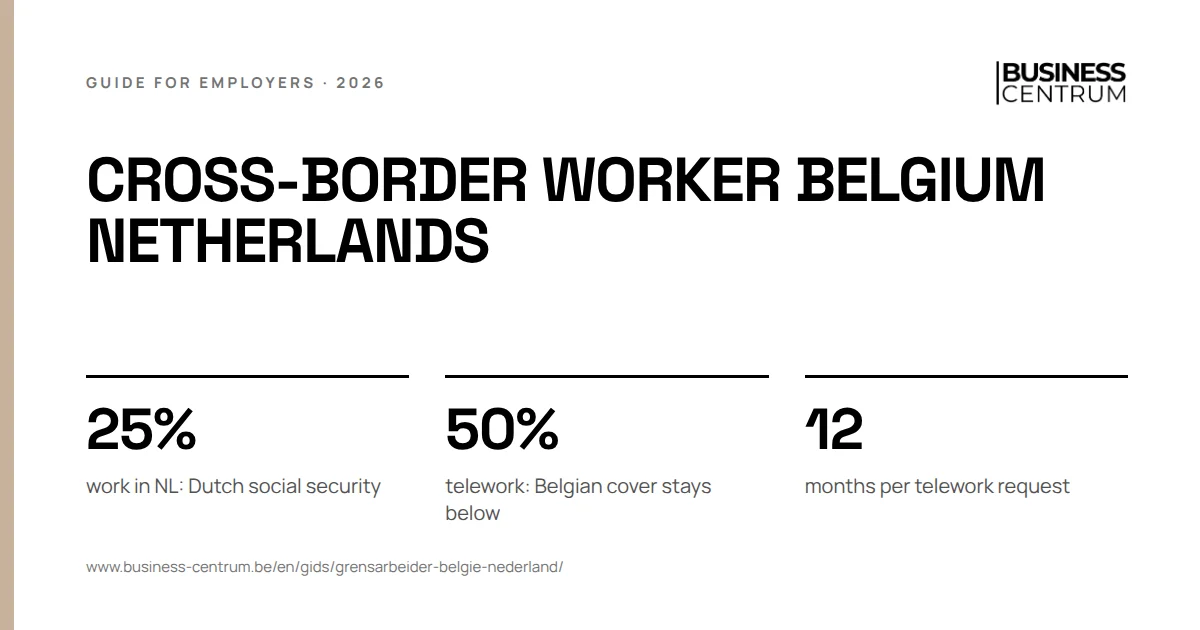
A cross-border worker between Belgium and the Netherlands lives in the Netherlands and works for your company in Belgium, or the other way round. If he only works in Belgium, Belgian social security applies and you pay NSSO contributions as for any employee. If he also works in the Netherlands, for example from home, the share decides: from 25% of his working time in the Netherlands he falls entirely under the Dutch system. For tax, pay follows the place where he works. Below you will find what you arrange per area.
Who is a cross-border worker between Belgium and the Netherlands?
Regulation 883/2004 calls a frontier worker anyone who works in one member state and lives in another, and who in principle returns home daily or at least 1 time a week. For an employer in Ghent or the Meetjesland, that is often an employee from Sluis, Terneuzen or Hulst. It can also be a Belgian who moved across the border. For the regulation's rules, what counts is where he lives and where he works.
Three questions decide everything that follows:
- Which social security applies? The European regulation decides, not your contract.
- Which country may tax the pay? The tax treaty between Belgium and the Netherlands decides.
- Which formalities do you complete? Dimona, returns, the A1 certificate and possibly a work permit.
A frontier worker who drives to Ghent every day is simple. It gets complicated once he does part of his work in the Netherlands: home working, visits to Dutch customers or a fixed day at a branch across the border. Then social security can shift to the Netherlands, for his entire pay.
Cross-border worker Belgium Netherlands: which social security applies?
The basic rule is in Article 11 of Regulation 883/2004: whoever works in a member state is subject to that state's legislation, even if he lives in another. An employee from Terneuzen who does all his work at your company in Ghent is therefore covered by Belgian social security. You file a Dimona, include him in your DmfA and pay the normal employer contributions.
If he normally works in two countries, Article 13 applies. The NSSO sums it up: first check whether the employee does a substantial part of his work in his country of residence, at least 25% of working time or pay.
- Yes: the legislation of his country of residence applies, so the Netherlands, even though you are a Belgian employer.
- No, and he only works for you: the legislation of the country where your company has its registered office applies, so Belgium.
That choice applies to his entire pay, not per day. A country where he works less than 5% of his time or pay does not count, according to the NSSO. The institutions look at the expected situation over the next 12 calendar months, as Article 14 of Regulation 987/2009 states.
Home working in the Netherlands: the 25 and 50 percent thresholds
Home working is work in the Netherlands. Two home working days a week for a full-time employee are already well above the 25% threshold. This is what applies if you are his only employer and your registered office is in Belgium:
| Share of work in the Netherlands | Social security | Who issues the A1 | What you do |
|---|---|---|---|
| 0%, all work in Belgium | Belgium (Article 11) | No work in two countries, so no A1 | Dimona, DmfA and NSSO as for any employee |
| Less than 5% | Belgium: the work in the Netherlands does not count | As in the row below | As for any employee, and monitor the share |
| 5% to less than 25% | Belgium (Article 13(1)(b)) | The Dutch institution determines the competent country, the NSSO issues the A1 | Report work in several countries to the Dutch institution, otherwise NSSO in Belgium |
| 25% to less than 50% | The Netherlands, unless you jointly request the framework agreement | Without agreement the Dutch institution, with agreement the NSSO | Choose: Dutch contributions or a telework request to the NSSO |
| 50% or more | The Netherlands (Article 13(1)(a)) | The Dutch institution | Register with the Dutch institution and pay contributions there |
For someone who lives in another member state and works in several countries, Article 16 of Regulation 987/2009 places the notification with the institution of the place of residence. That institution first determines the applicable law provisionally. It becomes final if neither country objects within 2 months. The NSSO puts it like this: if your employee lives in another member state, contact the competent institution of that country in advance. How the application works in Belgium itself is explained in applying for an A1 form.
The framework agreement on cross-border telework
For home working between 25% and 50% there is a way out. The framework agreement on cross-border telework lets the social security of the employer's country apply, at the joint request of employer and employee. Belgium and the Netherlands have both applied it since 1 July 2023. According to the NSSO, three conditions must be met:
- the employee does not live in Belgium;
- his cross-border telework in his country of residence is less than 50% of his total working time, and he does the rest in Belgium;
- you and the employee jointly decide to apply Belgian legislation.
The agreement only covers telework. If your employee also regularly visits customers in the Netherlands, or works there in another way, he falls outside it under Article 2 of the agreement. Then only an individual exception under Article 16 of Regulation 883/2004 remains.
You submit the request to the NSSO via the online service for working abroad, as a request for working in several countries. In step 3 you enter the percentage for Belgium and the percentage of telework in the Netherlands, in step 4 you confirm the choice and the employee's agreement. The agreement itself allows an arrangement of at most 3 years at a time. The NSSO accepts a request for the coming 12 calendar months, based on an estimate of the work pattern, and renews annually. A request for the past is limited: the agreement allows at most 3 months back, and only if Belgian contributions were already paid for that period or he was otherwise insured in Belgium. For the framework agreement, the FPS Social Security lists the Sociale Verzekeringsbank as the competent Dutch institution.
Also record the home working in employment law terms. How to set up a fixed home working arrangement is in our guide on structural telework.
What the employer does per area
| Area | Belgian social security applies | Dutch social security applies |
|---|---|---|
| NSSO | Normal contributions in the DmfA | No DmfA for the period of the Dutch A1; contributions under Dutch rules |
| Dimona | Yes, before the start | Yes: Dimona also applies to people not covered because they work in several countries |
| A1 certificate | From work in the Netherlands: request at the place of residence or, for telework under the agreement, at the NSSO | Issued by the Dutch institution |
| Payroll tax | On the pay for the work in Belgium | On the pay for the work in Belgium: tax follows the treaty, not social security |
| Health insurance | Belgian health insurance fund, care also in the Netherlands | Dutch insurance |
| Limosa | Not required | Not required |
Note the last column. Social security and tax are separate. An employee can be socially insured in the Netherlands and still be taxed in Belgium on part of his pay.
Dimona, DmfA and Limosa for a cross-border worker from the Netherlands
Dimona. According to the NSSO's administrative instructions, you file a Dimona for everyone who appears on the DmfA, but also for employees who work in several EEA countries and are not subject to Belgian social security, for example because they do not live in Belgium. So you always register a cross-border worker from the Netherlands, even if the Netherlands is competent. What you fill in and when is in Dimona declaration. If you leave Dimona management to us, we also follow up the changes.
DmfA. If the Dutch institution issues an A1, according to the NSSO you may no longer declare this employee in the Belgian system for the period the certificate covers. You then register with the Dutch institution and pay contributions under Dutch legislation and procedures.
Limosa. The NSSO expressly excludes frontier workers: no notification duty for employees who live abroad and work in Belgium only for a Belgian or foreign employer and for an indefinite period. Employees who normally work in several countries for a Belgian employer also fall outside it. Limosa is for people temporarily or partly employed in Belgium by a non-Belgian employer. When that declaration does apply is explained in Limosa declaration.
Contract. A written contract is no luxury for a cross-border worker. State the fixed workplace in Belgium and the home working days, so the share in the Netherlands is clear. When a written contract is required is covered in is a written employment contract mandatory. If the home working changes later, record it with an addendum to the employment contract.
Tax: the treaty between Belgium and the Netherlands
The tax treaty of 5 June 2001 covers employment income in Article 15. The rule: pay of a resident of the Netherlands is taxable only in the Netherlands, unless he exercises the work in Belgium. For the work he does in Belgium, Belgium may tax the pay.
For your employee from Zeeuws-Vlaanderen, that means:
- the days he works at your company in Ghent: Belgium may tax the pay for that work;
- his home working days in the Netherlands: he exercises his work in the Netherlands, so only the Netherlands taxes that pay.
The well-known 183-day rule does not help here. It only leaves pay taxable in the country of residence if the employee works briefly in the other country and the pay is paid by an employer that is not resident in the country of work. You are a Belgian employer, so that condition is never met.
What you withhold. According to the FPS Finance, pay that Belgium may not tax under a treaty is not subject to Belgian payroll tax either. That is in Article 87 of the Royal Decree implementing the Income Tax Code 92. So you withhold payroll tax on the pay for the work in Belgium and not on the pay for the Dutch home working days. Keep a monthly record of how many days he works where. How that works out net is shown in gross to net, and what goes on his annual form in form 281.10.
On 21 June 2023 both countries signed a new treaty that is to replace the 2001 treaty. It only enters into force after both countries have completed their approval and notified each other. The new Article 14 takes over the same rule for employment income.
Worked example
A wholesaler in Ghent hires a white-collar employee who lives in Terneuzen. She works five days a week: three in Ghent and two from home.
- Social security. Two days out of five is 40 percent work in the Netherlands. That is more than 25%, so Dutch social security applies. It is less than 50% and it is purely telework. The wholesaler and the employee can therefore jointly ask the NSSO to keep her insured in Belgium.
- Tax. Belgium may tax the pay for the three days in Ghent, only the Netherlands the pay for the two home working days. The wholesaler withholds payroll tax on the Belgian part.
- Consequence without a request. If the wholesaler does nothing, the Netherlands is competent for the social security of her entire pay, including the three days in Ghent. The wholesaler then pays Dutch contributions and no NSSO contributions for her.
If the same employee only works from home one day every two weeks, she is at 10 percent. Belgium stays competent. Because she normally works in two countries, the wholesaler does report this to the Dutch institution. That institution determines the competent country, and the NSSO issues the A1.
Health insurance, child benefit and unemployment of the cross-border worker
Health insurance. If Belgian social security applies, your employee joins a Belgian health insurance fund. He receives care in the Netherlands through the Dutch institution, at the expense of his Belgian fund (Article 17 of Regulation 883/2004), and also in Belgium itself (Article 18). According to the NIHDI, the document with which a frontier worker opens that right in the other country is the S1 form, issued by the health insurance fund of the country where he is insured. If he falls under Dutch social security, he is insured in the Netherlands for all his work: the regulation subjects a person to the legislation of only one member state.
Child benefit. If the children are entitled in two countries, Article 68 of the regulation sets the order: first the right based on work, then on a pension, then on residence. With two rights based on work, the country where the children live goes first. The other country pays at most a supplement. Let your employee apply to the funds involved.
Unemployment. If a frontier worker becomes fully unemployed, under Article 65 he makes himself available to the employment services of his country of residence and receives a benefit from that country. For your employee from the Netherlands, that is the Netherlands, even if he was insured in Belgium.
A cross-border worker from outside the EU
A Dutch national, a Belgian or another citizen of the European Economic Area or Switzerland needs no work permit. The Flemish government says so expressly. You therefore never need a single permit for him.
If your candidate lives in the Netherlands but holds the nationality of a country outside the EEA, it is different. Flanders always requires a work permit for frontier workers. A single permit is not possible, because he does not live in Belgium. As the employer, you apply for the permit in the region where he will work. It is valid for at most 12 months, and for a highly skilled worker, manager or postdoctoral researcher up to 3 years. He receives at least the minimum wage of the competent joint committee. Spouses of Belgians or EU citizens living in a neighbouring country as family members are exempt.
Decision aid: which system applies to your employee?
Work through these questions in order, using the expected working week for the next 12 months.
- Does he work entirely in Belgium? Then Belgian social security. Done for social security, go to tax.
- Does he work less than 5% in the Netherlands? Then that work does not count and Belgium stays competent.
- Does he also work for another employer? Then other rules of Article 13 apply. Have it checked before you declare anything.
- Does he work less than 25% in the Netherlands? Then Belgium stays competent. Report the work in two countries to the Dutch institution.
- Does he work less than 50% in the Netherlands, and is that only telework? Then you can jointly request the framework agreement from the NSSO. Without a request, the Netherlands applies.
- Otherwise: Dutch social security. You register with the Dutch institution.
Then tax, separately from the outcome above: how many days does he physically work in Belgium? You withhold payroll tax on the pay for those days.
What you do as an employer with a cross-border worker from the Netherlands
- Record the work pattern. How many days in Belgium, how many at home in the Netherlands, and does he work at Dutch customers? Put it in the contract or the telework agreement.
- Determine the competent country with the decision aid above, based on the expected 12 months.
- File the Dimona no later than when he starts work, even if the Netherlands turns out to be competent.
- Request the A1 in the right place. Telework under the framework agreement: with the NSSO. Other situations with work in two countries: with the Dutch institution. Track the end date and renew in time.
- Set up payroll. Belgium competent: NSSO in the DmfA. Netherlands competent: no DmfA for that period, but registration and contributions in the Netherlands.
- Split the pay for tax. Payroll tax on the part for the work in Belgium, not on the part for the home working days in the Netherlands. Keep the days per month.
- Follow up changes. An extra home working day, a move or a new customer in the Netherlands can flip the system. Review it at least with every change to the work pattern.
Mistakes we often see
- Not counting home working in the Netherlands. Two home working days a week shift social security to the Netherlands, even if the contract says he works in Ghent.
- Requesting the A1 from the NSSO for ordinary work in two countries. For an employee who lives in the Netherlands, the Dutch institution decides. Only for telework under the framework agreement does the request go to the NSSO.
- Confusing social security and tax. A Belgian A1 does not mean all pay is taxed in Belgium.
- Payroll tax on the full pay. Belgium may not levy on the home working days in the Netherlands.
- Hiring a non-EU national from the Netherlands without a work permit. Living legally in the Netherlands does not give him the right to work in Flanders.
What Business Centrum does for you
For every employee from the Netherlands we work out which country is competent for his social security, file the Dimona and request the A1 from the NSSO when the telework framework agreement fits. In your payroll we split the pay for payroll tax per working day, together with Acerta. In the contract we set out the work pattern so the share in the Netherlands is fixed. Unsure about an employee who lives across the border? Have it checked before you run the first payslip.