
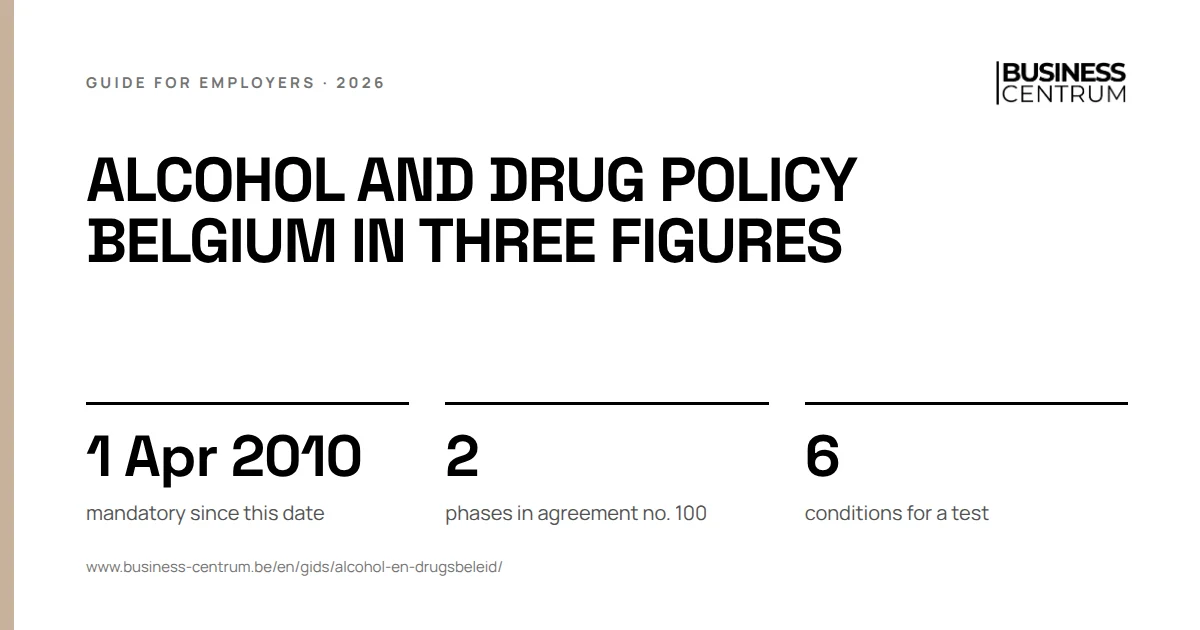
An alcohol and drug policy has been mandatory for every private-sector employer in Belgium since 1 April 2010. Collective agreement no. 100 of the National Labour Council requires at least a policy statement: why you have a policy, what you want to achieve and how you make alcohol and drugs at work open to discussion. That statement goes in your work rules. In a second phase you can add rules, procedures and tests, but only if your policy needs them, and tests only under 6 strict conditions. Below you will find what is mandatory, what is optional, a sample policy statement and a decision aid for tests.
What is collective agreement no. 100?
Agreement no. 100 of 1 April 2009 governs implementing a preventive alcohol and drug policy in the company. It was made generally binding by royal decree of 28 June 2009. That makes it binding on all employers and employees in the private sector, even if you signed nothing yourself. What a collective agreement is and how it binds you is explained in what is a collective agreement.
The starting point is not a ban but performance. The agreement aims to make dysfunction at work caused by alcohol or drugs open to discussion, to prevent it and to remedy it. So it is about behaviour you see at work: someone driving a forklift under the influence, dealing with a customer or missing appointments. What the employee does in his free time stays outside it, unless it affects his work.
The policy is part of your well-being policy under the Well-being at Work Act. The agreement speaks of work-related use: just before work, during working time and breaks, at events at work and on the way to and from work.
The two phases of an alcohol and drug policy in Belgium
| Phase | What | Mandatory? | Where |
|---|---|---|---|
| Phase 1 | Starting points, objectives and a policy or intention statement | Yes, for every employer | Work rules |
| Phase 2 | Rules on the availability of alcohol, bringing in alcohol and drugs, and work-related use | Only if your objectives require it | Work rules |
| Phase 2 | Procedures for dysfunction or breach of the rules | Same | Work rules |
| Phase 2 | A method for unfitness for work: transport home, support and who bears the costs | Same | Work rules |
| Testing | Alcohol or drug tests, with their detailed rules | Never mandatory, only after phase 2 | Work rules |
The policy must fit the size of your company, the nature of the work and the risks. A construction firm with crane operators needs different rules from an accountancy firm. A policy consisting only of tests is not a policy under the agreement.
What the employer must do under agreement no. 100
Draw up the policy with the prevention services. You ask for the advice and cooperation of your internal prevention advisor and your external service. They know the risks of your workstations.
Consult. The Committee and the works council receive information and give prior advice on the policy statement, the rules and procedures, and on the possibility of testing. Without a Committee the union delegation does this, and without a union delegation the employees themselves.
Put it in the work rules. All measures from phase 1, phase 2 and the testing rules go into the work rules, using the normal amendment procedure. You may also communicate them in other ways.
Inform and train. Managers and employees receive the necessary information, on joining and whenever needed. Managers implement the policy at their level: they are the first to see dysfunction.
Evaluate. You evaluate the policy regularly with managers and the prevention services, based on annual reports, Committee opinions and incidents. That fits into the annual action plan of your global prevention plan.
Sample policy statement
A policy statement need not be long. This text is a starting point to tailor with your prevention advisor and your employees:
"Our company wants safe and healthy work for everyone. Work-related use of alcohol and drugs can harm the safety, health and performance of our staff and their colleagues. That is why we run a preventive policy. We talk to each other about performance, not suspicions. Anyone with alcohol or drug problems can turn in confidence to the occupational physician or a support service of their choice. This policy applies to everyone, from management to new starter, and is evaluated every year."
Add who the confidential counsellor or contact point is, and whether there are rules on alcohol at work, for example at a reception or staff party.
Alcohol and drug policy Belgium: when may you test?
Testing is an optional part of the policy. If you do it, use only non-biological tests, such as a breath test or a psychomotor reaction test. They give only a positive or negative indication and have no evidential value. A blood or urine test is a biological test. It falls under the act of 28 January 2003 and only the occupational physician may carry it out, within health surveillance of employees.
A test is only allowed if these 6 conditions are met:
- the aim is preventive: checking whether the employee is fit to do his job;
- you do not use the result for anything else, and a sanction never rests on the test alone;
- the test is adequate, relevant and not excessive;
- the employee consents;
- the possibility of testing does not lead to discrimination, although you may limit it to a group, such as employees in a safety position;
- the results are not stored in a file.
In your rules you then set 6 elements: the type of test, the target group, the procedure, who tests, when, and the consequences of a positive result.
Decision aid: may I carry out this test?
| Question | Yes | No |
|---|---|---|
| Is there a policy statement in the work rules? | Next question | No test: start with phase 1 |
| Do the rules contain phase 2 rules and procedures? | Next question | No test: work out phase 2 |
| Are the testing rules in the work rules, after advice from the Committee or the employees? | Next question | No test: amend the rules |
| Is it a breath or reaction test, not blood or urine? | Next question | Only through the occupational physician |
| Does the employee consent and is the aim preventive? | Test allowed | No test |
The test itself is summarised in can an employer carry out a drug test.
What if you suspect something on the shop floor?
If a manager sees that an employee is not able to work safely, he follows the method in your rules. A practical playbook, to agree with your prevention advisor:
| Step | Who | What |
|---|---|---|
| 1. Observe | Manager | Describe the behaviour and performance: what you see, when, who was there |
| 2. Safety | Manager | Remove the employee from the workstation if he endangers himself or others |
| 3. Transport | According to the rules | Do not let him drive; arrange transport home and who pays for it |
| 4. Conversation | Manager and HR | Talk to him about his performance the next working day |
| 5. Help | Occupational physician or support service | Point to the help available, including the occupational physician through a spontaneous consultation |
| 6. Follow-up | Manager | Record agreements and follow them up |
The agreement asks you to set the method for unfitness for work if your policy has a second phase. How to include and apply disciplinary measures is explained in disciplinary sanctions for employees. Dismissal for serious cause has strict deadlines and rules of evidence, see dismissal for serious cause. A positive test alone does not carry such a dismissal.
Sectors where the policy weighs more
In transport, construction and logistics, many people work in a safety position. There a policy with clear rules and procedures is the minimum, and tests for that group are often defensible. See our pages on transport and construction. In hospitality alcohol is available at the workplace itself; rules on availability and drinking during a shift belong in phase 2, see hospitality.
Substance use is often linked to workload and stress. Include it in the analysis of psychosocial risks at work.
What do you risk?
An employer without a policy statement breaches a generally binding collective agreement. That is a level 1 infringement in the Social Penal Code: an administrative fine of € 100 to € 1,000, per employee concerned. The bigger risk lies elsewhere: without a procedure and testing rules in your work rules you may not test, and your position is weak if you want to act. What changes in the fines is in Social Penal Code 2026.
Mistakes we often see
- No policy statement in the work rules. That has been mandatory since 1 April 2010.
- Testing without phase 2. Without rules and procedures in the work rules, any test is unlawful.
- A urine test through your own lab. Only the occupational physician may carry out biological tests.
- Keeping a list of test results. The agreement expressly prohibits it. Watch out for other forms of monitoring too, such as cameras in the workplace.
- Letting someone under the influence drive home. Arrange transport in your procedure.
- Sanctioning on a suspicion. Talk about performance and record what you observe.
What Business Centrum does for you
Business Centrum drafts or updates your work rules, with the policy statement and, if you wish, the rules, procedures and testing rules of your alcohol and drug policy, and we prepare the amendment procedure, together with Acerta. You agree the content of the policy with your prevention advisor. Want to put the policy into your work rules? Ask us.