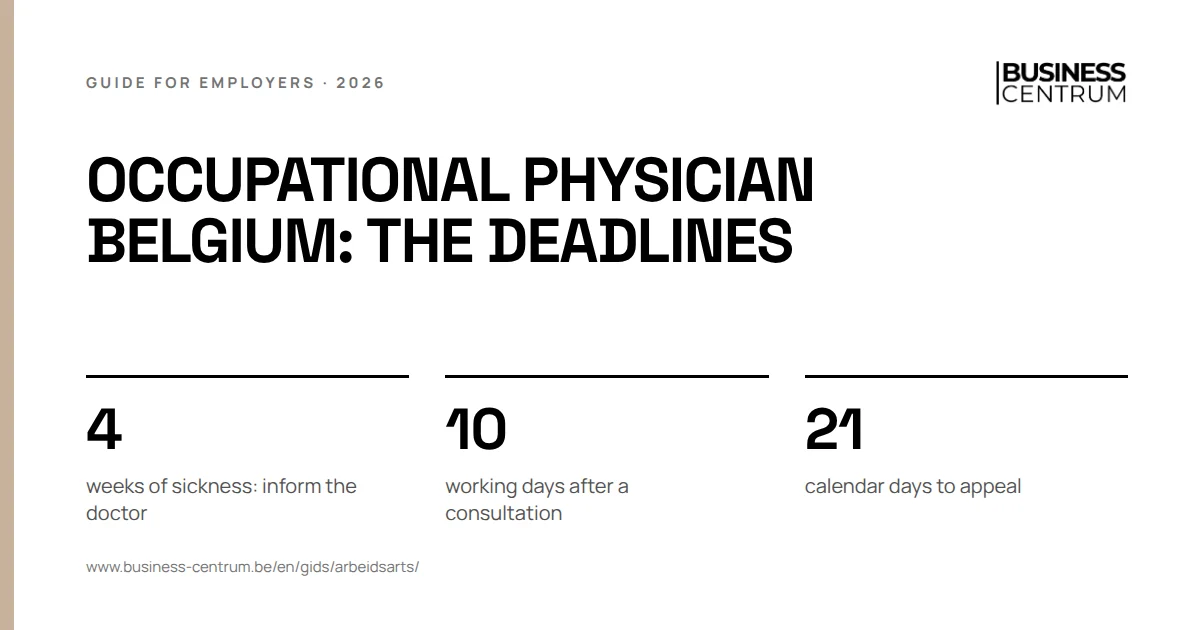
The occupational physician is the prevention advisor-occupational physician of your external service for prevention and protection at work. He assesses whether your employees are fit for their work, carries out the mandatory medical examinations and advises you on adapted work and reintegration. He does not treat, does not check sickness absence and never passes on a diagnosis to you. You call on him when hiring for a risk job, when an employee returns to work and for every incapacity of 4 weeks or more. An employee can also go to him directly: an assessment then follows within 10 working days. Below you can read what the occupational physician does, what he may tell you and how to work with him.
What does an occupational physician in Belgium do?
The legal title is prevention advisor-occupational physician. His role is set out in Book I, Title 4 of the Code on Well-being at Work and follows from the Well-being at Work Act. The aim is prevention: protecting your employees' health before damage occurs.
In practice the occupational physician:
- carries out the preventive medical examinations: the pre-employment and periodic health assessment and the return-to-work examination, see health surveillance of employees;
- sees employees who request a spontaneous consultation themselves;
- detects and reports occupational diseases and work-related conditions;
- proposes adaptations to the workstation, working method or pace of work;
- advises on the first aid kit, the first aid room and the number of first aiders, see first aid at work Belgium;
- assesses pregnant employees in a risk post, see maternity protection;
- estimates the work potential of long-term sick employees and carries out the reintegration assessment;
- takes part in the Committee and has free access to all workplaces.
He works with the other prevention advisors. In your company that is the internal prevention advisor; at the external service, among others the prevention advisor for psychosocial aspects, whom you know from the guide on psychosocial risks at work.
Is an occupational physician mandatory?
Every employer must be able to call on an occupational physician. Large companies can have their own medical department within their internal service. An SME does not, so it joins an external service for prevention and protection. That service provides the occupational physician, within the flat fee you pay per employee. If you have fewer than 200 employees and no prevention advisor with additional level II training, you are in group C- or D, and the ordinary health assessments are part of the basic package.
Whether an individual employee must see the occupational physician depends on his job. A driver or someone who lifts heavy loads falls under mandatory health surveillance. An office employee usually does not, but he can always go of his own accord, and after 4 weeks of sickness you report him to the occupational physician.
Occupational physician, inspecting doctor, medical adviser: who does what?
Employers often mix these doctors up. The difference determines what you may ask.
| Doctor | Who sends or chooses him | What he does | What he does not do |
|---|---|---|---|
| Occupational physician | The external service you are affiliated with | Assess fitness, prevention, adapted work, reintegration | Treat illness, check absence, give you the diagnosis |
| Inspecting doctor | You, at your own expense | Check whether the employee really is unfit for work and for how long | Advise on the workstation |
| Medical adviser of the health insurance fund | The health insurance fund | Recognise incapacity for benefits, authorise adapted work | Decide on fitness for your workstation |
| Treating doctor | The employee | Diagnosis and treatment, the sick note | Assess your workstation |
So the occupational physician may never verify whether an absence for health reasons is justified. If you doubt a sick note, send an inspecting doctor. The employee must then be available during a time slot of at most 4 hours if your rules provide for it. How that works is explained in sending an inspecting doctor, what you may ask when someone reports sick in sick note and the employer, and who pays the wages in guaranteed salary.
When do you call on the occupational physician?
| Situation | What you do | Deadline |
|---|---|---|
| Hiring for a safety position or risk job | Request a pre-employment health assessment | Before the first day in the job |
| An employee under surveillance returns after sickness, accident or childbirth | Return-to-work examination after at least 4 weeks of absence | At the latest on working day 10 after the return |
| Any employee has been unfit for work for 4 weeks or more | Inform the occupational physician | As soon as the 4 weeks are reached |
| An employee complains of problems caused by work, or his condition increases the risk | Inform the occupational physician; he decides on an examination himself | As soon as possible |
| An employee is at risk of dropping out and asks for adapted work | Ask the advice of the occupational physician or another prevention advisor | Answer the employee quickly |
| An employee has been unfit for at least 8 weeks | Request an estimate of work potential | From week 8 |
| An employee announces she is pregnant and works in a risk post | Examination under maternity protection | Immediately |
Outside these cases you may not send a job applicant to a doctor. Medical tests other than those in the Code are prohibited, even with the candidate's consent, see is a pre-employment medical examination mandatory. Only the occupational physician may take a blood or urine test for alcohol or drugs, see can an employer carry out a drug test and the guide on alcohol and drug policy.
What may the occupational physician tell you?
Very little, and that is deliberate. The occupational physician and his staff are strictly bound by professional secrecy on the health file. After each examination you receive the health assessment form. It states:
- whether the employee is fit for the job;
- which restrictions apply, temporarily or permanently;
- which measures you take, such as an adapted workstation or a temporary transfer.
It contains no indication of the diagnosis. Do not ask for it either: the employee does not have to tell you his illness, and the occupational physician may not. What you do receive, at least once a year, is a global report on the results of periodic surveillance, without names, to adjust your prevention.
The spontaneous consultation: the employee goes to the occupational physician himself
Every employee, including an office employee without a risk job, can request a consultation for complaints he attributes to his work. His treating doctor can also do so, with his consent. The occupational physician informs you, unless the employee does not want that, and carries out a health assessment within 10 working days.
You remind all employees of that right every year. A short notice on the intranet or with the payslip is enough. It pays off: an employee who talks about workload early is less likely to drop out with burnout.
The occupational physician in sickness, reintegration and medical force majeure
Worked example with dates. Lisa, a warehouse worker, has been sick since Monday 5 January 2026.
| Moment | Date | What happens |
|---|---|---|
| Week 4 | Monday 2 February | You inform the occupational physician; he contacts Lisa |
| Week 8 | Monday 2 March | You can request an estimate of her work potential |
| After 6 months of uninterrupted incapacity | From July | The medical force majeure procedure can start, if no reintegration pathway is running |
| Return after ten weeks | Monday 16 March | Lisa lifts loads every day and is under health surveillance: return-to-work examination at the latest on working day 10 |
If your company has at least 20 employees, you must start a reintegration pathway when the occupational physician finds work potential, at the latest six months after the incapacity began. That applies to incapacities starting from 2026. The full rules are in reintegration 2026. If the occupational physician finds permanent unfitness, medical force majeure explains how the contract ends. Keeping in touch with the sick employee is done by you or one of your own staff, not by the occupational physician; set that procedure out in your work rules.
What if the employee disagrees with the occupational physician?
If the occupational physician proposes a change of work, the employee has 5 working days to agree or to appoint a treating doctor for consultation. He can then lodge a registered appeal within 21 calendar days with the social inspector physician of the Federal Public Service Employment. For the pre-employment assessment that route does not exist. Complaints about a professional error by the occupational physician also go to the social inspector physician.
The appeal procedure is open only to the employee. If you disagree with the proposed measures, discuss it with the external service or in the Committee.
What does the occupational physician cost?
Nothing for the employee. You pay for the occupational physician through the annual contribution to your external service; the rates per tariff group are in the guide on the external prevention service. The examination takes place during working hours, the time is paid as working time and travel is at your expense. Additional examinations requested by the occupational physician are at your expense; those requested by the employee's treating doctor during consultation are not.
Mistakes we often see
- Asking the occupational physician to check a sickness. He may not. Send an inspecting doctor.
- Asking for the diagnosis. The form does not state it, and rightly so.
- Having an applicant examined without a risk job. Prohibited, even with the candidate's consent.
- No report after 4 weeks of sickness. Reintegration then starts too late.
- Using the occupational physician as the contact person for sick employees. That must be one of your own staff.
- Putting the advice on adapted work in a drawer. A restriction on the form always comes with measures you must take.
What Business Centrum does for you
Business Centrum is not an external service and has no occupational physicians. We handle the administration around sickness and return to work: absences and guaranteed salary in our leave and absence service, the procedure for keeping in touch with sick employees in the work rules we draw up for you, and the documents when a contract ends, together with Acerta. Is a long absence getting stuck? Call us and we will go through the steps with you.