
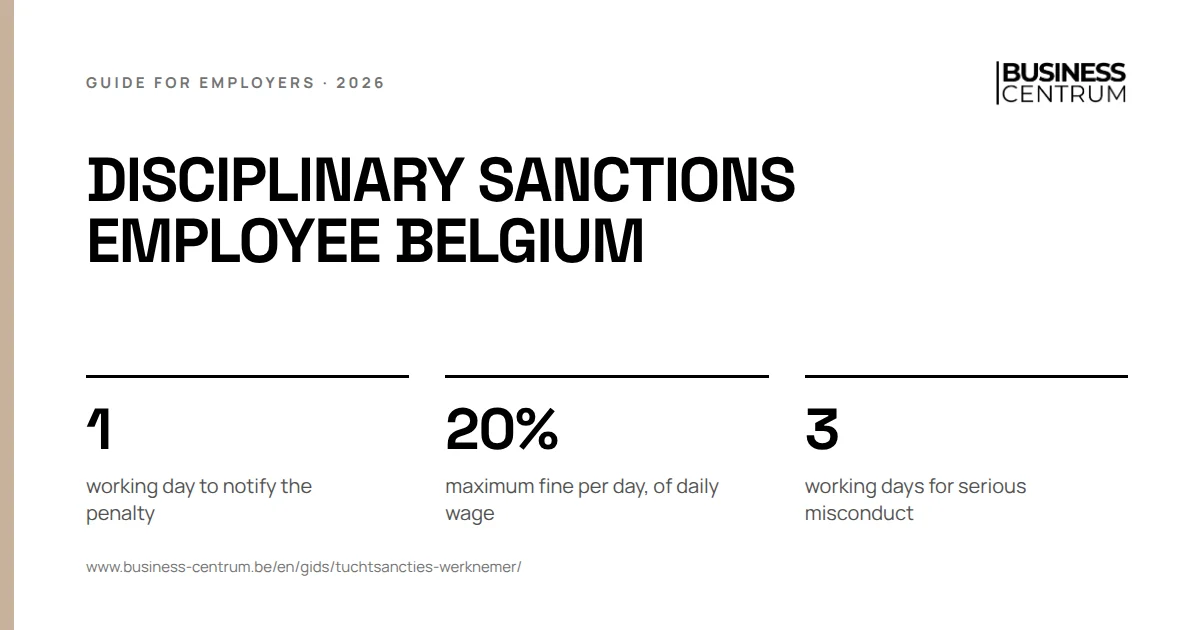
Disciplinary sanctions for an employee in Belgium follow strict rules. You may only impose the penalties listed in your work rules, you notify them no later than working day 1 after the failing is established, and you record them in a register before the next wage payment. A fine may not exceed 20% of the daily wage per day. Miss one of those steps and the penalty is void, and any wages withheld remain due. Below you will find which sanctions exist, how to choose between a warning and a suspension, and how to build a disciplinary file that holds.
What are disciplinary sanctions for an employee in Belgium?
A disciplinary sanction is a penalty you impose as an employer for a failing at work: lateness, an unjustified absence, ignoring a safety rule, refusing a task that is part of the job. The penalty calls the employee to order. The contract simply continues.
The legal basis is the Act of 8 April 1965 establishing work rules. It sets three things every employer must know:
- Only the penalties in the work rules are allowed (section 16). The work rules state the penalties, the amount and use of fines, and the failings they punish (section 6).
- The penalty must be fast and verifiable (section 17): notification no later than the first working day after the finding, and entry in a register before the next wage payment.
- A fine is capped (sections 18 and 19): one fifth of the daily wage per day, and the proceeds go to the employees.
Without work rules, or without penalties in them, you cannot impose any disciplinary sanction. How to draw up the work rules and what they must contain is explained in drawing up work rules. A full example with a chapter on sanctions is in our work rules template.
Disciplinary sanctions in the work rules: which penalties exist?
The law does not list the penalties. You choose them and put them in the work rules. In practice, SMEs use these five, from light to heavy:
| Disciplinary sanction | Form | Effect on pay | Legal limit |
|---|---|---|---|
| Oral warning | Conversation, with a short note in the file | None | Must be in the work rules and in the register |
| Written warning | Letter or e-mail with acknowledgement of receipt | None | Same, plus the deadline of 1 working day |
| Reprimand | Written finding with formal disapproval | None | Same |
| Fine | Deduction from pay | Deduction, max 20% of the daily wage per day | Proceeds go to the employees |
| Suspension without pay | One or more days off work | No pay for those days | Must be expressly provided in the work rules |
A transfer, a lower position or withdrawing a benefit are not classic disciplinary penalties. If they affect pay or the job, the employee can challenge them as a unilateral change to an essential element of the contract. Do not use them as a penalty unless your work rules expressly provide for them and you are sure they do not change the contract. If in doubt, have it checked before you decide.
Suspension without pay is the heaviest penalty that keeps the contract alive. What a suspension does to notice, public holidays and returns is covered in our guide on the suspension of the employment contract.
Disciplinary sanctions for employees: the three deadlines that count
Notification: no later than the first working day after the finding
The deadline runs from the day you, or the manager you appointed for this, establish the failing. Not from the day of the fault itself. If the team leader finds on Monday that an employee was absent without notice, the penalty must reach the employee by Tuesday. Late means void, and you cannot repair that.
Agree a fixed rule: whoever finds a fault reports it the same day to whoever imposes the penalty. A letter sent on Friday for a fault found on Monday is too late.
The register: before the next wage payment
Before the next wage payment, you enter the penalty in the register of sanctions. For each employee: the date, the reason, the type of penalty and, for a fine, the amount. The inspectorate may consult the register at any time. Paper or digital both work, as long as it is complete and you can produce it. What the inspectorate checks further during a visit is covered in labour inspection.
Limitation: when the employee reclaims pay
If a fine or a suspension was unjustified, the employee can reclaim the wages withheld. That is possible up to 1 year after the contract ends, or 5 years after the facts, although that period never runs beyond 1 year after the contract ends. A carelessly imposed penalty therefore remains a risk for years.
The fine: how to calculate the limit
A fine may not exceed 20% of the daily wage per day. That is the total of all fines on that day, not per fine. The wage protection act adds a second limit: all deductions together, including fines under the work rules, may not exceed 20% of the net cash pay at each payment, after tax and social security deductions.
Worked example. A full-time blue-collar worker earns 130 euros gross per day. He arrives late twice on the same day without notice, and your work rules provide a fine of 15 euros each time.
| Step | Calculation | Result |
|---|---|---|
| Maximum per day | 130 euros x 20% | 26 euros |
| Fines under the work rules | 2 x 15 euros | 30 euros |
| Fine allowed for that day | the lower of the two | 26 euros |
| Check at payment | all deductions under 20% of net cash pay | fine if there are no other large deductions |
You do not keep the proceeds of fines. They must be used for the benefit of the employees, for example a staff activity. If you have a works council, you decide on their use in consultation with it. A fine is not compensation: to recover damage an employee caused, the strict rules of section 18 of the Employment Contracts Act apply, and you may only deduct what the employee accepted after the facts or what a court set. What you may and may not deduct from pay is in may an employer withhold pay and, for the employee's creditors, in wage garnishment.
Which sanction fits which fault?
The law imposes no scale. The penalty must, however, be proportionate to the fault, and your work rules must name the failings you punish. This decision aid follows what most SME work rules provide. It is an example, not legal advice for your case.
| Situation | First time | Repeat | What you also do |
|---|---|---|---|
| Late without notice | Oral warning | Written warning, then fine | Record it in the time registration system |
| Unjustified absence | Written warning and formal notice | Fine or suspension | No pay for the day of absence, formal notice for absence |
| Safety rule not followed | Written warning | Suspension without pay | Check the rule was known and workable |
| Refusal of a task within the job | Written warning | Suspension without pay | Record the task and the refusal in writing |
| Serious fault that makes further cooperation impossible | No disciplinary penalty | No disciplinary penalty | Consider dismissal for serious misconduct within 3 working days |
For an employee who stays away without notice, discipline meets the question of whether he resigned. Read employee does not show up. If alcohol or drugs are involved, your policy in the work rules determines what you may test: see may an employer do a drug test.
Disciplinary sanction or dismissal for serious misconduct?
Dismissal for serious misconduct is not a disciplinary sanction. It ends the contract immediately, without notice or compensation, for a fault that makes any further cooperation impossible. It has its own rules: you dismiss within 3 working days after you had sufficient knowledge of the facts, and you notify the reason within 3 working days after the dismissal.
The difference matters. If you first choose a disciplinary penalty, you accept that the cooperation can continue. Invoking serious misconduct later for the same facts then becomes difficult. So decide first whether the fault is so serious that you cannot keep the employee one more day. If so, follow the procedure in dismissal for serious misconduct and use the dismissal letter for serious misconduct.
A series of disciplinary penalties can support a later ordinary dismissal. If the employee asks for the reasons after being dismissed, your register shows that you repeatedly established and notified failings. That helps with the statement of reasons under CLA 109. All choices in an ordinary dismissal are in dismissing an employee.
What you do as an employer when a failing occurs
- Establish the facts. Note what happened, when, who saw it and which rule in the work rules the employee did not follow. Keep evidence such as time records, e-mails or a colleague's statement. Only use camera footage if your cameras were properly announced: see cameras in the workplace.
- Check in the work rules which penalty fits. Is the failing listed, and which penalties do the rules provide? Choose the lightest penalty that does justice to the fault.
- Hear the employee. Let him tell his side before you decide. It avoids a penalty based on a misunderstanding and strengthens your file.
- Notify the penalty on time. No later than working day 1 after the finding, in writing with acknowledgement of receipt or by registered letter. Our written warning template contains all required details.
- Enter the penalty in the register. Date, reason, type and, for a fine, the amount, before the next wage payment.
- Process the financial consequences. A fine or suspension appears on the payslip. Pass it on in time for payroll.
- Keep everything in the personnel file. A complete file is your evidence if the employee contests the penalty or if you dismiss later.
How to approach and word the first warning is covered in written warning to an employee.
Adding or changing sanctions in the work rules
If your work rules contain no sanctions yet, or you want to add a fine or suspension, you follow the amendment procedure. You make the draft available, employees have 15 days to note comments, and after entry into force you send a copy to the inspectorate within 8 days. With a works council, it decides with you.
In the chapter on sanctions, state:
- the penalties, from light to heavy;
- the amount of fines and their use;
- the failings you punish, as concretely as possible;
- the recourse the employee has to contest a penalty;
- who in your company may impose penalties.
An employer without valid work rules risks a level 2 sanction under the Social Penal Code: an administrative fine of € 250 to € 2,500. What changes this year for those fines is in Social Penal Code 2026.
If the fault concerns harassment, violence or unwanted sexual behaviour, the procedures of the well-being at work act apply alongside discipline. They are in psychosocial risks at work.
Mistakes we often see
- Imposing a penalty that is not in the work rules. It is then void, however justified.
- Missing the one working day deadline. A letter sent only after the weekend is often already late.
- Keeping no register. The penalty is then not verifiable.
- Keeping the fine yourself. The proceeds go to the employees.
- Using a fine as compensation. Recovering damage follows other, stricter rules.
- Punishing first and then invoking serious misconduct for the same facts.
- Letting managers impose penalties without agreement on who keeps the register. To avoid the most common misunderstandings, also read mistakes in personnel administration.
What Business Centrum does for you
We write the sanctions chapter of your work rules, with penalties and failings that fit your company, and take you through the amendment procedure up to filing with the inspectorate. We process fines and disciplinary suspensions correctly on the payslip and in the returns, together with Acerta, and keep an eye on the daily wage limit. More on our help with contracts and rules is under employment contracts. Unsure about a penalty or deadline? Have it checked before you send the letter.