
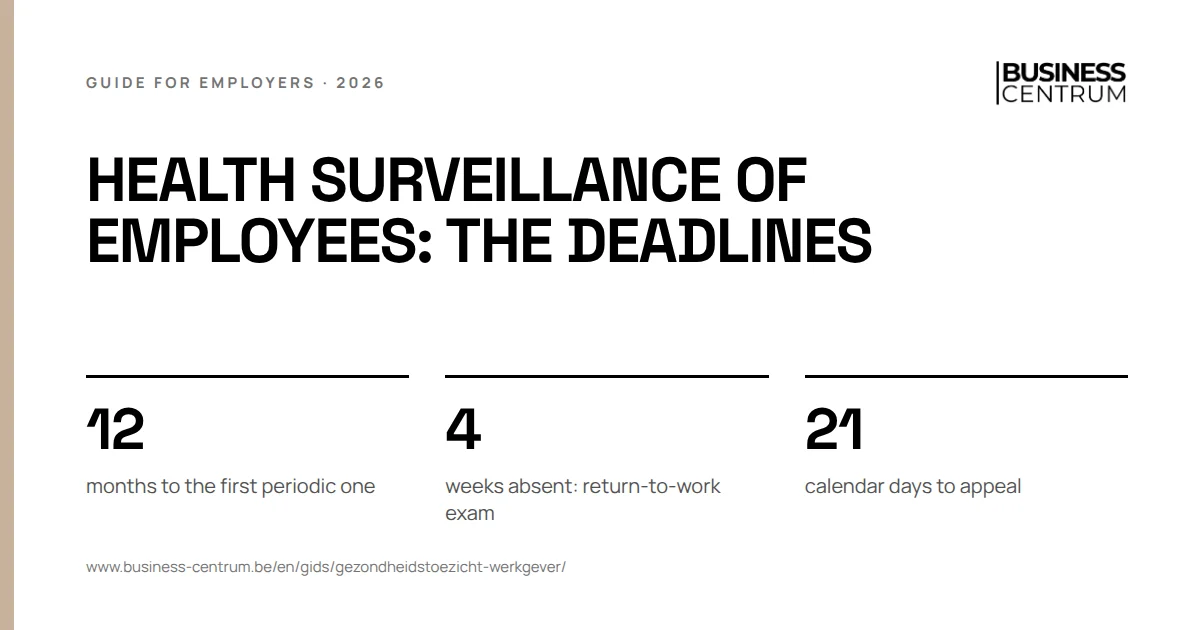
Health surveillance is mandatory for every employee in a risk job: a safety position such as forklift driver, a vigilance position, or work with a defined health risk. You have that employee examined by the occupational physician of your external service before the start, then periodically, and again after an absence of at least 4 weeks. You keep the lists, summon employees during working hours and pay the costs. The first periodic health assessment follows at the latest 12 months after hiring. Below you will find who is covered, which examinations exist and what you arrange in practice.
What is health surveillance of employees?
The rules are in Book I, Title 4 of the Code on Well-being at Work, which implements the Well-being at Work Act. Health surveillance has one aim: protecting your employees' health by preventing risks. The Code spells out what the occupational physician must achieve: detect occupational diseases as early as possible, prevent someone from doing work whose risks their health cannot bear, and look for adapted work for people with limited fitness.
So it is not a check on sickness. The occupational physician may never verify whether an absence for health reasons is justified. For that you send an inspecting doctor, see sending an inspecting doctor. Nor is it a pre-employment test of your choosing: outside the examinations in the Code you may not have any medical tests done on candidates or employees.
The examination is carried out by the prevention advisor-occupational physician; what he does and what he may tell you is in occupational physician Belgium. In an SME, that is the doctor of the external service for prevention and protection you are affiliated with. Only large companies have their own medical department.
Which employees fall under mandatory health surveillance?
The Code has three kinds of risk job. Which workstations they cover in your company follows from your risk analysis.
| Kind of job | What it is | Examples |
|---|---|---|
| Safety position | Work with vehicles, cranes, lifting equipment, dangerous machines or service weapons, where a mistake puts others at risk | Truck driver, forklift driver, crane operator |
| Vigilance position | Permanent monitoring of an installation, where a lapse of attention puts others at risk | Control room operator |
| Activity with a defined risk | Work for which the risk analysis shows an identifiable risk from a physical, chemical or biological agent, from heavy, monotonous or pace-bound strain, or from increased exposure to psychosocial risks | Work in noise or with solvents, lifting loads, night shifts on the line |
On top of that, specific groups apply whatever their job. Night workers and shift workers get a pre-employment health assessment, as do young people who are not yet 18 at the start, and domestic staff. For night work, see night work in 2026; for student jobs, our page on students. A pregnant employee in a risk post is examined under maternity protection.
Mandatory surveillance only falls away if the risk analysis, made with the occupational physician and submitted to the Committee, shows it is not needed. In case of dispute, the social inspector physician of the Federal Public Service Employment decides.
Decision aid: is this employee under mandatory health surveillance?
Go through the questions for every job in your company. A single yes is enough.
| Question | Yes | No |
|---|---|---|
| Does the employee drive a vehicle, forklift, crane or dangerous machine that puts others at risk? | Safety position | Next question |
| Does he permanently monitor an installation where a moment of inattention puts others at risk? | Vigilance position | Next question |
| Does the risk analysis show exposure to noise, substances, biological agents, heavy loads or high psychosocial strain? | Activity with a defined risk | Next question |
| Does he work nights or shifts, is he under 18, or is he domestic staff? | Specific group: pre-employment assessment | No mandatory examination |
In doubt? Ask your external service before the employee starts. An employee with ordinary office work usually falls under none of these. That changes if the psychosocial risk analysis shows an increased risk, see psychosocial risks at work.
The five forms of health surveillance
| Examination | When | Who takes the initiative |
|---|---|---|
| Pre-employment health assessment | Before the employee starts in the risk job, or when moving to such a job | You, through a request to the external service |
| Periodic health assessment | According to the frequency for the risk, the first at the latest after 12 months | The occupational physician summons via you |
| Return-to-work examination | After at least 4 weeks of absence through sickness, accident or childbirth, at the latest on working day 10 after the return | You |
| Spontaneous consultation | When an employee has complaints he attributes to his work | The employee himself, even without a risk job |
| Extended health surveillance | After an exposure to certain agents has ended | You, or Fedris if the employee has left |
The pre-employment assessment may also take place before the contract is signed, provided it is the last step of the selection. The occupational physician decides on fitness before the employee actually starts in the job. When that examination on hiring is mandatory, and when not, is summarised in is a pre-employment medical examination mandatory.
After a spontaneous consultation, the occupational physician carries out a health assessment within 10 working days. You must remind all employees of that right every year, including those not under mandatory surveillance.
Periodic health surveillance: how often?
The frequency per risk is in Annex I.4-5 of the Code. A periodic assessment consists of an interview and a clinical examination by the occupational physician, supplemented by questionnaires or other acts between two assessments. Three examples common in SMEs:
| Risk | Periodic health assessment | In between |
|---|---|---|
| Safety or vigilance position | Every 24 months | Questionnaire or other act halfway |
| Manual handling of loads, under 45 | Every 36 months | According to the annex |
| Manual handling of loads, from 45 | Every 24 months | According to the annex |
If an employee is exposed to several risks, the highest frequency applies. The occupational physician can increase the pace, for example after an accident or an unusual result. At least once a year he reports globally to you and the Committee.
What you arrange as an employer
The lists. Based on the risk analysis you keep two lists: the risk jobs and activities, and a list of names of the employees under mandatory surveillance, with each person's job and the date of the last assessment. They are attached to the annual action plan of your global prevention plan. You send them to the occupational physician every year and keep them for at least 5 years. Removing a name is only possible with the agreement of the occupational physician and the Committee.
The summons. You request the assessment, set a date with the external service and tell the employee in advance why and how the examination works. It takes place during working hours. The time counts as paid working time and travel is at your expense. A summons outside working hours or during a suspension of the contract is absolutely void.
Reporting long absence. You inform the occupational physician of every incapacity of 4 weeks or more, including for employees without a risk job. That is the starting point for reintegration. Sick notes and reporting sickness remain a matter for your sickness rules.
Who follows up internally. Your internal prevention advisor keeps an eye on the lists and due dates. In a small company that is often you.
What does health surveillance cost?
For the employee nothing: the Code prohibits any expense for him. You pay through the annual contribution to your external service. For an SME in group C- or D, the ordinary health assessments are part of the basic package of that flat fee. What the service does outside it is charged at € 104.35 per service.
Worked example. A transport company with eight employees is in tariff group 4. The minimum contribution in 2026 is € 128.53 per employee per year, together 8 x 128.53 = € 1,028.24. In summer it hires a driver for three months. For such a short employment you normally pay one twelfth per month, so 3 x 10.71 = € 32.13. If that driver gets a pre-employment health assessment, which a safety position requires, you pay the full annual amount of € 128.53. Factor that into the cost of a seasonal worker. The rates per group are in our guide on the external prevention service, the sector rules for drivers in joint committee 140.
The external service invoices on the basis of your workforce in Dimona. A correct Dimona keeps you from paying for people who have already left.
The decision, consultation and appeal
After each examination the occupational physician fills in the health assessment form. That form states whether the employee is fit, with which restrictions and which measures you take. It may contain no indication of the diagnosis.
If the occupational physician proposes a temporary or permanent change of work, the employee has 5 working days to agree or to appoint a treating doctor for consultation. He can then lodge a registered appeal within 21 calendar days with the social inspector physician, who handles it within 42 calendar days. For a pre-employment assessment there is no consultation or appeal.
The appeal suspends the decision, except for a safety position, a vigilance position, ionising radiation or a pregnant employee in a risk post. Someone declared unfit for a safety position may no longer be employed there. Otherwise you keep the employee at work according to the doctor's recommendations, through a reintegration plan. If that is not possible, medical force majeure comes into view, with its own procedure.
What if an employee refuses the examination?
An employee who evades a mandatory examination may not be put or kept to work in the job that requires it. Set out in your work rules how you summon employees and what happens after a missed appointment. The first time, plan a new date and talk about it before you think of a disciplinary sanction.
Separate rules apply to alcohol or drug tests: only the occupational physician may take a blood or urine test, see can an employer carry out a drug test and your alcohol and drug policy.
What do you risk?
An infringement of the Well-being Act or the Code is a level 3 sanction in the Social Penal Code, with an administrative fine of € 1,000 to € 10,000, higher if it causes damage to health or a workplace accident. A driver who drives without a valid assessment and causes an accident makes the file heavy. What changes in the fines this year is in Social Penal Code 2026.
Mistakes we often see
- No list of risk jobs. Without a list the external service summons nobody, and nobody notices until there is an accident.
- Letting a seasonal driver drive before the assessment. The decision must exist before the first trip.
- Planning the examination after working hours. The summons is then void, and so is the decision.
- Not reporting long absence. After 4 weeks you inform the occupational physician, including for an office employee.
- Forgetting office staff in the annual reminder. Every employee is entitled to a spontaneous consultation and must know it. High workload that leads to burnout often starts there.
- A home-made medical check on hiring. Medical tests outside the Code are prohibited, even if the candidate agrees.
What Business Centrum does for you
Business Centrum is not an external service and does not carry out medical examinations. We handle the administration attached to it: the correct Dimona on which your external service invoices, the absences we track for payroll in our leave and absence service, and the rules on summons and examination in the work rules we draw up for you, together with Acerta. Hiring drivers or warehouse staff for the first time? Also see our pages on the transport sector and construction. Unsure whether your lists are in order? Have them checked before the inspectorate visits.