
A training clause lets you claim back part of the cost of a training when an employee leaves shortly after a training you paid for. Article 22bis of the Employment Contracts Act of 3 July 1978 sets strict conditions: a contract of indefinite duration, annual pay above € 44,447 in 2026, an individual written clause before the start and a term of at most 3 years.
You pay for an expensive certification, and three months later the employee leaves for a competitor. The training clause is the legal answer to that, but it only works if every condition is met. It has existed since 7 January 2007. This guide describes the law and the explanation of FPS Employment, as they stood on 1 November 2026. For your own clause or a dispute, personal advice remains necessary.
What is a training clause in Belgium?
Article 22bis, §1 defines the training clause as the clause "whereby the employee, who follows a training at the employer's expense during the performance of his employment contract, undertakes to repay part of the training costs to the employer if he leaves the company before the end of the agreed period."
So three elements: a training during the contract, at your expense, and a period after the training during which the employee stays with you. If he leaves earlier, he repays part of it. It is not a fine and not damages: the amount depends on the cost and on how long he still stayed.
A training clause does not restrict where the employee works later. That is what the non-compete clause is for, with its own conditions and its own template, the non-compete clause template. Both clauses can sit side by side in one employment contract.
The conditions of a training clause
The law distinguishes between conditions for the clause to exist and conditions of form. If a condition of existence is missing, the clause "is deemed non-existent, which means it will have no legal effect at all", FPS Employment writes. Whether the clause is valid is only assessed at the moment one of the parties invokes it.
| Condition | What the law requires | Exception |
|---|---|---|
| Type of contract | An employment contract of indefinite duration | None |
| Annual pay | Higher than € 44,447 (amount on 1 January 2026), proportional for part-timers | Not for training for a shortage occupation |
| Type of training | New professional skills that also have value outside your company | None |
| Scope | At least 80 hours, or a value higher than twice the GGMMI: € 4,467.22 from 1 July 2026 | None |
| No compulsory training | The training does not follow from a law or rule required to practise the profession | Not for training for a shortage occupation |
| No free training | No training the employer must provide free of charge under a law or collective labour agreement and that is needed for the job the employee was hired for | None |
Twice the GGMMI follows the average guaranteed minimum monthly income (GGMMI) of € 2,233.61. If it rises through indexation, the minimum value of the training rises too. FPS Employment adjusts the pay threshold every year on 1 January. The amount for 2027 had not yet been published on 1 November 2026.
A collective labour agreement in the joint committee, declared generally binding, can exclude certain categories of employees or training from the training clause. So also check the rules of your joint committee.
The exception for shortage occupations
Since 10 November 2018, two conditions drop away if the clause concerns training for an occupation or function on the Regions' list of shortage occupations or hard-to-fill functions: the pay threshold and the rule that the training may not be legally required. Article 22bis, §8: "The place of employment determines which of these lists applies." If the employee works in Ghent, the Flemish list of VDAB applies. The other conditions remain: indefinite duration, new skills, 80 hours or the minimum value, and the written clause.
That makes the clause usable for lower-paid occupations where training is expensive, such as some technical and logistics functions. Check the list at the moment you agree the clause, because the Regions adjust it regularly.
The four entries in a training clause
The clause must be in writing, "on pain of nullity", "for each employee individually, at the latest at the moment the training covered by the clause begins". According to article 22bis, §3, the written clause contains:
| Entry | What you fill in | Where it goes wrong |
|---|---|---|
| Description, duration and place of the training | Name and content, number of hours or days, the place | A vague description such as "technical training", or not reaching the minimum of 80 hours |
| Cost of the training | The actual cost, or the elements to estimate it | Counting pay during the training and travel or accommodation costs |
| Start date and term | The date on which the clause starts and its term | With a certificate, the clause starts on the date of the certificate, not at the start of the training |
| Amount to repay | A decreasing amount according to the term | Higher than the legal scale or the cap |
FPS Employment adds: "The existence of a training clause cannot follow from a reference in the work rules or a collective labour agreement concluded at company level." A general sentence in the work rules is therefore not enough. If you add the clause to a running contract, use an addendum to the employment contract, signed before the first training day.
How much does the employee repay under a training clause?
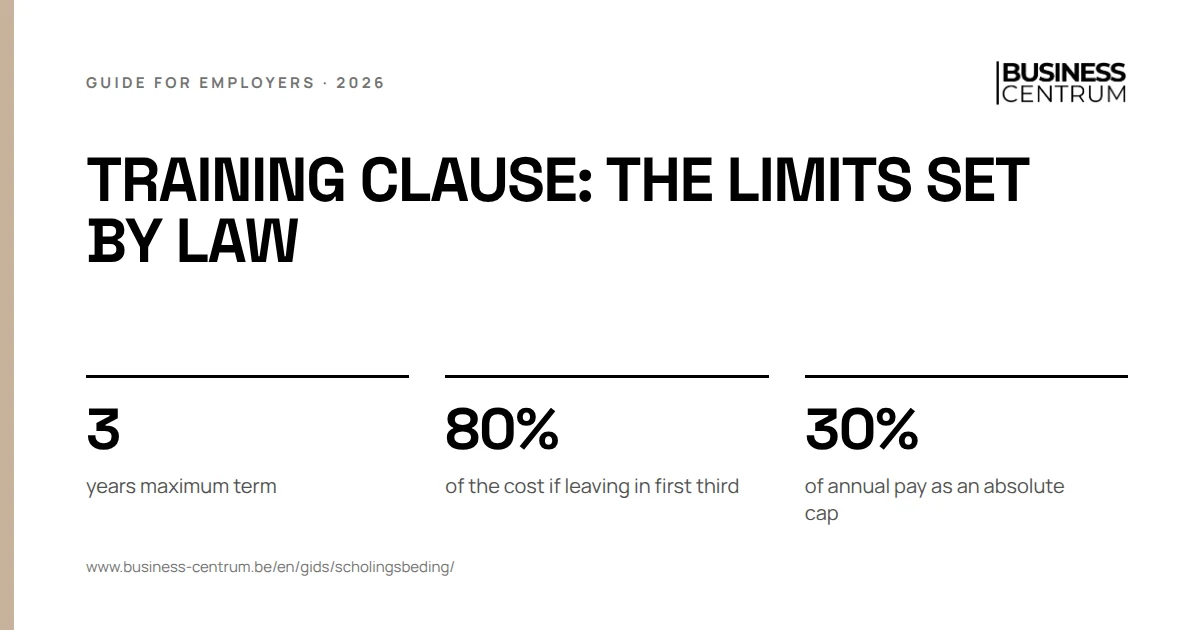
The term is at most 3 years and must be in proportion to the cost and duration of the training. A two-week training does not justify three years. Within that period, the law sets a maximum per third:
| Employee leaves | Maximum repayment |
|---|---|
| Before 1/3 of the agreed period | 80% of the training cost |
| Between 1/3 and 2/3 | 50% of the training cost |
| After 2/3 | 20% of the training cost |
| In any case | Never more than 30% of annual pay |
These are maximums. You may agree a lower scale. The amount in the clause must however decrease: the longer the employee stays, the less he repays.
The cap of 30% of annual pay protects the employee with an expensive training. The cap applies alongside the scale: you always take the lower of the two amounts.
Worked example: one certification and three leaving dates
Worked example
A technical company in Ghent sends Jana, a white-collar employee on a contract of indefinite duration since 2024 with annual pay of 52,000 euros, to a certification of 140 hours. The training provider invoices 6,000 euros. The clause is signed before the first lesson. Jana receives her certificate on Friday 8 January 2027. The term is three years and follows the legal scale.
- Period. The clause runs from 8 January 2027. The first third ends after twelve months, the second third after 24 months.
- Jana resigns and leaves on Wednesday 30 June 2027. That is in the first third: 80 percent of 6,000 euros is 4,800 euros. The cap is 30 percent of 52,000 euros, or 15,600 euros. She repays 4,800 euros.
- Jana leaves on Friday 31 March 2028. That falls in the second third: at most 50 percent, or 3,000 euros.
- The employer dismisses Jana in 2028 without serious cause. The clause has no effect: she repays nothing.
A second case: technician Kevin earns 46,000 euros a year and follows a training of 20,000 euros. If he leaves in the first third, 80 percent is 16,000 euros. The cap is 30 percent of 46,000 euros, or 13,800 euros. He repays at most 13,800 euros.
How you collect the repayment is something you agree with the employee. A deduction from the final pay is not free: the Wage Protection Act limits which amounts you may deduct from pay. Read salary payment first or ask for advice before you deduct anything.
When does the training clause have no effect?
A valid clause does not work with every way of leaving. Article 22bis, §6 and FPS Employment list four situations in which you cannot claim anything back:
| End of the contract | Training clause applies? |
|---|---|
| In the first 6 months from the start of the contract, by either party | No |
| Dismissal by the employer without serious cause, after that period | No |
| Resignation by the employee for serious cause, after that period | No |
| End through a restructuring under the Generation Pact act of 23 December 2005 | No |
| Resignation by the employee of his own accord, after the first 6 months | Yes |
| Dismissal for serious cause by the employer | Yes |
The first 6 months count from the start of the employment contract, not from the training. An employee who gets a training in his fourth month and leaves in his fifth month therefore repays nothing. If you dismiss an employee, you calculate the ordinary notice period or severance pay and the clause lapses. If an employee leaves by mutual agreement, the law does not mention that situation explicitly. In that case, record in the termination agreement what happens to the clause.
The employee remains the holder of his diplomas and certificates, even if the clause takes effect. He is entitled to the original or a copy certified by the training provider. So you may not hold back a certificate until he repays.
Training clause and the right to training
Since the labour deal, every employee has an individual right to training days, and companies above a certain size must draw up a training plan. A training you must provide free of charge under the law or a collective labour agreement and that the employee needs for the job you hired him for cannot, according to article 22bis, §9, be covered by a training clause.
Flemish training leave governs the absence of an employee who follows a recognised training. That is separate from a training clause, which only concerns the cost of a training you pay for as an employer.
Common mistakes with a training clause
- Having the clause signed only after the training. It must exist at the latest at the start of the training.
- A standard sentence in the work rules. The clause must be individual.
- A training clause in a fixed-term contract. The law does not allow it.
- Not checking the pay threshold. Below € 44,447, the clause is deemed non-existent, except for a shortage occupation.
- Counting pay during the training as a cost. Only the actual training cost counts.
- A fixed amount over the whole period. The amount must decrease.
- Invoking the clause after your own dismissal. If you dismiss without serious cause yourself, it lapses.
- Forgetting the cap. Never more than 30% of annual pay.
If the employee needs a written contract for his status, also read whether a written employment contract is required. What else has to be put on paper when someone leaves is set out in social documents at the end of employment.
What Business Centrum does for you
Business Centrum is a social bureau in Ghent, founded in 2013, and a recognised partner of Acerta. With a training clause, Business Centrum helps with checking the pay threshold and the minimum value, drafting the clause in an addendum, calculating the scale and the cap, and the payroll and social documents when the employee leaves. The returns go through Acerta, the recognised secretariat with number 250, which files them. More about clauses in contracts is on employment contracts and about processing on payroll administration. How the work is divided between Business Centrum and Acerta is set out in Business Centrum and Acerta.
Planning an expensive training for an employee and want to know whether a training clause is possible? Request a call back and Business Centrum goes through it with you. For a dispute about a repayment, we refer you to a lawyer or your sector federation.