
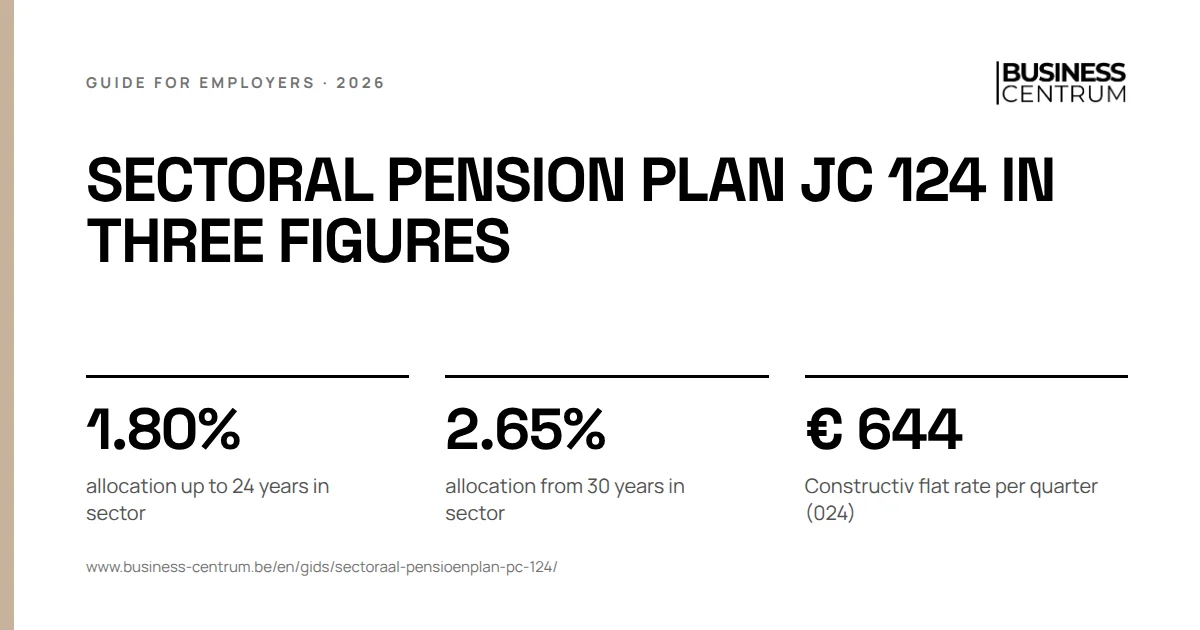
The sectoral pension plan JC 124 is called the Construo Plan. Since 1 January 2007, every worker employed by a company under the Joint Committee for the construction industry has automatically built up a pension capital. Since 1 January 2026, he receives a quarterly allocation of at least 1.80% of his reference wage, and 2.65% after thirty years in the sector. You do not pay a separate premium: the plan runs on part of the flat-rate contribution you pay to Constructiv for each worker.
This guide covers the plan for JC 124 blue-collar workers. How sectoral pension plans work in general is explained in our guide on the sectoral pension plan. The other rules of the committee, from job categories to loyalty stamps, are in the guide on joint committee 124.
Sectoral pension plan JC 124 at a glance
| Item | Rule |
|---|---|
| Name | Construo Plan, a social sectoral pension scheme |
| In force since | 1 January 2007 |
| Plan type | Cash balance: a fixed quarterly allocation plus an assigned return |
| Allocation since 1 January 2026 | 1.80% to 2.65% of the reference wage, by seniority in the sector |
| Reference wage | 108% x 1.04 of the NSSO wage |
| Organiser | fbzp-fsep Constructiv |
| Pension institution | Pensio B, an IORP |
| Who pays | The employer, through the flat-rate contribution to Constructiv collected by the NSSO |
| Worker contribution | None |
| Solidarity part | Yes: build-up during bad weather and primary incapacity, annuity for the partner |
| Legal basis | CLA of 19 March 2026 (no. 199072/CO/124), introduced by the CLA of 16 November 2006 (no. 81550/CO/124) |
The plan has two parts. The pension part builds the capital on an individual account. The solidarity part tops up the build-up when the worker cannot work because of weather or illness, and pays an annuity to the partner if the worker dies before retirement. Both are set out in the CLA of 19 March 2026, which recoordinated the pension rules and the solidarity rules.
Who builds up a sectoral pension in JC 124?
The Construo Plan applies to the blue-collar workers of employers under the Joint Committee for the construction industry: bricklayers, roofers, joiners, tilers, groundworkers and the other trades on site. White-collar staff of a construction company fall under JC 200 and have their own plan for construction employees. It is covered in our guide on the sectoral pension plan JC 200.
Two conditions decide whether a worker is covered:
- He has a blue-collar employment contract with a JC 124 employer.
- The employer reports him under a construction index. The pension fund determines membership from the DmfA, under index 024, 026, 044, 054.
If both are met, the worker is covered from the first day of his contract. Age, job, category and type of contract do not matter: a worker on a fixed-term contract also builds up rights. Anyone who joined since 1 January 2019 is immediately entitled to what he builds up, without a waiting period.
Four groups do not build up anything in the Construo Plan:
| Who | Why not |
|---|---|
| Temporary agency workers | The rules exclude work through agency work or secondment |
| Student workers and apprentices | Excluded: student employment contract, apprenticeship contract or agreement |
| Retired people who work again | Membership ends on retirement, even with a new contract |
| White-collar staff of a construction company | They fall under JC 200 and the construction employees' plan |
Not sure your company falls under JC 124, for instance because you also install or trade? Read our guide on how to find your joint committee in Belgium first. A wrong committee or index means your workers build up nothing.
How much does a worker build up? The allocation in the sectoral pension plan JC 124
Each quarter the worker receives an allocation on his individual account: a percentage of his reference wage. The percentage depends on his seniority in the sector, the number of legitimation cards Constructiv holds for him. Each year worked in construction gives one legitimation card.
| Seniority in the sector | Allocation until end 2025 | Allocation since 1 January 2026 |
|---|---|---|
| 0 to 14 years | 1.10% | 1.80% |
| 15 to 19 years | 1.35% | 1.80% |
| 20 to 24 years | 1.65% | 1.80% |
| 25 to 29 years | 2.20% | 2.20% |
| 30 years or more | 2.65% | 2.65% |
The 2026 increase mainly helps young and mid-career workers: a worker with ten years in construction went from 1.10% to 1.80%. At the same time the additional allocation, a transitional scheme for older workers, was abolished.
The reference wage. The allocation is calculated on 108% times 1.04 of the wage you report in the DmfA under pay codes 1, 3, 4. What the quarterly return showed as wages subject to NSSO counts. Later NSSO reductions do not change the reference wage.
The capital earns an assigned return. That is the percentage the supplementary pensions act sets as the minimum on employer contributions, currently 2.50%. If the law changes that percentage, the plan follows automatically.
Worked example: the supplementary pension of a skilled construction worker
A full-time worker in category II has earned at least € 19.99 an hour since 1 October 2026. The full table is on our JC 124 pay scale page. We take a quarter of 13 weeks at the average working time of 38, so 494 paid hours, without bonuses or overtime.
- NSSO wage for the quarter: € 19.99 x 494 = € 9,872.59.
- Reference wage: € 9,872.59 x 108% x 1.04 = € 11,054.77.
- Allocation with less than 25 years in construction: € 11,054.77 x 1.80% = € 198.99 per quarter.
- Over a year of four such quarters: € 795.96, plus the return.
The same worker with 25 years in the sector receives € 243.20 per quarter, with 30 years € 292.95. If he earns more than the pay scale, the allocation rises with it: it follows the actual NSSO wage. A construction worker's year-end bonus comes as loyalty stamps; how they work is explained on the end-of-year bonus JC 124 page.
What you pay as an employer for the sectoral pension plan JC 124
You do not pay a separate percentage for the Construo Plan and you do not receive an invoice. The statutes of the organiser (CLA 178049/CO/124) explain how it works: part of the flat-rate contribution you owe Constructiv per worker and per quarter goes to the pension plan. The NSSO collects that contribution through your DmfA and passes it on. Constructiv pays the pension fund at the end of each quarter.
| Index in the DmfA | Flat-rate contribution per worker, Q4 2026 | Worker under 25 when hired |
|---|---|---|
| 024 (category A) | € 644 | € 444 |
| 054 and 044 (categories B and C) | € 633 | € 433 |
| 026 (category D) | € 553 | € 353 |
The amounts are set in CLA no. 200905/CO/124 and apply to the fourth quarter of 2026. The committee sets them again for a limited period each time. The lower amount for a young worker applies in the quarter he is first hired by you and the 7 quarters after that. The flat-rate contribution funds more than the pension: Constructiv also pays other sector benefits from it.
Two things you do not do:
- No deduction from wages. The worker pays nothing for the Construo Plan. There is no pension line on his payslip.
- No separate 8.86% NSSO contribution on the sector plan in your DmfA. You only report that special contribution of 8.86% on payments into a plan of your own, such as group insurance you give on top of the sector plan.
Bad weather, illness and death: the solidarity part
A construction worker loses pay when it freezes or rains, or when he falls ill. The solidarity part makes sure his pension build-up does not stop. Two types of periods are treated as equivalent:
- Temporary unemployment due to bad weather. What that means for you as an employer is in the guide on temporary unemployment.
- Primary incapacity for work: illness or accident, after the period of guaranteed wage that you pay yourself.
For those periods the solidarity part pays an allocation on a notional wage, at the same rate by seniority. Economic unemployment and other absences are not treated as equivalent. You do nothing extra: a correct DmfA with the right absence codes is enough.
If a covered worker dies before retirement, the amount on his account goes to the beneficiaries. If he leaves a spouse or legal cohabitant, that partner receives a quarterly survivor's annuity based on that amount. If the annuity is below € 300 a year, it is paid as a lump sum.
Leaving: what happens to the sectoral pension plan JC 124
When a worker leaves, the build-up does not stop at once. A worker only counts as having left if he does not appear in the DmfA of a construction employer for 2 consecutive quarters. If he joins another contractor within that time, his plan simply continues. That suits construction, where workers often change site and employer.
Once he has left, the pension fund asks him to confirm it. If he does not respond within 3 months, he counts as having left anyway. He then chooses what happens to his reserve:
| Choice | What happens |
|---|---|
| Leave it with Pensio B | He becomes a deferred member, the reserve keeps earning until retirement |
| Transfer it to a new employer's pension institution | Possible if that employer has its own plan |
| Transfer it to another sector's plan | Possible if he is covered there |
| Transfer it to an institution that shares its profits | An institution operating under the rules set by the King |
A reserve of no more than € 150 stays in the pension fund unless the worker expressly asks otherwise. For you, what matters is that the end of the contract is correct in the Dimona declaration and the DmfA, and that the social documents are right. Which ones, you can read on the C4 form page and in the guide on the notice period.
Payment: when the construction worker receives his capital
The capital is paid when the worker takes his statutory pension: early from age 60, or at the normal pension age. In the rules that is 66, and 67 from 1 February 2030. If he keeps working for a construction employer after that age, he keeps building up until he stops.
The pension is in principle paid as a lump sum. The worker can ask to convert it into a quarterly annuity. He sees his balance on mypension.be, where Sigedis updates the reserves every year, and in the pension statement the fund sends him. That statement also shows the seniority the fund uses.
Sectoral pension plan JC 124 in 2026 and 2027
In 2026 the allocations of the CLA of 19 March 2026 apply, with 1.80% as the lowest rate. The CLA is concluded for an indefinite period. A change can only come through a new JC 124 CLA.
For 2027 the NSSO has announced a change to the flat-rate contribution. From 1 January 2027, a reduced flat-rate contribution will apply to a worker who is new to the sector: someone with no construction job in the 12 months before his Dimona. It applies in the quarter of first hiring and the 4 quarters after that, and only for indices 024, 026, 044 and 054. The NSSO refers to a draft CLA.
Common mistakes with the sectoral pension plan JC 124
- Reporting a worker under the wrong index or committee. Without index 024, 026, 044, 054 the fund does not record membership and the worker builds up nothing.
- Expecting a white-collar employee in the Construo Plan. Construction employees fall under the JC 200 plan, with their own contribution.
- Putting a pension deduction on the payslip. The worker pays nothing.
- Reporting the 8.86% on the sector plan. That only applies to a plan of your own.
- Coding bad weather incorrectly. Only correctly reported bad-weather days give equivalent build-up.
- Reporting a departure too late. A wrong date in Dimona and the DmfA shifts the exit and the worker's choice.
What to check now
- Are all your blue-collar workers in the DmfA under JC 124 and a construction index?
- Are your white-collar staff under JC 200, with the sector contribution for construction employees?
- Is the flat-rate contribution per worker correct on your quarterly statement, with the lower amount for young newcomers?
- Are bad weather and illness reported with the right codes?
- Does a new worker know at hiring that he builds up a pension in the Construo Plan and where to see it?
- If you have your own group insurance alongside the sector plan, is the 8.86% reported on it separately?
What Business Centrum does for you
Business Centrum processes the payroll of construction companies together with Acerta, with one dedicated contact in Ghent who knows your sites and your people. What that means in practice is described on payroll for construction companies and on our page on the social secretariat for construction. Do you have a question about your workers' supplementary pension? Request a call back.