
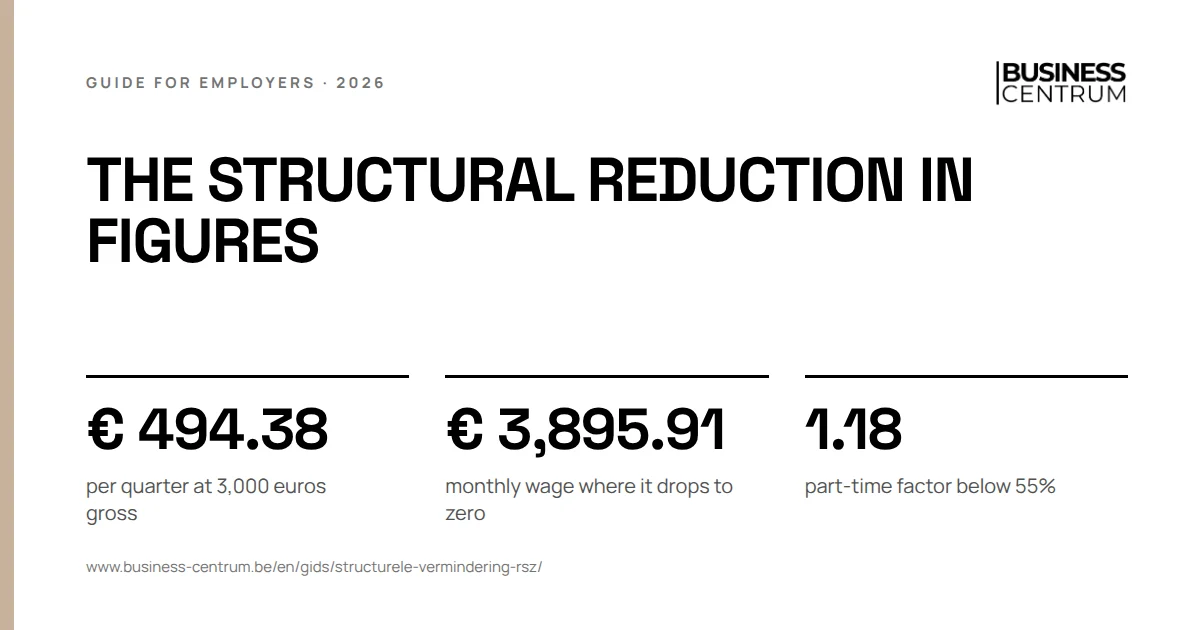
The structural reduction is an automatic cut in your employer social security contributions to the NSSO on low and middle wages. The lower the wage, the larger the reduction. For a full-time employee on € 3,000 gross it is worth € 494.38 per quarter. From about € 3,895.91 a month it disappears in the general category.
This guide is for the employer who wants to understand the wage cost: what the structural reduction is, how the NSSO calculates it, what it saves on your wages and where it goes in the DmfA. Every amount comes from the NSSO administrative instructions for the third quarter of 2026. What you pay without any reduction is in employer social security contributions.
What the structural reduction is and who gets it
The structural reduction is a contribution reduction the NSSO grants per worker and per quarter. You deduct it from the basic employer contribution and the wage moderation contribution for that worker, together 19.88% plus 5.12% of the gross wage in the general category. You never get money back: the reduction cannot exceed those contributions.
It applies to all employers with workers covered by all branches of social security: pension, health and disability insurance, unemployment, occupational diseases, work accidents and annual holidays. A worker not covered by all of them does not open a right.
| Worker | Structural reduction |
|---|---|
| Private sector employee or blue-collar worker covered by all branches | yes |
| Young worker up to 31 December of the year they turn 18 | no |
| Occasional worker in agriculture and horticulture | no |
| Doctor in specialist training, childminder | no |
| Flexi-job worker (flexi wage, remuneration code 22) | no |
| Most statutory and contractual staff in the public sector | no |
The NSSO also calculates no structural reduction on a severance payment (remuneration code 3 or 9). If you work with flexi-job workers, the real cost is in flexi-job cost for the employer.
The formula of the structural reduction
The NSSO calculates the structural reduction as Ps = R x µ x βs. R is the flat amount for a full-time worker, µ the work fraction and βs a fixed factor that corrects for part-time work. R has at most four parts.
| Part of R | What it does | When it counts |
|---|---|---|
| F, flat amount | a fixed amount per quarter | only in category 2 and in category 3 without wage moderation |
| α x (S0 - S), low wages | grows as the wage drops below the threshold S0 | if S is below S0 |
| γ x (S2 - S), very low wages | an extra for the lowest wages, since 1 April 2022 | if S is below S2 |
| δ x (W - S1), high wages | grows above a high-wage threshold | only in category 2 |
S is the reference quarterly wage: the actual quarterly wage W, converted to a full-time quarter. For a full-time worker who works the whole quarter, S equals W. Each part of R is rounded to the cent separately and set to zero if it is negative. The thresholds S0, S1 and S2 follow the indexation of the wage thresholds of the work bonus.
W is the quarterly wage at 100 percent, excluding among others the severance payment, the single holiday pay on leaving, the flexi wage and overtime in hospitality. A year-end bonus you pay yourself does count. How to get from gross to the real cost is in calculate the wage cost.
The structural reduction per category
The parameters depend on the category of the worker. Category 1 is the general category: every worker who does not fall under category 2 or 3. Category 2 covers employers within the scope of the social Maribel, except family and elderly care services and sheltered workshops. Category 3 covers sheltered workshops, social workshops and customised work companies.
| Category | Formula for R from the third quarter of 2026 |
|---|---|
| 1, general | 0.14 x (€ 11,687.74 - S) + 0.16 x (€ 9,738.14 - S) |
| 2, social Maribel | € 79 + 0.23 x (€ 10,175.11 - S) + 0.16 x (€ 10,175.11 - S) + 0.06 x (W - € 17,140.06) |
| 3, with wage moderation | 0.14 x (€ 12,664.40 - S) + 0.16 x (€ 9,738.14 - S) |
| 3, without wage moderation | € 495 + 0.18 x (€ 12,024.07 - S) + 0.16 x (€ 9,738.14 - S) |
Two differences stand out. In category 2 every worker gets a flat amount of € 79, and above a quarterly wage of € 17,140.06 the reduction rises again. In category 1 there is no flat amount and no high-wage part: above S0 the structural reduction is simply zero. A small business outside the social Maribel calculates with category 1.
The structural reduction per wage: what it saves
For a full-time worker in category 1 who works the whole quarter, the structural reduction equals R. The table shows what that gives for a few gross wages, with the parameters from the third quarter of 2026.
| Gross wage per month | Quarterly wage S | Structural reduction per quarter |
|---|---|---|
| € 2,500 | € 7,500 | € 944.38 |
| € 3,000 | € 9,000 | € 494.38 |
| € 3,500 | € 10,500 | € 166.28 |
| from € 3,895.91 | from € 11,687.74 | € 0 |
Below € 3,246.05 a month the very-low-wage component comes on top and the reduction rises fast: every euro of quarterly wage less brings € 0.30 more reduction, the sum of α and γ. Between S2 and S0 it is € 0.14 per euro. The reduction only affects your employer contributions, not your worker's net pay; that you calculate with the gross to net calculator.
Worked example: the structural reduction for an employee
Worked example
Structural reduction for a full-time employee on 3,000 euros
A fictitious small business outside the social Maribel employs a full-time employee in joint committee 200 on € 3,000 gross a month. She works the whole third quarter of 2026. Her quarterly wage W is € 9,000, and because she works full-time, S is also € 9,000.
| Step | Calculation | Amount |
|---|---|---|
| Low-wage component | 0.14 x (€ 11,687.74 - € 9,000) | € 376.28 |
| Very-low-wage component | 0.16 x (€ 9,738.14 - € 9,000) | € 118.10 |
| Structural reduction | full-time: µ = 1 and βs = 1 | € 494.38 |
| Basic contribution plus wage moderation | (19.88% + 5.12%) x € 9,000 | € 2,250 |
| To pay after the reduction | € 2,250 - € 494.38 | € 1,755.62 |
In the fourth quarter the business pays a year-end bonus of one month's wage, declared under remuneration code 2 in the quarter of payment, as the general rule says. The quarterly wage then becomes € 12,000, above S0 and S2. The structural reduction for that quarter is zero. Over the year it saves € 1,483.14, three quarters of € 494.38. How to calculate the bonus itself is in calculate the year-end bonus.
If the business hires this employee as its first worker, the first hires reduction comes on top, up to € 2,000 per quarter on the contributions left after the structural reduction. The guide NSSO reduction for a first employee works that out in full.
The structural reduction for part-time work
For a part-time worker the NSSO first converts the wage into a full-time quarterly wage S. A half-time employee on € 1,500 a month therefore has the same S as a full-time colleague on € 3,000, and so the same R. The NSSO then multiplies by the work fraction µ and by the fixed factor βs, which depends on all work done for the same employer.
| Work for the same employer | Fixed factor βs | Effect |
|---|---|---|
| less than 27.50%, without an at least half-time contract | 0 | no reduction |
| less than 55% | 1.18 | more than proportional |
| from 55% to 80% | 1.18 + (µ - 0.55) x 0.28 | rises with µ |
| from 80% | 1 / µ | full reduction |
For the half-time employee µ is 0.50. Her structural reduction is € 494.38 x 0.50 x 1.18 = € 291.68 per quarter. Strictly proportional it would have been € 247.19. A four-fifths worker on € 2,400 a month gets the full amount of € 494.38, because the work fraction reaches 80%.
Structural reduction, target group reduction and high wages
Per worker and per quarter you can combine the structural reduction with one target group reduction and with the social Maribel. The target group reductions that still exist in 2026 are in target group reduction. Together they cannot exceed the contributions they apply to.
| Situation | What the NSSO does |
|---|---|
| Structural reduction plus target group reduction above the contributions | caps the target group reduction first, then the structural reduction |
| Quarterly wage above € 11,687.74 in category 1 | structural reduction is zero |
| Ordinary wage above € 88,434 per quarter | no basic contributions on the part above it, reduction code 1360 |
| Employer who does not pay contributions without justification | the reduction can be refused in whole or in part |
At the other end of the wage scale an exemption applies since 1 July 2025: on the part of the ordinary wage above € 88,434 per quarter, the basic employer contributions are not due. That exemption can be combined with the structural reduction, but not on the same wage amounts. If you are behind with the NSSO, settle it quickly with a payment plan, because the NSSO can refuse the reductions.
The structural reduction in the DmfA
You do not have to apply for the structural reduction. It goes into the DmfA, the quarterly return to the NSSO, in block 90109 "employment reduction" with reduction code 3000. You declare it for the whole duration of the employment, as long as the conditions are met.
| Field in the DmfA | Structural reduction |
|---|---|
| Block | 90109, employment reduction |
| Reduction code | 3000 |
| Duration | whole duration of the employment |
| Calculation base | not filled in |
| Amount | yes, per employment line |
If you file the DmfA on the web, the amount is calculated automatically when you activate the reduction; for software the NSSO provides a calculation macro in TechLib. How the quarterly contributions end up in your payments is explained in NSSO advance payments. From 1 July 2026 the criminal court can take the structural reduction away from an employer for intentional Dimona offences, forgery, false statements on social contributions or social fraud.
Five mistakes with the structural reduction
- Calculating with the monthly wage instead of the quarterly wage. The thresholds S0 and S2 are quarterly amounts. If you compare € 11,687.74 to a monthly wage, every wage seems to be below it.
- Forgetting the year-end bonus. A thirteenth month under remuneration code 2 raises the fourth quarter wage. Do not multiply the reduction by four. Only bonuses with a periodicity of 6 months or more that exceed 20% of the other wages of the reference period are spread over the quarters.
- Calculating part-time work proportionally. Below 55% of full-time hours the factor is 1.18, so more than proportional. Below 27.50% without a half-time contract it is zero.
- Using the wrong category. An employer within the social Maribel calculates with category 2, with a flat amount and a high-wage part. Applying category 1 declares a wrong amount.
- Adding a second target group reduction. Per worker only one target group reduction counts next to the structural reduction. The list of amounts and thresholds per quarter is on our figures page.
The structural reduction with Business Centrum and Acerta
Business Centrum is a social bureau in Ghent, founded in 2013, and a recognised partner of Acerta. We handle the employer side: the wages, the Dimona, the contracts and the leave of your staff. Acerta, recognised under number 250, files the returns and collects the contributions. The structural reduction goes into the DmfA the secretariat files every quarter. If you are hiring your first worker, also read hiring your first employee and becoming an employer. How it works with payroll for one employee or for a small business, see those pages; how we work with Acerta is on social bureau Acerta.
Want to know what the structural reduction saves on your wages? Request a call back and Business Centrum works out your wage cost per worker with you.