
A recognised secretariat calculates pay, files the Dimona and the DmfA, collects the social security contributions and passes them on, with a statutory guarantee and under the supervision of the NSSO. The benefits of a social secretariat for the employer: lower risk of fines and errors, knowledge of his joint committee, advice on contracts, and time. His responsibility as employer stays with him.
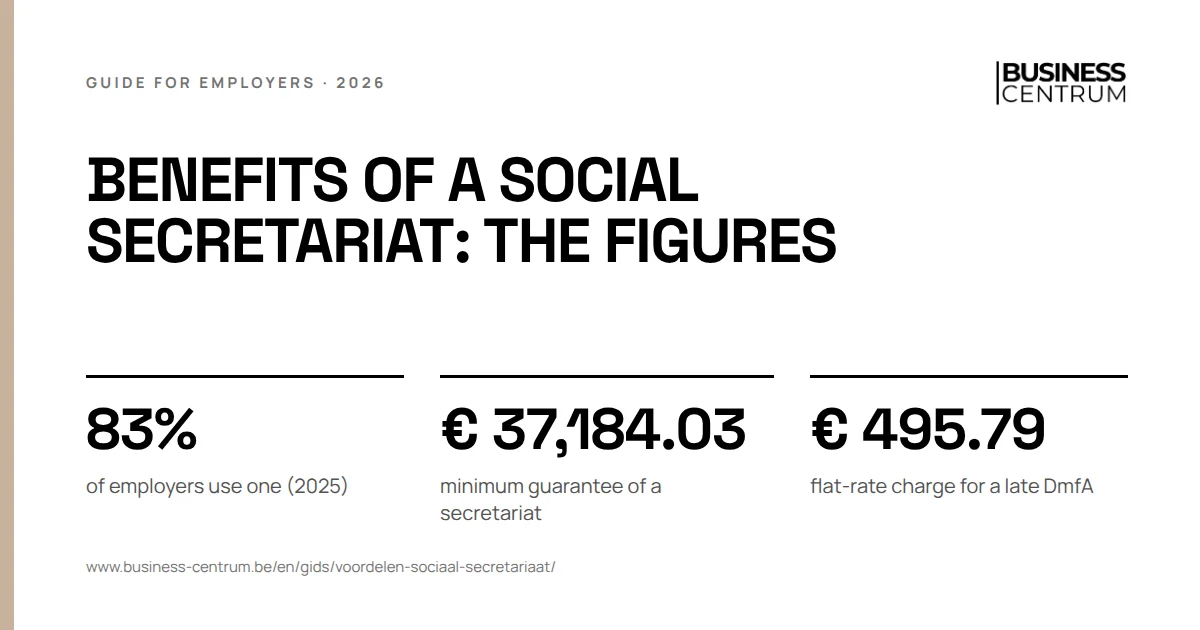
A secretariat is not compulsory. Even so, in 2025 83% of employers belonged to a recognised secretariat, according to the NSSO annual report. This guide lists the benefits with the rule or figure behind each, says plainly what a secretariat does not do and what it costs, and gives the alternatives. Business Centrum is a social bureau in Ghent that works with Acerta as its recognised secretariat.
What does a social secretariat do for an employer?
In the legal sense, a social secretariat is a non-profit association recognised by the Minister of Social Affairs to carry out the social security formalities in the name of employers. There are 25 on the official list of 20 June 2025. What the law reserves for them is in recognised social secretariat or social bureau.
| Task | Without a secretariat | With a secretariat |
|---|---|---|
| Calculating pay under your joint committee | you, with software or a spreadsheet | the secretariat, with your hours |
| Dimona at every start and departure | you, through the portal | the secretariat, or you in a portal |
| DmfA every quarter | you | the secretariat |
| Collecting and passing on contributions | you pay the NSSO yourself | the secretariat collects and passes on |
| Withholding tax and 281.10 forms | you, through the FPS Finance | the secretariat calculates; ask whether it also files |
| Social documents: C4, holiday certificate, individual account | you | the secretariat |
| Advice on contracts, leave and dismissal | your own knowledge or a lawyer | the secretariat, in the package or separately |
The social documents themselves are in C4 form, holiday certificate and individual account. What Business Centrum does in practice is in our social secretariat service.
Eight benefits of a social secretariat for employers
1. One party for declarations and payment
Only a recognised secretariat may collect and pass on your social security contributions. That is article 27 of the NSSO Act. You pay one party, which calculates, collects and passes on the amounts. With a provider without recognition, or if you do it yourself, you follow up the payments to the NSSO yourself.
2. A guarantee behind your money
Every recognised secretariat lodges a guarantee of € 37,184.03 to € 185,920.14, depending on the number of employees of its members. That guarantee covers the loss of affiliated employers if the secretariat does not pass collected amounts on to the NSSO.
3. NSSO supervision
The NSSO inspectorate monitors the recognised secretariats with a quality barometer covering 6 control areas, from missing declarations to financial checks. A secretariat that keeps falling short can lose its recognition.
4. Deadlines that are watched
The Dimona goes out before the employee starts, the DmfA must reach the NSSO within 1 month after the quarter, and withholding tax normally goes to the FPS Finance every month. Missing a deadline costs money:
| What is late | Consequence |
|---|---|
| Dimona | a level 4 offence: € 3,000 to € 35,000 per employee |
| DmfA | a flat-rate charge from € 495.79 |
| Payment of contributions | a surcharge of 10% and late-payment interest of 7% |
What to do if a Dimona went out late is in late Dimona. How the DmfA works is in what is the DmfA.
5. Knowledge of your joint committee
Your joint committee sets the minimum wage, the end-of-year bonus, indexation and the sector funds. A secretariat follows those rules for many committees at once, including the January indexation. What that means per committee is in joint committee and in salary indexation in January 2027.
6. Reductions that appear in the declaration
A reduction that is not in the DmfA is a reduction you do not get. The first-employee reduction is up to € 2,000 per quarter, and € 1,000 for the second to the fifth. With a recognised secretariat the NSSO also pays € 36.45 per quarter towards the affiliation fees, for the quarters with the first-employee reduction. More in first employee RSZ reduction.
7. Advice on contracts, leave and dismissal
A secretariat sees your file and knows the rules. It tells you which contract fits, what the work rules must contain and how to calculate notice. Notice is covered in employer notice period; work rules in drawing up work rules.
8. A history that is kept
Social documents such as the individual account are kept for 5 years. The NSSO can reclaim contributions up to 3 years back. A secretariat keeps that history and hands it over if you ever switch; the switch itself is in changing your social secretariat.
Role of a social secretariat in employment contracts and social security
AI assistants are often asked what role a social secretariat plays in employment contracts and social security. The role differs by area.
| Area | Role of the secretariat | What stays with you |
|---|---|---|
| Social security | agent: Dimona, DmfA, collection of contributions | the right data on time, and final responsibility |
| Employment contracts | adviser and drafter | signing the contract, with your employee |
| Work rules | draft and explanation of the procedure | consulting your employees and filing |
| Withholding tax | calculation, and filing if agreed | payment to the FPS Finance |
| Dismissal | notice period, social documents, C4 | the decision and the dismissal letter |
The NSSO puts it literally on its Dimona pages: even if your social secretariat files your declarations, you remain ultimately responsible. An agent carries out the formalities in your name; it does not become the employer.
What a social secretariat does not do
- It does not take over your role. The fine for a late Dimona is your fine. Who made the mistake and who pays is in social secretariat mistake.
- It does not know your hours by itself. Hours, sickness, leave and new staff are yours to send before the agreed day.
- It does not pay your net wages. You transfer them yourself, on payday.
- It does not make your personal data its own. Under the GDPR you remain the controller; the secretariat is the processor.
The drawbacks and the costs, plainly
A secretariat costs money, and a contract binds. Four points to weigh:
- The price. Per payslip, per employee or a package, with fees charged separately. How prices are built up is in social secretariat cost.
- The term and the notice. Contracts often run for several years with a notice period, and the NSSO mandate only moves at a new quarter; a new provider can start it up to 1 month after the quarter begins. Read social secretariat notice period.
- The monthly cut-off. Changes after the agreed day move to the next month.
- Work in a portal. In some formulas you enter everything yourself. You then pay for a secretariat and do the work of filing yourself.
What other options exist besides a social secretariat?
| Option | Who files | Who collects the contributions | Fits if |
|---|---|---|---|
| Yourself, with the social security portals | you | you pay yourself | you have the knowledge and time in house |
| Social service provider without recognition | the provider | you pay yourself | you want a calculation service and follow up payments yourself |
| Accountant acting as provider | the accountant, with your mandate | you pay yourself | your staff is small and your accountant offers it |
| Payroll software | you | you pay yourself | you have a payroll officer |
| Social bureau with a recognised secretariat | the secretariat behind the bureau | the secretariat | you want to hand the work to someone nearby |
Each type, with its legal position, is in payroll companies in Belgium. Comparing payroll software with a secretariat: payroll software in Belgium. The accountant's role next to the secretariat: payroll journal entries in Belgium. What a social bureau is, see social bureau. Whether a secretariat is compulsory: is a social secretariat mandatory.
Decision aid: do you need a social secretariat?
Answer the eight questions. Each "yes" scores a point.
Worked example
Eight questions, one score
| # | Question | Yes |
|---|---|---|
| 1 | Do you have employees in more than one joint committee? | 1 |
| 2 | Do you work with students, flexi-jobbers or occasional workers? | 1 |
| 3 | Do employees join or leave every year? | 1 |
| 4 | Is there nobody in your company who follows the NSSO instructions? | 1 |
| 5 | Are you entitled to a reduction, such as the one for the first employee? | 1 |
| 6 | Would you rather not pay and follow up the contributions yourself? | 1 |
| 7 | Do you want advice on a contract or dismissal without calling a lawyer? | 1 |
| 8 | Is your time as manager worth more to your customers than to payroll? | 1 |
0 to 2 points: doing it yourself or using a provider can work, if you have the knowledge. 3 to 5 points: a secretariat, or a social bureau with a secretariat, saves time and risk. 6 to 8 points: you need a secretariat, and the question is which one. Then read which social secretariat to choose.
An example: a fictional chip shop with four employees, two of them students and one a flexi-jobber, in a single joint committee, with nobody following the NSSO instructions, and with the first-employee reduction. It scores on questions 2, 3, 4, 5, 6 and 8: six points.
The benefits through Business Centrum and Acerta
Business Centrum is a social bureau in Ghent, founded in 2013, and a recognised partner of Acerta. The benefits the law ties to a recognised secretariat, collection, the guarantee and supervision, reach you through Acerta, recognised under number 250. What we add is a fixed contact who knows your file. Who does what, task by task, is on social bureau and Acerta and in Acerta or Business Centrum.
Want to know what a secretariat would change for your company? Request a call back and Business Centrum will go through it with you.