
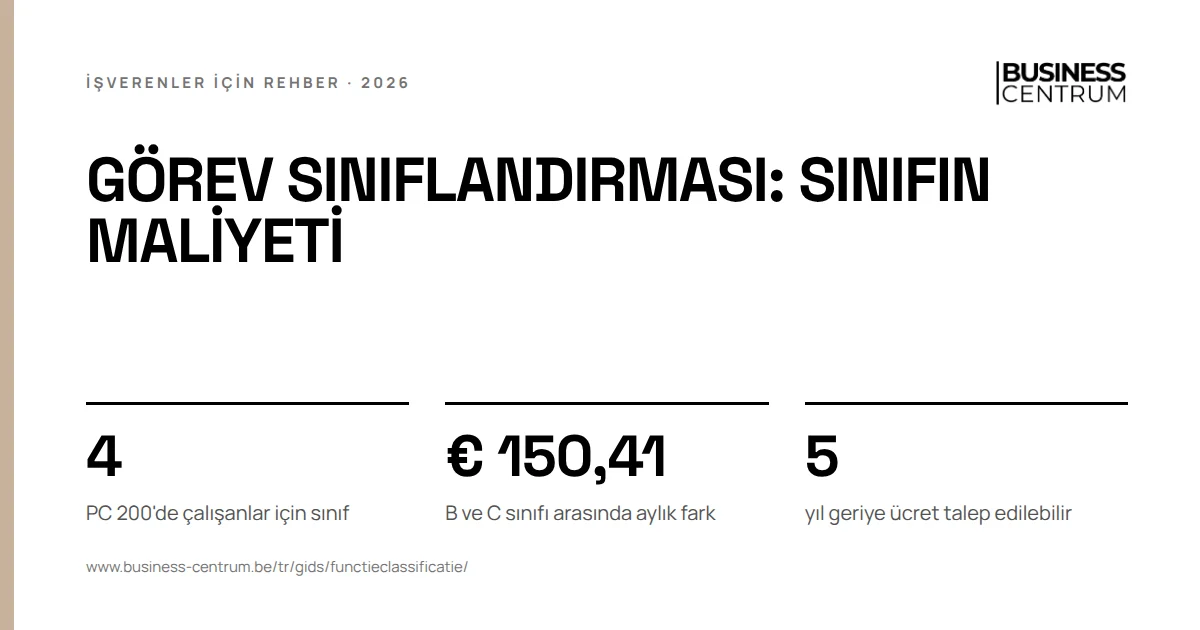
A job classification ranks the jobs of a sector into classes, and each class has its own minimum wage. What an employee earns at least therefore depends not only on experience, but also on the class you place the job in. Joint committee 200 has 4 classes, A to D. An employee with five years of experience in class C earns at least € 150.41 a month more there than in class B. Classify too low, and the employee can claim the difference up to 5 years back. Below: how to classify a job correctly, with a decision aid, a worked example and the rules on gender neutrality.
What is a job classification in Belgium?
Every joint committee sets out in a collective agreement which jobs exist in the sector and how much weight they carry. The result is a ranking of classes or categories. Each class has a pay scale: a minimum wage that rises with experience or seniority.
A job classification answers one simple question: which minimum wage goes with this job? The employer does not freely decide which class a job gets. The content of the work decides. A title like "office manager" or "assistant" says little: what counts is what the employee actually does, with how much autonomy and responsibility.
Two terms are often confused:
- Job evaluation is the method: describing jobs and scoring them on criteria such as knowledge, autonomy, responsibility and contacts.
- Job classification is the result: the jobs placed in classes, with a wage per class.
In most sectors, the social partners have already done this exercise. As an employer, you apply the sectoral classification. You can add your own system on top, but never below the sector's minimum wages.
Sectoral job classification: how do the committees differ?
Every committee has its own system. The number of classes, their names and the way pay rises vary widely. A few examples:
| Joint committee | For whom | System | Starting wage, lowest class |
|---|---|---|---|
| PC 200 | White-collar employees without their own committee | 4 classes, A to D, with years of experience | € 2,242.80 |
| PC 226 | Employees in international trade, transport and logistics | Eight classes, with seniority | € 2,574.27 |
| PC 220 | Employees in the food industry | 7 pay classes | See the guide |
| PC 330 | Healthcare | IFIC, its own classification per category | See the guide |
| PC 302 | Hospitality | Categories per job | See the PC 302 pay scale |
Healthcare uses IFIC, introduced in the federal care sectors on 1 May 2018. Each job there gets a category with its own target pay scale. If you are not sure which committee applies, start with find your joint committee. The right classification only follows from the right committee.
Job classification in PC 200: the four classes
In the auxiliary joint committee for employees, the minimum wage depends on the class and the years of experience. You classify each job by the actual content of the work and you inform the employee in writing of their class.
| Class | Description | Examples | Minimum, 0 years' experience |
|---|---|---|---|
| A, executive | A limited number of simple, repetitive tasks | Checkout assistant, shipping clerk, van driver | € 2,242.80 |
| B, supporting | A defined set of tasks that contributes to a larger assignment | Purchasing administrative assistant, telephone receptionist | See the pay scale |
| C, managing | A complete set of tasks that together form one assignment | Accounting clerk, HR administration clerk, dispatcher | See the pay scale |
| D, advisory | Monitors and develops a business process towards a goal | Accountant, buyer, programmer, prevention adviser | € 2,555.72 |
The amounts are gross monthly minimums for a full-time employee on scale I, from the first year of service. After one year in the same company, the higher scale II applies. Experience counts broadly: years with previous employers count too. The full PC 200 pay scale is on our pay scale page per year of experience, and what changes in January is in PC 200 indexation January 2027.
Worked example: what the wrong class costs
Sarah has worked for five years as an employee in an SME under PC 200. Her contract says "administrative assistant" and she is in class B. In practice, she keeps the books independently, follows up customer accounts and prepares the VAT return. That is a complete set of tasks: class C.
| Class B | Class C | |
|---|---|---|
| Monthly minimum, 5 years' experience, scale I | € 2,413.36 | € 2,563.77 |
| Difference per month | € 150.41 | |
| Difference per year, 12 months | 1,804.92 euros | |
| With end-of-year bonus and double holiday pay, about 13.92 months | about 2,094 euros | |
| Over five years, without indexation and social security | about 10,470 euros |
If an inspector or Sarah herself discovers the error, she claims the difference. A wage claim expires 5 years after the fact during the contract and 1 year after the end of the contract (article 15 of the Employment Contracts Act). On the back pay, you also pay employer contributions and interest. On scale II, after one year of service, the class C minimum is already € 2,633.21, so the gap grows.
Two effects are often forgotten. The end-of-year bonus in PC 200 follows the monthly wage, and holiday pay rises too. What you pay net and as total cost can be checked with the gross to net calculator.
Decision aid: which class does this job belong in?
Go through these questions for every job in your company. Start from the job, not the person.
- Which joint committee applies? Without the right committee, no classification is correct. White-collar and blue-collar workers often fall under different committees.
- Is there a sectoral job classification? Look for the committee's collective agreement on job classification. Most sectors have one, with reference jobs.
- Describe what the employee actually does. Note the main tasks, how independently they work, which decisions they take and what they are responsible for. The title on the contract does not count.
- Compare with the reference jobs and descriptions. If the job resembles an example in a class, that is a strong indication. In PC 200 the description helps: executive, supporting, managing or advisory.
- Torn between two classes? Look at the tasks that recur regularly and weigh the most. In many sectors, such as PC 226, the highest class the employee regularly performs applies.
- Record the classification. Put job and class in the contract or an annex and inform the employee in writing.
- Review it with every change. New tasks, a promotion or a reorganisation can mean a different class.
A quick test: would an outsider who only knows the tasks choose the same class? If not, have the classification checked before an inspector does.
What changes with a promotion or new tasks?
A job is not fixed forever. If an employee permanently takes on heavier tasks, they can move to a higher class, with a higher minimum from that moment. The rules are in the sectoral collective agreement.
| Situation | Effect on the class | What to watch |
|---|---|---|
| Promotion to a heavier job | Higher class | The new minimum applies immediately, unless the agreement provides a transition |
| Big jump in PC 226 | Transitional arrangement | Two classes up, the employee reaches the new class after 1 year, in two steps |
| Temporarily replacing a higher job | According to the committee's agreement | Record duration and allowance in writing |
| Fewer tasks, lower job | A lower class affects pay, an essential element | Not unilaterally, only with written agreement |
Moving a job unilaterally to a lower class, with less pay, is in principle not possible. Pay is an essential element of the contract. That requires agreement and a written amendment, as described in our help with employment contracts. The same logic applies to other essential elements: see can an employer change the work schedule.
Gender-neutral job classification and the pay gap
Equal pay for equal work also applies to the system behind the pay. Collective agreement no. 25 of 15 October 1975 says so explicitly: job evaluation systems must ensure equal treatment in the choice of criteria, their weighting and the conversion of job points into pay points.
The pay gap act of 22 April 2012 added a check at sector level:
| Step | What happens |
|---|---|
| Check | The Federal Public Service Employment tests every sectoral job classification with a tool of 12 questions |
| Result of the first check | 45 classifications had to be changed, because the job titles were not gender-neutral |
| Negative opinion | The joint committee has 24 months to adjust the classification |
| No adjustment | The committee must justify itself within 3 months |
| No valid justification | The committee is put on a public list |
For you as an employer, this means two things. If you apply the sectoral classification correctly, you are in principle in order. If you use your own system on top, it must itself be gender-neutral: the same criteria and weighting for jobs done mainly by men or mainly by women.
At company level, a business with at least 50 employees draws up an analysis report on the pay structure every two years, broken down by men and women, and discusses it with the employee representatives. From 50 employees, you can also appoint a mediator, not compulsory, with expertise in job evaluation and job classification. The European pay transparency directive goes further and requires objective, gender-neutral criteria for every pay structure. What that means for you is in pay transparency 2026.
Job classification in six steps for your SME
- List all jobs in your company, not all people. Five people at reception are one job.
- Write a short description per job: purpose, main tasks, autonomy, decisions, contacts.
- Classify each job under the sectoral classification, using the decision aid above.
- Check the pay: is each employee's wage at or above the minimum for their class and experience? The minimum wage in Belgium is the floor, the sectoral pay scale is usually higher.
- Record everything: the class in the contract or an annex, the job description in the personnel file.
- Repeat every year, and with every hire, promotion or reorganisation. After each indexation the minimums rise, so a wage that used to be above the minimum can now fall below it.
A correct classification also makes pay conversations easier. Employees see why a colleague earns more, and you have an objective basis for the wages you pay.
Common mistakes
- Classifying by title instead of by tasks. "Assistant" in the contract and class C tasks in practice.
- The wrong committee, so the whole classification is off. A mixed company often has two committees, one for blue-collar and one for white-collar workers.
- No review after a promotion: the tasks grew, the class did not.
- Checking the minimum only at hiring. After an indexation or an extra year of experience, the minimum rises.
- Your own pay policy without criteria, so equal work is paid unequally. That is a risk under collective agreement no. 25 and soon under the transparency rules.
- Not putting the class in writing. Without a written classification, you are in a weak position in a dispute.
What Business Centrum does for you
We review your jobs, classify each one under your committee's classification and check whether every wage meets the right minimum, again after every indexation. In payroll, we apply the class, experience and scale, together with Acerta. Want an overview of your pay structure, comparing jobs, men and women? We do that as part of our workforce analysis. For day-to-day processing of wages and pay scales, there is our payroll administration. In doubt about a class? Have it checked before the inspectorate asks.