
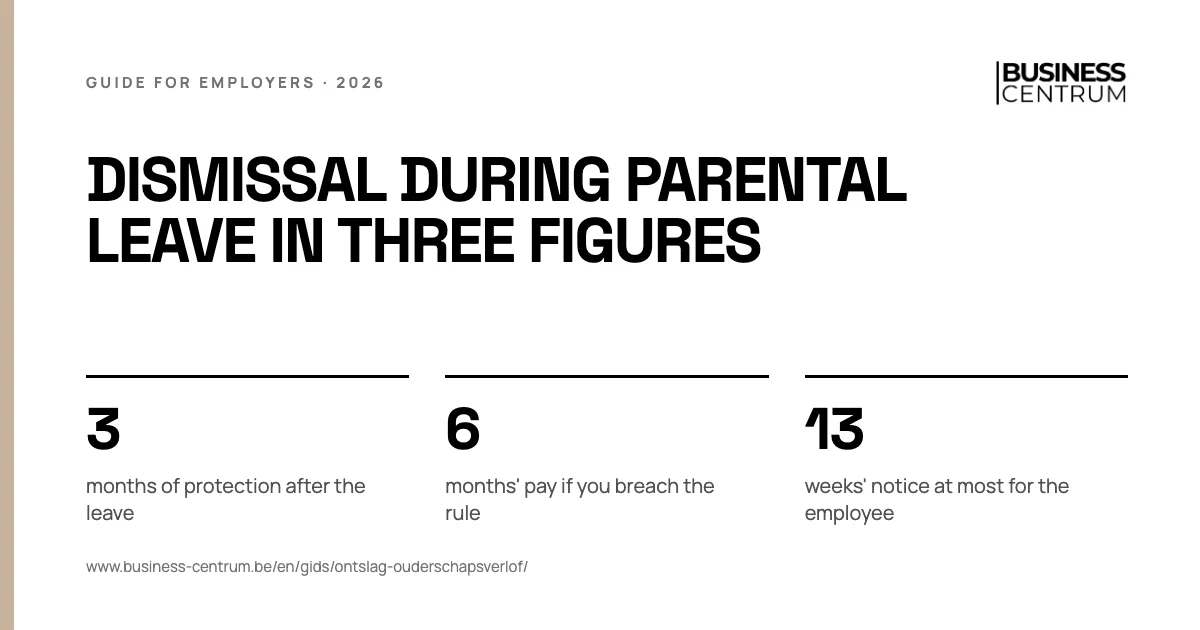
Dismissal during parental leave is only possible for the employer for a reason unrelated to the leave: a serious cause or a sufficient reason you can prove. Protection runs from the written notification until 3 months after the leave. If you breach it, you pay 6 months' pay on top of the compensation in lieu of notice. The employee can always resign.
Dismissal during parental leave: what may the employer do?
An employee who exercises the right to parental leave is protected against dismissal. You may not end the employment contract unilaterally, except for a reason unrelated to the parental leave. The National Employment Office (NEO, RVA in Dutch) names two kinds:
- A serious cause. A serious fault that makes any further cooperation immediately and permanently impossible. The strict deadlines are in dismissal for serious cause.
- A sufficient reason. A reason the court accepts as such, whose nature and origin have nothing to do with the leave, for example a restructuring that affects the whole department.
The burden of proof is yours. If you dismiss during the protection, you prove the reason, and if the employee asks for it, you state it in writing. This comes on top of the ordinary duty to give reasons under CBA 109, which still applies.
The protection does not depend on the form of the leave. It applies to full-time, half-time, 1/5 and 1/10 parental leave. Which forms exist and when you may postpone a request is explained in parental leave: what the employer can refuse.
Parental leave dismissal protection in Belgium: from when until when?
Protection starts before the leave and ends after it. The employee notifies you 2 to 3 months in advance, and is protected from that day.
| Moment | Protected against dismissal? |
|---|---|
| Before the written notification | No, the ordinary dismissal rules apply |
| From the day of the written notification | Yes |
| During the leave, in any form | Yes |
| Until 3 months after the end date of the leave | Yes |
| The leave does not take place | Yes, until 1 month after the requested start date |
| Dismissal after the protection, but prepared during it | Treated as a dismissal during the protection |
An example. On 15 December 2026 your employee requests in writing full-time parental leave from 1 March to 30 June 2027. He is protected from 15 December 2026 to 30 September 2027, more than nine months for a leave of four.
A second example. On 1 February 2027 an employee requests in writing 1/5 parental leave from 1 May 2027 to 31 December 2028. Her protection runs from 1 February 2027 to 31 March 2029.
Does the protection apply to every form of parental leave?
Yes. Every employee who exercises the right to parental leave is protected, whatever the form. The employee has that right after 12 months of service with you in the 15 months before the notification, and if the leave starts before the child turns 12, or 21 for a child with a disability. The form does determine how long protection lasts and what happens to the notice period.
| Form | Duration per child | Notice period if the employer gives notice | Pay used for compensation in lieu of notice |
|---|---|---|---|
| Full-time | 4 months | Does not run during the leave, starts afterwards | The pay from before the interruption |
| Half-time | 8 months | Runs, the employee keeps working half-time | The pay without reduction |
| 1/5 | 20 months | Runs, the employee keeps working four fifths | The pay without reduction |
| 1/10, only with your agreement | 40 months | Runs | The pay without reduction |
The longer the leave, the longer the protection. Someone who takes the 20 months of 1/5 leave in one go is protected during those months, the 3 months after them and the weeks between the notification and the start: more than two years in total. If the employee takes the leave in parts, each notification opens its own protected period, which ends 3 months after the end date of that part.
Dismissal after parental leave: when are you free again?
After the 3 months, the ordinary rules in dismissing an employee apply again. One trap remains: preparation. According to the FPS Employment, a dismissal given after the protection is treated as a dismissal during the protection if you prepared it in that period. The FPS itself gives the example of a vacancy for the employee's replacement.
So hold back not only the dismissal letter, but everything that points to it: the vacancy, the interview with a successor, the internal email. If the employee moves straight into a new period of parental leave or another thematic leave, the new notification opens a new protection. Time credit and maternity leave have their own periods.
What does a dismissal during parental leave cost?
Two amounts add up: what you pay for any dismissal, and the penalty if the reason does not hold.
| Item | Rule |
|---|---|
| Notice period | The ordinary notice period for the employer. It does not run during full-time parental leave: it starts after the leave. With reduced working time it does run. |
| Compensation in lieu of notice | Calculated on the pay the employee would earn if working time had not been interrupted or reduced. |
| Flat-rate compensation | 6 months' pay, on top of the notice or the compensation in lieu of notice, if you do not prove a serious cause or a sufficient reason. |
Worked example
A white-collar employee with three years of service earns € 3,600 gross per month and is on full-time parental leave. You end the contract during the leave because you want to organise the job differently. That is not a reason unrelated to the leave.
- Compensation in lieu of notice: 13 weeks' pay, which is three months or € 10,800 gross.
- Flat-rate compensation: 6 months' pay or € 21,600 gross.
- Together: € 32,400 gross, without the contractual benefits you add to current pay.
If the same employee takes 1/5 parental leave, you temporarily pay € 2,880 gross for four fifths of the hours. You still calculate the compensation in lieu of notice on € 3,600: 13 weeks' pay remains € 10,800 gross.
If you wait until the protection is over and prepare nothing in the meantime, only the notice of 13 weeks remains, which the employee can also work. How to calculate the compensation with benefits is explained in severance pay calculation. You can check the notice period itself with the notice period calculator.
Resigning during parental leave: what applies to the employee?
This part is for the employee who wants to leave. The dismissal protection only forbids a dismissal by the employer. Resigning is always possible, during or after the leave.
- Notice period. The ordinary notice period for an employee who resigns, 13 weeks at most. Employer and employee can also agree on an end date together, see termination by mutual agreement.
- NEO benefit. The interruption benefit stops on the day the employment contract ends. The employee informs the NEO office immediately and in writing. Whether the leave itself is paid is covered in is parental leave paid.
- Resigning after parental leave. No special rule applies: the ordinary notice period, with no extra condition because a leave has just ended.
- The remaining leave with a new employer. Someone with parental leave left can only request it after 12 months of service with the new employer in the 15 months before the request.
- Unemployment. Someone who leaves without a new job applies for a benefit with the C4. The NEO decides whether and from when there is an entitlement.
If the employee is dismissed, the NEO says this: with full-time leave the notice period only starts after the leave and the benefit continues until then. With an immediate termination the benefit stops on the termination date. Someone who is then unemployed receives a benefit calculated on the pay that would have been earned without the leave.
Decision aid: can this dismissal go ahead?
- Put the dates side by side. When did the written notification arrive, when does the leave end, and when are the 3 months after it over?
- Does the dismissal fall within that period? If not, check that you prepared nothing during the protected period.
- Do you have a reason unrelated to the leave? Write it down and gather the documents before you decide: figures, reports, warnings.
- Is it a serious cause? Then the deadlines of three working days run. Waiting until after the leave is not possible.
- No strong reason? Wait until the protection is over, or look into an agreement the employee consents to.
- Calculate the cost on full pay. With 1/5 or half-time leave too, you calculate the compensation in lieu of notice on the pay without reduction.
Mistakes employers make
- Looking only at the leave. Protection starts at the notification, weeks before the first day of leave.
- Dismissing the day after the leave. The 3 months after it count as well.
- Publishing the vacancy too early. Looking for the replacement during the protection is preparing the dismissal.
- Calculating compensation in lieu of notice on part-time pay. The pay without reduction is the basis.
- Not having the reason on paper. Without documents you do not prove a sufficient reason, and the flat-rate compensation follows.
- Miscounting the end date of a notice given during full-time leave. The period only starts after the leave.
Which papers you hand over at the end is covered in social documents at end of employment.
What Business Centrum does for you
Business Centrum tracks leave and absences in your payroll administration, together with Acerta. If you are considering a dismissal around a parental leave, we set the protection dates against your plan, calculate the notice and the compensation on the right pay and produce the final settlement, the C4 and the Dimona exit. The follow-up of the leave itself runs through our leave and absence service. Want to know your risk first? Contact us.