
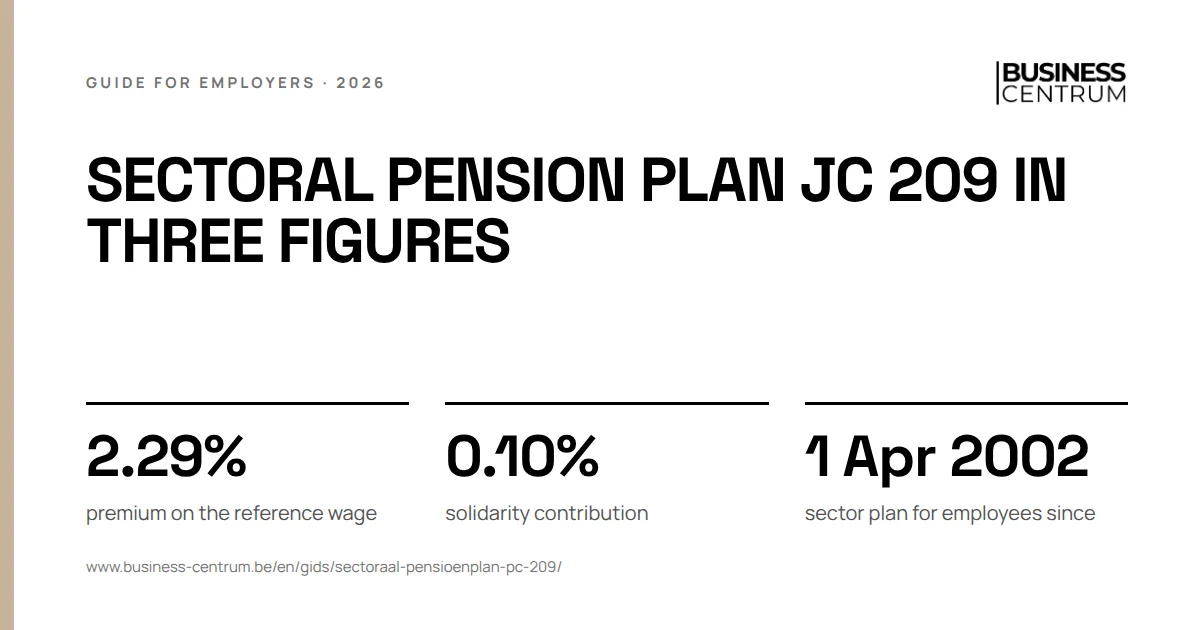
The sectoral pension plan JC 209 gives every white-collar employee in the metal manufacturing industry a supplementary pension paid by the employer. Since 1 January 2020 the premium has been 2.29% of the reference wage, plus 0.10% for the solidarity part. The Social Fund for Metal Industry Employees collects both every quarter based on your DmfA. Only employers with an old equivalent plan of their own or an opt-out from before 2011 are outside it.
This guide covers the JC 209 sector plan and what you need to check as an employer. How sectoral pension plans work in general is explained in our guide on the sectoral pension plan. The other rules of the committee, from pay scales to eco-vouchers, are in the guide on joint committee 209.
Sectoral pension plan JC 209 at a glance
| Item | Rule |
|---|---|
| In force since | 1 April 2002 for employees, 1 July 2007 for managers |
| Plan type | Defined contributions, with the statutory minimum return |
| Pension premium | 2.29% of the reference wage, since 1 January 2020 |
| Solidarity contribution | 0.10% of the reference wage |
| Special contribution | 8.86% on the pension premium, collected with it |
| Employee contribution | None |
| Organiser | SFBM-BIS (Social Fund for Metal Industry Employees-BIS) |
| Collection | SFBM, every quarter based on the DmfA |
| Pension institution | Monument Assurance Belgium |
| Social plan | Yes, with a solidarity part since 1 January 2017 |
| Legal basis | CLA of 11 March 2024 (no. 187003/CO/209) |
The plan consists of a pension commitment and a solidarity commitment. The pension commitment builds up capital on an individual account. The solidarity commitment tops up the build-up during periods without pay and pays an annuity on death. The CLA of 11 March 2024 coordinates all the rules and replaces the previous version from 2022.
Who is covered by the sectoral pension plan JC 209?
The plan applies to employers under the Joint Committee for employees in the metal manufacturing industry, and to everyone they employ on a white-collar contract: administrative and technical employees, draughtsmen, foremen and managers. Blue-collar workers at the same company fall under JC 111 and have their own sector plan, run by the Metal Pension Fund.
All employees of an employer that is not exempt and has not opted out are compulsorily covered. The CLA sets no age or seniority condition. An employer with several sites counts per legal entity and per establishment unit.
Not sure your employees fall under JC 209, for instance because you process metal but also trade or install? Read our guide on how to find your joint committee in Belgium first. An employee wrongly reported under JC 200 builds up nothing in this plan, and back premiums await you: the SFBM also collects arrears from employers that failed to enrol their staff, plus administrative costs.
How much is the premium in the sectoral pension plan JC 209?
Funding consists of two contributions on the same reference wage:
| Contribution | Rate | For |
|---|---|---|
| Pension premium | 2.29% | The employee's individual pension account |
| Special contribution | 8.86% of the pension premium | Social security, collected by the SFBM |
| Solidarity contribution | 0.10% | The solidarity part |
The reference wage. This is the gross annual pay you report to the NSSO, excluding single and double holiday pay. In practice the SFBM uses the gross wage bill: 1/1.08 of DmfA pay code 1, plus codes 2, 3 and 4. Holiday pay does not count, the year-end bonus does.
Costs. The SFBM deducts a flat percentage from the premiums collected for collection costs. For 2023 and 2024 it was 1%. The organiser's board sets it every year. Since 2021, 96% of the solidarity contributions goes to the solidarity institution, the rest covers running costs. The SFBM passes the premiums on within 4 months after the end of the quarter.
Worked example: what the sectoral pension plan JC 209 costs for a technical employee
A technical employee at step 7 earns at least € 2,948.60 gross a month in 2026. The full scale by category and step is on our JC 209 pay scale page. He works in East Flanders, where the year-end bonus is 100% of a monthly salary. More on that bonus by province on the end-of-year bonus JC 209 page.
- Reference wage: € 2,948.60 x 13 = € 38,331.80. Holiday pay does not count.
- Pension premium: € 38,331.80 x 2.29% = € 877.80.
- Special contribution: € 877.80 x 8.86% = € 77.77.
- Solidarity contribution: € 38,331.80 x 0.10% = € 38.33.
- Total cost: € 993.90 a year, or € 82.83 per calendar month.
The pension premium goes to the employee's individual account, after the collection costs and the insurer's charges. If he earns more than the pay scale, the premium and the cost rise, because they follow the actual wage. Look at the pension cost together with the rest of the wage cost in our guide to gross to net pay.
How you pay: SFBM, DmfA and the quarterly statement
The SFBM does not collect the premiums through the NSSO statement itself, but every quarter from you, based on the data in your DmfA. It is supported in this by the Subsistence Fund for the Metal Processing Industry. In practice:
- You report your employees' wages every quarter in the DmfA, under JC 209.
- The SFBM calculates the premium, the special contribution and the solidarity contribution and collects them from you.
- The SFBM passes the premiums to Monument Assurance Belgium and the special contribution to the NSSO.
Your part is a correct DmfA: the right committee, the right pay codes, correct start and end dates. When an employee leaves, retires or dies, the SFBM can also claim extra premiums if the reserves are below the statutory return guarantee. Those shortfalls are borne by the employer employing the person at that time.
Exemption and opting out of the sectoral pension plan JC 209
Two groups of employers do not pay the pension premium:
| Situation | Condition | What you still pay |
|---|---|---|
| Outside the scope | An equivalent plan of your own for employees from before 11 June 2001 or for managers from before 31 December 2006, without interruption, with an annual certificate | Nothing to the sector plan |
| Opt-out | Chosen before 1 April 2011, still meeting the conditions and the annual certificate | The solidarity contribution of 0.10% |
A new opt-out is no longer possible. If you set up your own group insurance today, you keep paying the sector premium and add your own plan on top. In a takeover, merger or demerger, an employer can stay exempt for the transferred employees if the opt-out or out-of-scope conditions are met. If your company comes under JC 209 because of a change of committee, the same applies for being out of scope.
Illness, unemployment and death: the solidarity part
The solidarity part has existed since 1 January 2017. It funds the pension build-up during periods when you pay no wages, and an extra payment on death:
- Temporary unemployment. What that means for you as an employer is in our guide on temporary unemployment.
- Incapacity for work due to illness or a non-work accident, after the guaranteed wage. Work accidents and occupational diseases are not covered. More on the period you pay yourself in employee off sick.
- Bankruptcy, liquidation, closure or judicial reorganisation of the company, for at most 12 months.
- Death before retirement: an extra payment in the form of an annuity to the beneficiaries.
The committee sets the amounts of these benefits in a separate CLA. You do nothing except code absences correctly in the DmfA.
What the employee receives and where he sees it
The plan is a defined contribution plan: the sector sets the premium, not the final amount. The capital carries the statutory minimum return under the supplementary pensions act, currently 2.50%, calculated on all reserves since 2004. If the reserves are below that guarantee when the employee leaves, retires or dies, the SFBM collects the shortfall from the employer employing him at that time.
The employee receives his capital on retirement and can have it converted into a life annuity. If he dies before retirement, the reserves go to his beneficiaries. He sees his build-up on mypension.be, where Sigedis updates the reserves every year, and in the pension institution's annual pension statement.
Leaving: what happens to the JC 209 sector pension
When an employee leaves, the premiums stop with the last DmfA in which he appears. What has been built up remains his. If he moves to another JC 209 employer that is not exempt, the plan continues. If he leaves the sector, he chooses under the supplementary pensions act what happens to his reserves: leave them, or transfer them to his new employer's pension institution or to an institution that shares its profits.
For you, what counts is a correct exit in the Dimona declaration and the DmfA, and correct social documents such as the C4 form. The length of the notice period does not change the premium: it runs on the wages paid during notice.
Sectoral pension plan JC 209 in 2026 and 2027
In 2026 the rates of 2.29% and 0.10% apply, as they have since 2020. The CLA of 11 March 2024 is concluded for an indefinite period. A new rate can only come through a new JC 209 CLA.
Pitfalls in the sectoral pension plan JC 209
- Reporting employees under JC 200. They then build up nothing in the JC 209 plan, and the SFBM can collect back premiums with costs.
- Thinking your own group insurance is enough. Without an old exemption or an opt-out from before 2011, the sector premium remains due.
- Forgetting the annual certificate. Employers out of scope or with an opt-out must prove every year that their plan still meets the conditions.
- Skipping the solidarity contribution after an opt-out. It remains due.
- Leaving the 8.86% special contribution out of the budget. It comes on top of the premium.
- Coding illness or unemployment incorrectly. The solidarity build-up then goes wrong.
What to check now
- Are all your employees and managers in the DmfA under JC 209?
- Do you have an exemption or opt-out, and has this year's certificate been submitted?
- Do the SFBM statements match your employees' gross wage bill?
- Is the premium, with the special contribution and the solidarity contribution, in your wage cost budget?
- Does a new employee know he builds up a pension in the sector plan and where to see it?
- Do you also employ blue-collar workers? Check that they are correctly under JC 111 and the Metal Pension Fund; the rules are in the guide on joint committee 111.
What Business Centrum does for you
Business Centrum processes the payroll of metal companies together with Acerta, with one dedicated contact in Ghent who knows your employees and workers. We check the committee for every employee, process the sector contributions in your payroll administration and include the pension cost in your wage cost calculation. Also see our social secretariat for SMEs, or request a call back.