A foreign employer can employ staff in Belgium without opening a branch here. If you send your own employee to Belgium temporarily, an A1 keeps them under your country's social security for up to 24 months, and you file a Limosa declaration first. If you hire an employee to work here, within the EU they fall under Belgian social security: you identify yourself with the NSSO (in Dutch: RSZ) through WIDE, file a Dimona when they start and a DmfA every quarter.
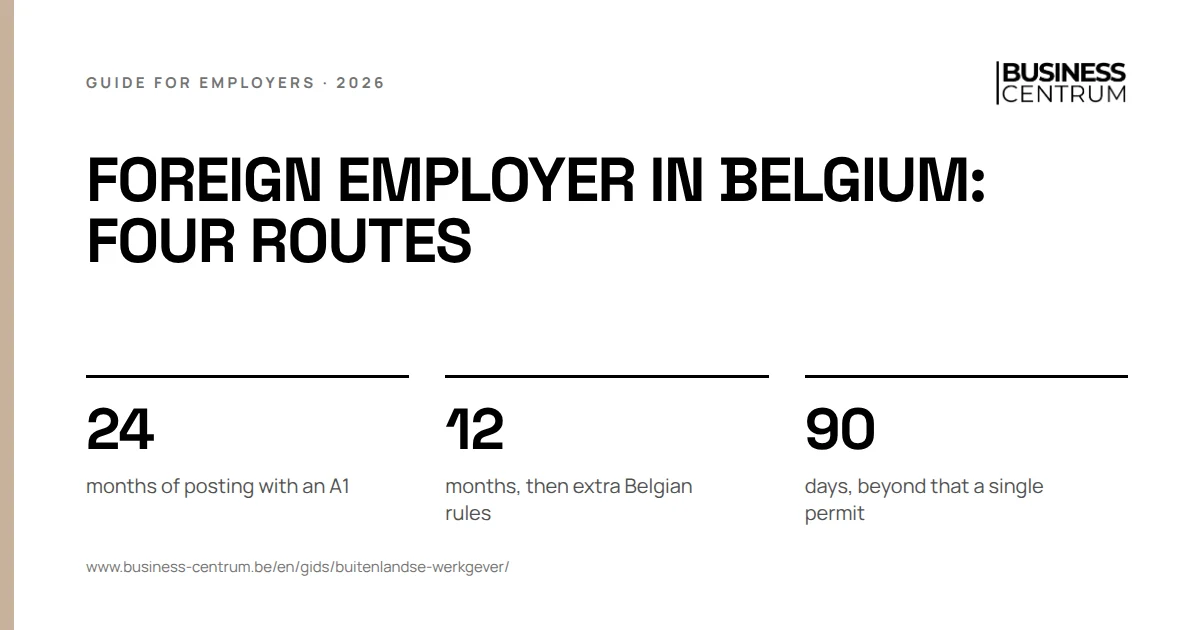
Foreign employer in Belgium: four routes side by side
Two questions decide everything: who is the employer, and where is the employee insured. The European base rule is article 11(3)(a) of Regulation (EC) 883/2004, which has applied since 1 May 2010: "a person pursuing an activity as an employed or self-employed person in a Member State shall be subject to the legislation of that Member State". The NSSO adds the consequence for you: every employee falls under the social security of the country where they work, "even if he lives in another Member State and/or his employer is established in another Member State" (our translation). Posting is the exception to that rule.
| Route | Who is the employer? | Which social security? | Prior declaration | Returns to the NSSO | Belgian withholding tax |
|---|---|---|---|---|---|
| 1. Posting your own employee | your foreign company | your country's, with an A1 (EU, EEA, Switzerland) or under an agreement | Limosa, naming a liaison person | no Dimona, no DmfA | depends on the tax treaty, see below |
| 2. An employee in Belgium, no branch | your foreign company | Belgian, if you are in the EU, EEA or Switzerland; otherwise under the agreement with your country | in principle no Limosa | identification through WIDE, Dimona, DmfA | not answered directly in the sources we read: have it checked |
| 3. A branch (place of business) in Belgium | your foreign company, through the branch | Belgian (article 3 of the NSSO Act) | in principle no Limosa | WIDE, Dimona, DmfA | yes, where the wages are deductible expenses for Belgian non-resident tax |
| 4. A Belgian subsidiary | the Belgian company | Belgian | none | as any Belgian employer | yes, as a Belgian company |
| 5. An employer of record | the employer of record | the employer of record's | according to its own situation | by the employer of record | by the employer of record |
Routes 3 and 4 need a presence in Belgium. Route 5 is the most sensitive in law.
Route 1: your employee comes to Belgium temporarily (posting)
Under the NSSO instructions, your employee stays under your country's social security only if every condition is met:
- the expected duration in Belgium is no more than 24 months;
- your company carries out significant economic activity in your country, pure administration does not count;
- the employee stays under your authority for the whole period;
- the employee was insured in your country before the posting, according to the European Commission as a rule for at least 1 month;
- the employee does not replace another posted worker.
You apply for the A1 certificate in your own country, before departure. If the assignment runs longer, the competent authorities can agree an exception, in principle up to 5 years. Outside Europe, a bilateral agreement plays the same role, if Belgium has one with your country. How the A1 works from the Belgian side is explained in applying for an A1 certificate.
Limosa. Since 1 April 2007, the foreign employer or its agent declares every posted worker before they start work in Belgium. The NSSO describes them as workers who in principle do not fall under Belgian social security. The declaration states, among other things, the workplace, the period and the liaison person you appoint. One declaration covers at most 24 months. You receive an L1 receipt at once, which the worker shows to your Belgian client before starting. Without a declaration, you risk an administrative fine of € 3,000 to € 35,000 per worker. What your client has to check is set out in the Limosa declaration.
Belgian working conditions. Posting under social security law is not the same as posting under labour law. According to Working in Belgium, the federal social security portal, you must give posted workers the Belgian working, pay and employment conditions: those in legislation and in the collective agreements declared generally binding by royal decree. Pay therefore follows the joint committee of the activity in Belgium. If the posting actually lasts longer than 12 months, additional conditions apply. A reasoned notification to the FPS Employment postpones them by 6 months.
Social documents. According to the FPS Employment, an employer that filed a Limosa declaration, or is exempt from one, is released for 12 months from certain Belgian social documents, such as the work rules, the staff register, the individual account and the pay statement. Under certain conditions, the labour inspectorate can ask for the equivalent documents from your own country.
In construction, the declaration of works and the daily attendance registration come on top; see staff in construction.
Route 2: hiring employees in Belgium as a foreign company without a branch
You have no office in Belgium but want to employ someone who works here. That is not a posting. Under article 11 of Regulation 883/2004, the employee falls under Belgian social security. Limosa, according to the NSSO, is in principle meant for workers who do not.
You are the employer, with every obligation. Article 21 of Regulation (EC) 987/2009 is explicit: an employer whose registered office or place of business is outside the competent Member State "shall fulfil all the obligations laid down by the legislation applicable to his employees, notably the obligation to pay the contributions provided for by that legislation, as if he had his registered office or place of business in the competent Member State". The second paragraph offers one practical option: you and the employee may agree that the employee pays the contributions on your behalf. Your underlying obligations remain, and you notify the NSSO of the arrangement.
Outside Europe. Article 3 of the NSSO Act of 27 June 1969 applies the Act to employees "employed in Belgium by an employer established in Belgium or attached to a place of business established in Belgium" (our translation), without prejudice to EU regulations and international agreements. If your company is outside the EU, the EEA and Switzerland and has no place of business here, the answer depends on the agreement with your country. Ask the NSSO's International Relations Department before you hire.
Registering with the NSSO: your employer number. Anyone hiring a first employee must inform the NSSO to obtain employer status. That happens through WIDE, the online service for employer identification. A company not yet registered on the social security portal uses the unsecured version. The application immediately issues a provisional number 51.xxx.xxx-xx, which you use for the Dimona. After processing, the NSSO sends the definitive NSSO number, the NACE code, the employer category and, among other codes, the code "foreign employer". This is what people abroad usually mean by the employer identification number in Belgium. An employer subject to Belgian social security also receives a company number in the Crossroads Bank for Enterprises (KBO) where needed. See your NSSO number.
Returns. The NSSO sets the order plainly: only an employer recorded in the employer directory has access to the social security online services and can file a Dimona or a DmfA. You file the Dimona at the latest when the employee starts work. The DmfA must reach the NSSO within 1 month after the end of each quarter: by 30 April, 31 July, 31 October and 31 January. What you pay in contributions per employee is covered in employer NSSO contributions.
Joint committee. According to the FPS Employment, the key criterion is "the activity actually carried out by the employer on Belgian territory" (our translation). Your activity in your home country does not decide it; what you do here does. Look up your joint committee before you promise a salary.
Work accidents. Fedris, the federal agency for occupational risks, states that in the private sector the employer must insure paid employees against work accidents with an approved insurer from the first working day. If you do not, Fedris steps in and recovers the costs from you.
The employment contract. If the employee habitually works in Belgium, Belgian law governs the contract unless you jointly choose another law. Even then, article 8 of Regulation (EC) 593/2008 (Rome I) says the choice "may not, however, have the result of depriving the employee of the protection afforded to him by provisions that cannot be derogated from by agreement". So have the employment contract drawn up under Belgian law.
Withholding tax. Article 270 of the Income Tax Code 1992 names who owes the withholding tax: Belgian residents and companies that pay wages, and non-residents for whom those wages are deductible expenses within the meaning of article 237. For the employer without a branch, see the box further down. For the employee, the Minister of Finance answered in 2022 that, in principle, anyone who carries out a professional activity on Belgian territory, even as an employee, is subject to Belgian income tax on that income (our translation). The exception, the 183-day rule in tax treaties, requires three conditions together: presence of fewer than 183 days, an employer that is not resident in Belgium, and pay that is not borne by a permanent establishment in Belgium. See also what withholding tax is.
Routes 3 and 4: a branch or a subsidiary in Belgium
A branch. A foreign company with a place of business in Belgium falls under the NSSO Act for the employees attached to it. The NSSO defines that link: attached to the Belgian place of business is the employee who receives orders and pay from it and reports to it. The obligations are those of route 2. A foreign legal entity with a seat in Belgium receives a company number in the KBO. For withholding tax, article 270 expressly names non-residents for whom the wages are deductible expenses.
A subsidiary. A Belgian subsidiary is a Belgian employer like any other. It signs the contracts, files WIDE, Dimona and DmfA, and withholds tax as a company. Since 1 March 2019, pay that a related foreign company grants for work done for the Belgian company also counts (article 270, second paragraph). A first employee may qualify for an NSSO reduction.
Route 5: through an employer of record
An employer of record hires your people and is their employer in law. You pay it and say what work is done: that is precisely the risk. Article 31 of the Act of 24 July 1987 forbids placing workers at the disposal of a user who exercises any part of the employer's authority over them, outside the exceptions in the law, such as temporary agency work. The FPS Employment uses the same definition for "placing at disposal". Have any set-up checked before you sign. The difference with being the employer yourself is set out in employer of record in Belgium.
Obligations of a foreign employer in Belgium: deadlines and sources
| Obligation | Route | Deadline | Primary source |
|---|---|---|---|
| A1 certificate in your country | 1 | before the posting; at most 24 months | NSSO instructions, posting (Regulation 883/2004, art. 12) |
| Limosa declaration with liaison person | 1 | before work in Belgium; at most 24 months per declaration | NSSO instructions, Limosa (Programme Act of 27 December 2006, art. 137 ff.); FPS Employment |
| Additional Belgian working conditions | 1 | after 12 months, or later after a reasoned notification | Working in Belgium (social security portal) |
| Employer identification through WIDE | 2, 3 | before or at the moment of hiring | NSSO instructions, first-time employer |
| Dimona IN | 2, 3, 4 | at the latest when the employee starts work | NSSO, Dimona |
| DmfA | 2, 3, 4 | within 1 month after each quarter | NSSO instructions, DmfA |
| Work accident insurance | 2, 3, 4 | from the first working day | Fedris, Act of 10 April 1971 |
| Determine the joint committee | 1 to 4 | before the first payroll | FPS Employment |
| Combined permit (single permit) | all, employee from outside the EEA | before work starts, for work of more than 90 days | Working in Belgium; Flemish government |
Step by step: hiring in Belgium as a foreign employer without a branch
For route 2, this is the order.
- Establish which social security applies. In the EU, the EEA or Switzerland: Belgian. Outside: ask the NSSO.
- Check the right to work. An employee from outside the EEA who works here for more than 90 days needs a combined permit. See applying for a single permit.
- Determine the joint committee from your actual activity in Belgium.
- Identify yourself through WIDE and note the provisional number for the Dimona.
- Decide who files the returns: you through the portal, or a service provider or social secretariat with a mandate in Mahis. The differences between those parties are explained in choosing a payroll provider in Belgium.
- Take out work accident insurance, effective from the first working day.
- File the Dimona at the latest when the employee starts work.
- Have the withholding tax checked before the first payroll.
- File the DmfA every quarter and pay the contributions, or let the employee pay them on your behalf and notify the NSSO.
Decision path: which route fits your plan?
- Does the person normally work in your country and come to Belgium temporarily? Yes: route 1, posting with A1 and Limosa. No: go to question 2.
- Do you want your own presence in Belgium? Yes, with your own legal entity: route 3, a branch. Yes, with a Belgian company: route 4, a subsidiary. No: go to question 3.
- Do you want to be the employer yourself? Yes: route 2, with WIDE, Dimona and DmfA. No: route 5, an employer of record, after legal advice on placing workers at disposal.
- Is the employee from outside the EEA? Then the single permit applies on every route.
Hiring an interim manager in Belgium as a foreign company
An interim manager can work for you in three ways, each with a different result.
- As your employee. Route 2 applies, with Belgian labour law if they habitually work in Belgium. The contract terms come from legislation and from the collective agreements of your joint committee.
- As a self-employed person or through their own company. You are not the employer and file no Dimona. The relationship must genuinely be self-employed. If you direct them like an employee, it becomes bogus self-employment. A foreign self-employed person only files a Limosa declaration in a risk sector: construction, meat processing or cleaning.
- Through a temporary employment agency. Agency work is one of the exceptions to the ban on placing workers at disposal. What it costs is covered in the cost of a temp agency.
Business Centrum: a social bureau in Ghent that works with Acerta
Business Centrum is a social bureau in Ghent, founded in 2013 and a recognised partner of Acerta. Acerta files the returns and collects the contributions; we handle the communication and the processing through Acerta, with one fixed contact who knows your file. What a recognised secretariat or social bureau may do is explained separately. Whether and how we can help you as a foreign employer depends on your situation, and we do not decide that on this page. See our payroll administration or ask us to call you back, and we will look at your situation together.