
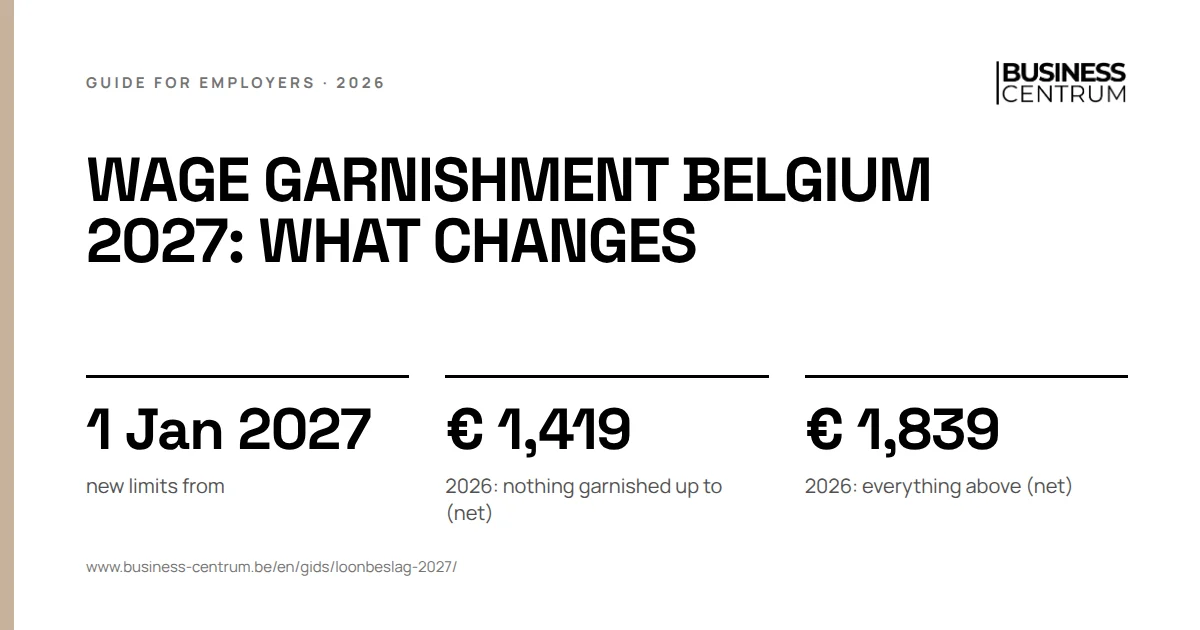
The limits for wage garnishment and wage assignment in Belgium get new amounts on 1 January 2027. The royal decree with the 2027 amounts has not appeared yet: in the past two years it was published in early December. Until 31 December 2026 you withhold nothing on a net monthly wage up to € 1,419 and everything above € 1,839, minus € 88 per dependent child. An end-of-year bonus you pay in December therefore still falls under the 2026 limits, and is added to that month's net pay.
Wage garnishment Belgium 2027: what is fixed and what is not
A garnishment or assignment can never take the whole wage. The Judicial Code protects part of the net wage with limits that rise with the index every year. What is fixed on 24 October 2026:
| 2026 (applies now) | 2027 | |
|---|---|---|
| Net monthly wage that cannot be garnished | up to € 1,419 | not yet known |
| Band at 20% | up to € 1,524 | not yet known, same percentage |
| Band at 30% | up to € 1,682 | not yet known, same percentage |
| Band at 40% | up to € 1,839 | not yet known, same percentage |
| Everything garnishable above | € 1,839 | not yet known |
| Reduction per dependent child | € 88 | not yet known |
| In force from | 1 January 2026 | 1 January 2027 |
| Third-party garnishee declaration | within 15 days | unchanged |
The percentages per band, the time limits and the procedure do not change on 1 January. What to do step by step when a new garnishment arrives, with a model declaration, is in our guide wage garnishment for employers. This page covers the turn of the year: the new amounts, the month of December and what you recalculate in January.
How the wage garnishment limits for 2027 are calculated
The law itself contains fixed base amounts: € 1,316 for the first limit, € 1,706 for the top limit and € 81 per dependent child, with two more limits in between. Each year a royal decree converts these amounts to the index:
- The base amount is multiplied by the smoothed health index of November.
- The result is divided by the starting index 123.47.
- The amount is rounded up to the next euro.
For 2026 the decree used the November 2025 index, 133.07. The first limit thus became € 1,316 x 133.07 / 123.47, rounded to € 1,419. For 2027 the same formula applies with the November 2026 index. The new amounts take effect on the 1 January after the adjustment, so on 1 January 2027.
If the index rises or falls by more than 5% during the year compared with the last adjustment, the King also adjusts the amounts in the course of the year. That is rare, but it means you keep an eye on the Official Gazette beyond December. How indexation works and when wages rise in your committee is explained in indexation January 2027.
Wage garnishment limits: 2025, 2026 and 2027 side by side
A comparison shows how the protected amounts follow the index every year.
| Net monthly wage | 2025 | 2026 | 2027 |
|---|---|---|---|
| Not garnishable up to | € 1,388 | € 1,419 | not yet known |
| End of the 20% band | € 1,492 | € 1,524 | not yet known |
| End of the 30% band | € 1,646 | € 1,682 | not yet known |
| Everything garnishable above | € 1,800 | € 1,839 | not yet known |
| Per dependent child | € 86 | € 88 | not yet known |
| Royal decree of | 5 December 2024 | 3 December 2025 | not yet published |
Higher limits mean the employee keeps more of their wage. For you they mean a new calculation in January, even if the wage itself does not change. If the wage rises on 1 January through your committee's indexation, wage and limits move together, and the garnishable part can go up or down.
Wage garnishment in December: end-of-year bonus and holiday pay
The limits apply to the net wage the employee receives per calendar month, after social security, withholding tax and deductions for supplementary social security such as group insurance. The Federal Public Service Employment explicitly lists the notice pay, the end-of-year bonus and the thirteenth month as pay. Holiday pay can also be garnished.
That is the December trap. If you pay the end-of-year bonus with the December wage, the net for that month rises sharply. Everything above € 1,839 can be garnished in full, so in practice the net bonus goes entirely to the creditor.
Worked example: wage garnishment in December 2026 with an end-of-year bonus
Sofie is a white-collar employee with no dependent children and an ongoing garnishment. Her net monthly wage is € 2,050. In December she receives her end-of-year bonus, € 1,450 net. You apply the 2026 limits.
| Band | November: € 2,050 net | December: € 3,500 net |
|---|---|---|
| Up to € 1,419 | € 0.00 | € 0.00 |
| € 1,419 to € 1,524 at 20% | € 21.00 | € 21.00 |
| € 1,524 to € 1,682 at 30% | € 47.40 | € 47.40 |
| € 1,682 to € 1,839 at 40% | € 62.80 | € 62.80 |
| Above € 1,839 | € 211.00 | € 1,661.00 |
| Deduction | € 342.20 | € 1,792.20 |
In November Sofie keeps € 1,707.80, in December € 1,707.80: exactly the same. The entire net end-of-year bonus goes to the garnishment. That is not a payroll error, it is the rule. Tell the employee in advance, so the December payslip is no surprise.
How to get from a gross bonus to the net amount that counts here: end-of-year bonus net calculation. The gross amount per sector is in calculating the end-of-year bonus and in the overview end-of-year bonus 2026 by committee. If a sector fund pays the bonus, as in road haulage, the fund is the garnishee and pays the bonus to the garnishing creditor; see the end-of-year bonus JC 140.
The same applies to a white-collar employee's double holiday pay in the month you pay it, and to notice pay on dismissal. What holiday pay contains is in holiday pay 2026; how notice pay is calculated in severance pay calculation.
Which income falls under wage garnishment in 2027?
| Income | Can be garnished or assigned | Limits |
|---|---|---|
| Wage, commissions, bonuses | yes | the bands of article 1409 |
| End-of-year bonus and thirteenth month | yes, as pay | the bands, on the net of the month of payment |
| Notice pay | yes, as pay | the bands |
| Holiday pay | yes | the bands |
| Unemployment and sickness benefits | yes, with whoever pays them | stricter: 40% in the second band |
| Family allowances and disability allowances | no | cannot be garnished |
| Garnishment for maintenance | yes | no limits: the whole wage |
The table of the Federal Public Service Employment distinguishes between professional income and replacement income. For pay, the second band can be garnished at 30%, for replacement income at 40%. The guaranteed wage you pay yourself during the first weeks of illness is pay. After that the health insurance fund pays the benefit, and it carries out the garnishment on that benefit. Who pays what during illness is explained in guaranteed wage.
What employers arrange at the turn of the year
- Pay December with the 2026 limits. That includes the end-of-year bonus you pay in December. If you only pay the December wage in January, have it checked which limits apply.
- Watch the Official Gazette in the first half of December. The decree is called "royal decree implementing article 1409, § 2, of the Judicial Code" every year.
- Enter the new amounts in your payroll before the first January pay run: the four limits and the amount per dependent child.
- Recalculate every ongoing garnishment and wage assignment on the January net wage. The net wage itself also changes, through the index, new withholding tax scales or another social security reduction.
- Keep the dependent child declarations. A declaration the employee gave according to the rules remains valid; only the amount per child goes up. A new declaration applies from the month after receipt, if you received it at least 10 working days before the usual payday.
- Show the deduction correctly on the payslip and on the employee's individual account.
If a new garnishment arrives in January, the time limit for the garnishee declaration remains 15 days. A model to fill in is at garnishee declaration. For an enforcement garnishment you pay the bailiff after the objection period of 15 days, at the earliest 2 days later.
Calculating wage garnishment in 2027 for a part-time employee
With a lower net wage, a higher limit can make the garnishment disappear completely. An example with the 2026 limits, to show the mechanism.
Karim works half-time and earns € 1,650 net a month. He has one dependent child and gave you the declaration on time.
| Step | Calculation | Amount |
|---|---|---|
| Band at 20% | (€ 1,524 - € 1,419) x 20% | € 21.00 |
| Band at 30% | (€ 1,650 - € 1,524) x 30% | € 37.80 |
| Garnishable before children | € 58.80 | |
| One dependent child | - € 88 | - € 88.00 |
| Deduction | never negative | € 0.00 |
Karim is already outside the garnishment in 2026. If the limits rise in 2027 and his net stays the same, that remains so. If his wage rises through indexation or more hours, recalculate. You can work out the net of a gross wage with the gross-net calculator or read it in gross to net.
Mistakes at the turn of the year
- Keeping the old amounts in January, so you withhold too much and have to repay the difference to the employee.
- Entering an estimated amount before the decree appears. The limits are rounded up to the next euro; an estimate is almost always wrong.
- Keeping the end-of-year bonus out of the garnishment. It is pay. Whether you may withhold wages outside a garnishment or assignment is a different question: only in the cases the law allows.
- Forgetting the garnishment on departure in the final settlement with notice pay. The documents for a dismissal are in social documents on dismissal, the steps in dismissing an employee.
- Paying wages late while waiting for the garnishment. The pay dates still apply; see salary payment.
Everything that changes for employers on 1 January 2027, from indexation to company cars, is brought together in what changes in 2027.
What Business Centrum does for you
Business Centrum enters the new limits in your payroll as soon as the decree appears in the Official Gazette, and recalculates every ongoing garnishment and wage assignment on the January wage, together with Acerta. In December we take the end-of-year bonus and the month's net pay into account, and we help you draw up the garnishee declaration within 15 days. Do you have an employee with a garnishment and doubts about December or January? Have it checked.