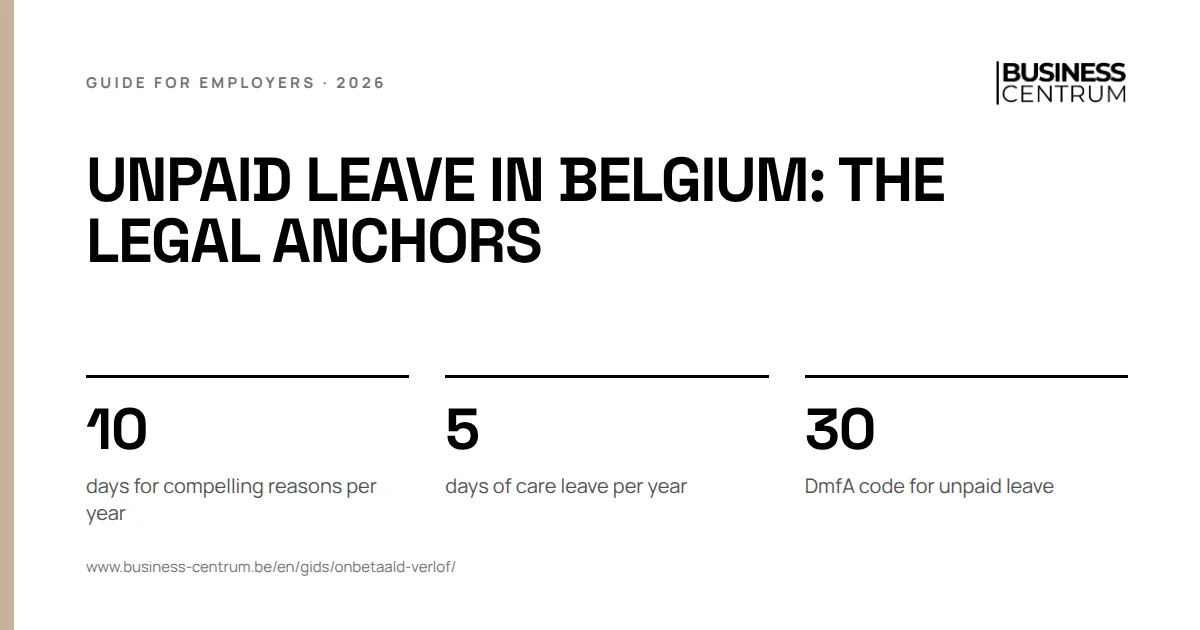
Unpaid leave in Belgium is not a right of the employee in the private sector. Employer and employee can, however, always suspend the employment contract temporarily by mutual agreement, and during that unpaid leave you pay no salary. You may refuse, unless a collective agreement, your work rules or an earlier arrangement says otherwise. Always record an agreement in writing.
That sounds simple, but the questions come afterwards: does the leave count for holidays, for the end-of-year bonus, for length of service? What if the employee falls ill? And which absences can you not refuse, because the law makes them a right? This guide sets it all out, with the rules as they apply on 1 November 2026.
Unpaid leave in Belgium's private sector: an agreement, not a right
No law gives a private-sector employee a right to unpaid leave. The FPS Employment puts it this way: employer and employee "can always agree between themselves to suspend the employment contract temporarily", and during that period of unpaid leave "the employer is not obliged to pay the salary". Everything else is for the parties to decide.
Three sources can turn it into a right:
- A collective agreement of your joint committee or your company. Some sectors provide for extra days of absence or for days treated as worked. How to find and read your committee is explained in finding your joint committee.
- Your work rules. If they contain a scheme for unpaid leave, you are bound by it. How to draw up or amend those rules is explained in drawing up work rules.
- A custom or an earlier arrangement. If you give everyone a week of unpaid leave every year, you create expectations. A habit can weigh heavily in a dispute.
The public sector has its own statutes with leave for personal reasons. This guide covers employees with an employment contract at a private employer.
Authorised absence and unpaid leave: the difference
In practice two concepts get mixed up. Authorised absence is any absence you approve as an employer. Unpaid leave is the form without pay. The social security return draws a sharp line between them.
| Authorised absence with pay | Unpaid leave | |
|---|---|---|
| Salary | you pay the normal salary | no salary |
| NSSO contributions | yes, on the salary paid | none, there is no salary |
| Code in the DmfA | code 1, "authorised absence with retention of pay" | code 30, "unpaid leave" |
| Counts for next year's holidays | yes, they are paid days | no, not a day treated as worked |
| Counts for the end-of-year bonus | usually yes, as a paid day | according to the agreement of your sector |
| Employment contract | continues as normal | suspended |
The NSSO calls code 30 a residual category: all days on which the employee did not work, for which you paid no salary and which cannot be charged to social security. The instructions expressly ask you to use the code "with caution", because it affects the employee's social security rights. It may also never hide a switch from full-time to part-time work: that requires a new employment line.
Some sectors count authorised absence for their bonuses. One example: in building materials in Antwerp and Limburg (JC 111), the agreement on the end-of-year bonus counts days of authorised absence up to 5 days per reference period. How the bonus itself works is set out in end-of-year bonus 2026.
Leave the employee is entitled to
Before you refuse a request, check whether it is really about statutory leave. You cannot simply refuse that.
| Leave | Duration | Pay | What you can do as an employer |
|---|---|---|---|
| Leave for compelling reasons (CLA no. 45) | up to 10 working days per calendar year | unpaid unless agreed otherwise; DmfA code 24 | no refusal if the reason is unforeseen and urgent; you may ask for proof |
| Care leave | up to 5 days per calendar year, deducted from the compelling reasons | unpaid | ask for a certificate |
| Parental leave | 4 months full-time per child, also in part-time forms | benefit from the National Employment Office (RVA/ONEM) | postpone for business reasons, in writing within 1 month |
| Time credit | depending on the reason and the form | benefit from the RVA/ONEM if the reason qualifies | in companies with up to 10 employees it is not a right |
| Short leave (klein verlet) | per event, under the royal decree and your agreement | paid | no refusal for the statutory events |
An employee who asks for "a few days unpaid" for a sick child or a flooded home is in fact asking for leave for compelling reasons. Treating that as a favour and refusing it is a mistake. More on each type of leave is in types of leave, on thematic leave in thematic leave and on your room to refuse in can an employer refuse leave. Parental leave has a separate guide: refusing parental leave as an employer. The rules on time credit are in time credit and the employer.
Refusing unpaid leave or granting it: the decision guide
Go through these questions before you answer a request for unpaid leave.
- Is it statutory leave? An unforeseen, urgent family reason is leave for compelling reasons. A child under 12 can give access to parental leave. If the answer is yes, handle the request under those rules.
- Does a collective agreement, the work rules or a custom create a right? Then you follow that scheme, with its deadlines.
- Can the team cope without the employee? Look at the period, cover and other absences. You may refuse or suggest another period.
- Do you treat similar requests the same way? If you refuse one employee and grant another, you must be able to explain it objectively. A difference based on age, sex or origin is discrimination.
- Will the leave last longer than a few weeks? Then also discuss holidays, the end-of-year bonus, benefits and the return, and put everything in a written agreement.
- Answer in writing. An email is enough. That way it is clear what was agreed, even if someone else later decides on the absence.
Consequences of unpaid leave: what continues and what stops
During unpaid leave the employment contract is suspended. It continues, but the main obligations stop: the employee does not work, you do not pay.
| Topic | What happens during unpaid leave | What you do |
|---|---|---|
| Salary | no salary and no NSSO contributions | supply the days correctly for payroll |
| Employment contract | suspended, not terminated; length of service keeps running | fix the return date |
| Holidays next year | no days treated as worked under the royal decree of 30 March 1967 | warn the employee in advance |
| End-of-year bonus | according to the agreement of your sector; often not treated as worked | read the agreement of your committee |
| Fringe benefits | according to the scheme or the policy: group insurance, hospitalisation, company car | check with the insurer or the scheme rules |
| Illness during the leave | no guaranteed salary for days on which the employee would not have worked anyway | refer the employee to his health insurance fund |
| Social security return | DmfA code 30 | have the code checked, certainly for long leave |
| Dismissal | remains possible; the notice period does not run during a suspension caused by the employee | ask for advice if in doubt |
The guaranteed salary follows the normal rules: you pay it for the days on which the employee should have worked. How that works is explained in guaranteed salary and in employee sick. Suspension of the contract in general is covered in suspension of the employment contract.
The employee's own rights, such as pension and benefits, are decided by the social security institutions. Before long leave, ask the employee to check this with his health insurance fund, the holiday fund and mypension.be. You do not advise on his personal rights; you make sure the return is correct.
Requesting and recording unpaid leave: what goes in the agreement
The law sets no required form, but a written agreement prevents most disputes. Include at least:
- the names of employer and employee, and a reference to the employment contract;
- the start date and end date of the unpaid leave;
- that no salary is due and the contract is suspended;
- what happens to benefits such as the company car, the laptop, the group insurance and the hospitalisation insurance;
- whether the employee may work elsewhere, and that competition remains prohibited;
- how and when the employee returns, and whether an earlier return is possible;
- the date and the signatures of both parties.
An example of the core: "Employer and employee agree to suspend the employment contract of 1 March 2024 from 1 February to 30 April 2027 inclusive. No salary is due during that period. The employee resumes work on 3 May 2027."
If the agreement changes the employment contract itself, such as the work schedule after the return, that belongs in an addendum. A template is available in addendum to the employment contract.
A year of unpaid leave, or unpaid leave for another job
Long unpaid leave is more common than you might think: a trip around the world, a year with a partner abroad, a temporary job elsewhere. Three points deserve extra attention.
The return. Agree whether the employee returns to the same position, and what happens if that position has disappeared in the meantime. The contract stays the same, so the position and the salary in the contract still apply.
Work for another employer. The question of "unpaid leave for another job" comes up often. It is allowed if you agree, but the duty of loyalty under the Employment Contracts Act remains: no unfair competition and no trade secrets. A non-compete clause only applies after the contract ends; read non-compete clause if that is relevant.
Holidays in the following year. A year of unpaid leave gives little or no statutory holiday in the next year. An employee who returns in January is then entitled to fewer days. How holiday days are calculated is explained in holiday days 2027.
If the employee actually wants to work less rather than stop for a while, time credit, landing jobs or a part-time employment contract are often the better route.
Mistakes we often see with unpaid leave
- Treating a compelling reason as a favour. The employee is entitled to those days, even if you would rather refuse.
- No written agreement. After a few months nobody remembers what was agreed about the company car or the return.
- The wrong code in the return. Putting paid authorised absence under code 30, or the other way round, causes errors in the employee's holidays and benefits.
- Not warning the employee about holidays. The loss of holiday days only shows a year later, and then the surprise is big.
- Unequal treatment. A "yes" for one and a "no" for another without an objective reason is a risk.
What Business Centrum does for you
Business Centrum is a social bureau in Ghent, founded in 2013, and a recognised partner of Acerta. You supply the work data, including the days of unpaid leave, and we process them through Acerta, the recognised secretariat with number 250. Your fixed contact person knows your file and your joint committee, and checks with you whether a request is really statutory leave. Day-to-day handling of absences sits in our leave and absence service. How the work is divided between Business Centrum and Acerta is set out in Business Centrum and Acerta.
Received a request for long unpaid leave and want to go through the consequences first? Request a call back and Business Centrum looks at your situation with you. For personal legal advice on a dispute, we refer you to a lawyer or your sector federation.