
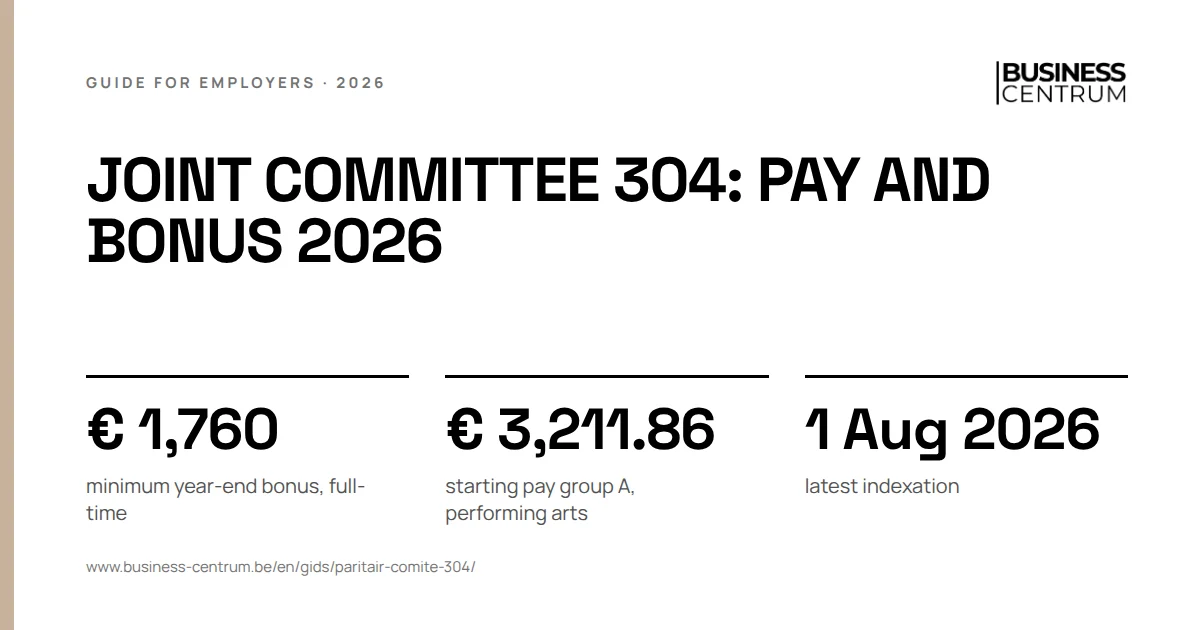
Joint committee 304 is the committee for the entertainment industry: theatre, dance, music theatre, festivals, arts centres, orchestras and everyone who works on a performance. On 1 August 2026 wages rose by 2%. An employee in pay group A of the Flemish performing arts now starts at € 3,211.86 gross a month. At an employer with Flemish subsidies, the year-end bonus is at least € 1,760.
Who falls under joint committee 304?
JC 304 covers employees who perform in public, wherever and in whatever circumstances: anyone who gives a show or fairground performance, or who practises an art alone or in a group, such as music, singing, dance, the spoken word, mime, feats of skill or strength. Anyone who works in any role on the performance itself, or on its preparation and organisation, is also covered. Think of the stage technician, the dresser, the production manager and the box office staff.
Three separate sets of rules exist within the committee. Which one applies to you depends on your registered office, your language register at the NSSO and the nature of your work:
| Situation | Rules |
|---|---|
| Theatre, dance company, arts centre or festival based in Flanders, or in Brussels with the Dutch language register | JC 304, CLA performing arts Dutch-speaking area |
| Company based in Wallonia, or in Brussels with the French or German language register | JC 304, CLA dramatic stage performances |
| Employer hiring musicians or singers, directly or through an intermediary | JC 304, CLA for musicians |
| Staff working in a hotel's activities | JC 302 |
| Paid athletes | JC 223 |
| Film production | JC 303 |
| White-collar staff in the audiovisual sector | JC 227 |
A Dutch-speaking employer that falls under another committee for its main activity still applies the JC 304 pay scales to the artists it hires. The reverse also holds: if the hotel part of your business belongs to JC 302, those staff stay there. If in doubt, first read what a joint committee is and how to find your joint committee in Belgium. A non-profit with socio-cultural work but no performances often falls elsewhere, for example under supplementary joint committee 337.
Pay scales and wage categories in joint committee 304
The pay scales are minimum wages. You can always pay more. Below are the key figures; the full tables by year of seniority are on the pay scale pages.
Performing arts in Flanders: pay groups A to D
The CLA of 19 December 2016 (138114/CO/304) places every job in one of five pay groups. Group A includes the artist, the director, the choreographer, the dramaturge, the designer and the production manager of a larger production. Group B includes the assistant director, the stage technology coordinator, the education officer and the production manager of a small production. C+ covers the specialised stage technician, the props master and the driver with a CE or D licence, C the assistant stage technician, the dresser, the make-up artist and the box office staff, and D reception, cleaning, canteen and door staff.
Gross per month, full-time 38 hours a week, for a contract of 4 months or more:
| Pay group | Start | After 10 years | After 20 years |
|---|---|---|---|
| A | € 3,211.86 | € 3,989.98 | € 4,928.36 |
| B | € 3,211.86 | € 3,595.10 | € 4,166.65 |
| C+ | € 2,818.28 | € 3,183.83 | € 3,750.88 |
| C | € 2,424.69 | € 2,772.55 | € 3,331.62 |
| D | € 2,405.34 | € 2,669.01 | € 2,972.39 |
For a contract shorter than 4 months, higher monthly rates apply: group A starts at € 3,346.69, group D at € 2,506.31. All amounts by year of seniority are on the performing arts JC 304 pay scale page.
Three rules from the CLA often shape the wage more than the table itself:
- Seniority from the whole sector counts. Short contracts with other JC 304 employers count too, as does work in the same role outside the sector, under any status.
- Higher group, less seniority. Someone moving up to a higher pay group loses 1/3 of their seniority, except when moving from D to C or if you agree something more favourable.
- Group A without a degree. That employee must first prove 4 years of relevant experience. Until then, the grading is open to negotiation.
An organisation without Flemish subsidies, or with a small subsidy below a threshold in the CLA, may pay group A on scale C and all other employees on scale D. In a co-production, the highest scale of the partners applies to that co-production's contracts.
Dramatic stage performances in Wallonia and Brussels: groups 1 to 6
French- and German-speaking employers follow the CLA of 21 November 2018 (149470/CO/304). It has six occupational groups. For artists and for technical and administrative staff, experience after compulsory schooling counts: under 12 years someone is in subgroup a, above that in subgroup b. An artist in group 1a earns at least € 2,917.02, in group 1b € 3,443.82. A technician or administrative employee with final responsibility in group 2a starts at € 2,759.49. The amounts per group are on the dramatic stage JC 304 pay scale page.
Musicians: per service or per month
For orchestras, bands and choirs, there are fees per service. A concert service pays at least € 143.69, a rehearsal service € 95.20, and a choir singer receives € 129.32 per concert service. For Dutch-speaking employers a service is an uninterrupted period of 3.50 hours, with a compulsory half-hour break. If the musician works more than 54 days in three months, or four weeks in a row, he moves to a monthly wage: at least € 3,172.20 at the start in group A. All service fees and monthly wages are on the musicians JC 304 pay scale page.
If your company falls under another committee for its main activity and you hire musicians or singers, only the provisions on stage artists apply to them.
Indexation in joint committee 304 in 2026
All JC 304 wages, both the minimum wages and the wages you actually pay, follow the smoothed health index under CLA 144378/CO/304. Each time the index reaches a pivot index, they rise by 2%, from the first day of the second month after that. The minimum wage database expresses the pay scale as a base wage times a coefficient. For the performing arts and the musicians it has been 1.81 since August, for the French-speaking dramatic stage performances 1.40.
| Indexation | Increase |
|---|---|
| 1 August 2026 | 2% |
| 1 February 2026 | 2% |
| 1 March 2025 | 2% |
| 1 June 2024 | 2% |
| 1 December 2023 | 2% |
So the sector had two indexations in 2026. The August one was the first since the cents index started on 1 June 2026. For a full-time reference wage above € 4,000 a month, the first 2% of indexation is only calculated on the threshold. In JC 304 this mainly affects group A, which already reaches € 4,928.36 after twenty years. How to calculate the difference is explained in our piece on the cents index. The general course of the index this year is in wage indexation in 2026.
If you calculate with hourly wages, use the sector formula: monthly wage times 3, divided by 13 and then by 38. A monthly wage of € 3,211.86 gives 3,211.86 x 3 / 13 / 38 = € 19.51 an hour.
Year-end bonus in joint committee 304
JC 304 has no year-end bonus for the whole sector. The bonus only exists for employees of a legal entity based in Flanders, or in Brussels with the Dutch language register, who work during the reference period for an employer with Flemish subsidies: among others through the arts decree, the circus decree, the supra-local cultural work decree, the participation decree, the organisations subsidised by name and the structural subsidies of Literatuur Vlaanderen. For the French-speaking dramatic stage performances and for musicians, we found no sector year-end bonus in the CLA database on 24 October 2026.
The rules are in CLA 196205/CO/304 of 24 October 2025, which implements the Flemish Intersectoral Agreement for the arts sector. For a full-time employee with a complete reference period, the bonus is at least € 1,760 gross. In 2024 it was € 1,682. Who pays depends on the length of the contract:
| Contract shorter than 4 months | Contract of 4 months or more | |
|---|---|---|
| Who pays | The Social Fund for the performing arts | You as the employer, with a contribution from the fund |
| Reference period for the 2026 bonus | 1 July 2025 to 30 June 2026 | calendar year 2026 |
| When | according to the fund | in December, or when the employee leaves |
Consecutive contracts without a break count together. Three one-month contracts in a row are still shorter than four months together, so the fund pays. If a contract of four months or more runs over the turn of the year, you pay the bonus for the current year in December and the share for the new year at the end of the contract.
The rules for granting it:
- Pro rata: an incomplete reference period or part-time work gives a bonus in proportion to the days worked.
- Treated as worked: absences treated as worked for annual leave, such as illness and work accidents. Palliative leave and leave for a seriously ill household or family member count up to 3 months.
- Not treated as worked: unpaid leave, time credit and the other thematic leaves.
- Thirteenth month: if you already pay a full thirteenth month, the bonus may be limited to that amount. If you pay it as the year-end bonus, explain to your employees how you use the amount from the agreement.
- Reporting: for the 2026 bonus, send the fund a named list with each employee's gross amount and social contributions by 31 January 2027 at the latest.
- Not compulsory for student workers (employee codes 840, 841) and flexi-jobs (employee codes 050, 450).
From the bonus you withhold the personal NSSO contribution of 13.07%, then withholding tax under the scale for exceptional payments. How this works in practice is explained in calculating the year-end bonus. The rules in the other sectors are in our overview of the year-end bonus 2026.
Worked example: the year-end bonus of a stage technician
This is an example, not a calculation for your situation. A specialised stage technician works full-time on a permanent contract at an arts centre with an operating subsidy under the arts decree. He is in group C+ with five years of seniority and earns € 3,009 gross a month. He worked the whole year.
- Year-end bonus: the minimum of € 1,760 gross.
- Personal NSSO: 13.07% of € 1,760 = € 230.03.
- Taxable: € 1,760 minus € 230.03 = € 1,529.97, on which withholding tax is still due.
A colleague who started on 1 July and works 4/5 worked half the working days of the year. She receives 1,760 x 4/5 x 1/2 = € 704 gross. If the arts centre already pays a full thirteenth month of € 3,009, that is above the minimum and nothing is added. An actor on a six-week contract in spring gets his bonus not from you but from the fund.
Short contracts, Dimona and the arts work certificate in joint committee 304
Short contracts are the norm in the performing arts, and the CLA has its own pay rules for them. At Dutch-speaking employers, a fixed-term contract that does not cover a full month is paid at 1/22 of the monthly wage per rehearsal or travel day and 1/20 per performance day, however long the work lasts. At French-speaking employers, an incomplete month is paid pro rata to the working days worked, and a working day of less than four hours always counts as four hours.
Worked example. An actor in group A without seniority rehearses four days and plays three performances. The monthly wage for a contract shorter than four months is € 3,346.69. Rehearsals: 4 x 3,346.69 / 22 = € 608.49. Performances: 3 x 3,346.69 / 20 = € 502.00. Together € 1,110.49 gross.
Every contract, even for one day, requires a Dimona before the first working day. The Dimona obligation also applies to artists without an employment contract. How to file it and what a forgotten declaration costs is in our guide on the Dimona declaration. If you chain fixed-term contracts, also check the rules on successive fixed-term contracts.
Arts work certificate and article 1bis. An artist with an arts work certificate, issued by the Arts Work Commission, can fall under employee social security even without an employment contract. This is the contract under article 1bis of the law of 27 June 1969. As the client you are then the employer: you pay NSSO contributions and at least the wage for the same job, never less than the GGMMI. In the DmfA you report an artist with employee code 046. These assignments also count towards the year-end bonus.
Task-based pay. If you pay an artist per assignment rather than per hour, the contract must state this expressly since 1 September 2019, together with the artistic assignment. On the C4 form you then tick "per task" or "subject under article 1bis" at the end. If you do not, the National Employment Office calculates your artist's benefit differently.
Amateur arts allowance. Since 1 January 2024, the amateur arts allowance has replaced the former small allowances scheme. It is at most € 81.90 a day, for a maximum of 30 days a year across all clients together. It is meant for amateurs, not for people you pay for the same work under an employment contract or article 1bis.
Working time, leave and allowances in joint committee 304
Normal working time is 38 hours a week, but the sector works with broad exceptions that must be in your work rules:
- Per day: up to 12 hours for dress rehearsals, festivals and performances.
- Per week: at Dutch-speaking employers up to 84 hours for dress rehearsals, festivals and touring performances, at French-speaking employers up to 72 hours.
- Overtime pay: at Dutch-speaking employers 75% overtime pay or time off in lieu for every hour above ten hours a day. You choose the form.
- Runs: at most 10 working days in a row during rehearsal or touring periods. Anyone working on a Sunday gets another rest day.
Put those regimes in the work rules before applying them. How to adapt them is in our guide on drafting work rules.
Extra leave. At Flemish-subsidised employers, artistic and technical-artistic staff on a contract of four months or more get 10 extra days of leave a year in a five-day week. If you pay a full thirteenth month, this can become one week by agreement with the employee. Days not taken are paid out at the end of the contract as a bonus: 4% of the gross wage for two weeks.
Allowances on the road. When travelling in Belgium you pay a flat rate of € 6 for a light meal and € 18 for a main meal. At French-speaking employers the maximum is € 24 a day. If an employee on a short contract cannot buy a season ticket, Dutch-speaking employers pay 75% of a second-class train ticket, whatever transport he uses.
Sector pension and social funds in joint committee 304
Dutch- and French-speaking employers each have their own social fund. The Social Fund for the Performing Arts, for employers based in Flanders or with the Dutch language register in Brussels, pays the year-end bonus on short contracts and organises the sector pension. The Social Fund for the performing arts of the French Community has existed since 1 January 2009 and funds training and employment. The contributions you pay:
| Contribution | Who | Amount | Collected by |
|---|---|---|---|
| Sector pension | Employers based in Flanders or with the Dutch language register in Brussels | 1.50% of gross annual pay, NSSO and costs included | NSSO |
| Risk groups | Legal entities based in Flanders or with the Dutch language register in Brussels | 0.10% of gross wages | NSSO |
| New contribution from 1 January 2027 | Dutch-speaking BV, NV, partnership, VOF and CommV without Flemish subsidies | 0.10% of total pay | NSSO |
The sector pension has existed since 1 January 2006 and is set out in CLA 153927/CO/304. The pension institution is Ethias. The 1.50% contribution already includes the special contribution of 8.86%. If your organisation already had its own pension plan when the sector plan started, it could opt out; for the extra pension premium the Flemish government pays for artists, that option does not exist. Your employees see their reserves on mypension.be. More on the sector plans in other committees in our guide on the sectoral pension plan.
The new contribution comes from CLA 202114/CO/304 of September 2026 and targets commercial players: show producers, concert organisers and other companies. Non-profits, natural persons, subsidised organisations and production houses or agents working mainly with subsidised organisations are excluded. It is not due on student workers or flexi-jobs. The parties have applied for a royal decree making it binding, so budget for the contribution in your 2027 wage costs.
Flexi-jobs and students in joint committee 304
Since 1 July 2026 flexi-jobs have in principle been open in almost all sectors. In JC 304 an important limit remains: artistic, artistic-technical and artistic support roles are excluded, as the law on the Arts Work Commission defines them. A flexi-job worker cannot be an artist or stage technician. For other roles you pay a 28% special contribution. All the conditions are in flexi-jobs in all sectors and in our guide on the flexi-job rules in 2026.
At Dutch-speaking employers you may pay students under 21 on a student contract a percentage of the pay scale, but never less than the legal minimum. How this ties in with the quota and the solidarity contribution is explained on our page on student workers.
Pitfalls in joint committee 304
- The wrong CLA because of the language register. A Brussels employer with the French register follows groups 1 to 6, with the Dutch register pay groups A to D. A wrong registration means a wrong pay scale and a wrong year-end bonus.
- A short contract on the monthly scale. At Dutch-speaking employers, contracts shorter than four months have their own, higher scale.
- Forgetting seniority from other productions. Short contracts with other employers in the sector count for grading.
- Paying the bonus yourself on a short contract. Under four months the fund pays. If you pay it anyway, it falls outside the CLA scheme.
- Forgetting the reporting. Without a list to the fund by 31 January 2027, your contribution is at risk.
- Task-based pay without the required wording. A fee without the CLA wording is treated as ordinary pay, with consequences for your artist's benefit.
- A flexi-job worker on stage. Artistic and artistic-technical roles are excluded, even after the extension.
Checklist for a new hire in joint committee 304
- Determine your rules: registered office, NSSO language register and whether you hire musicians.
- Check whether your organisation receives Flemish subsidies: that decides the scale for non-subsidised employers, the year-end bonus and the extra leave.
- Place the job in the right pay group or occupational group and count seniority from the whole sector.
- Choose the scale for a contract longer or shorter than four months.
- Put task-based pay or an article 1bis contract in writing.
- File the Dimona before the first working day.
- Put the special working time in the work rules.
- Plan the year-end bonus in December and the list for the fund in January.
What Business Centrum does for you
Business Centrum handles the payroll administration of theatres, companies, festivals and organisers in JC 304, together with Acerta. We determine which of the three sets of rules applies to you, grade every employee with their sector seniority, file the Dimona for every short contract and calculate the year-end bonus under the CLA. If you are a non-profit, also read how we provide payroll for non-profits.